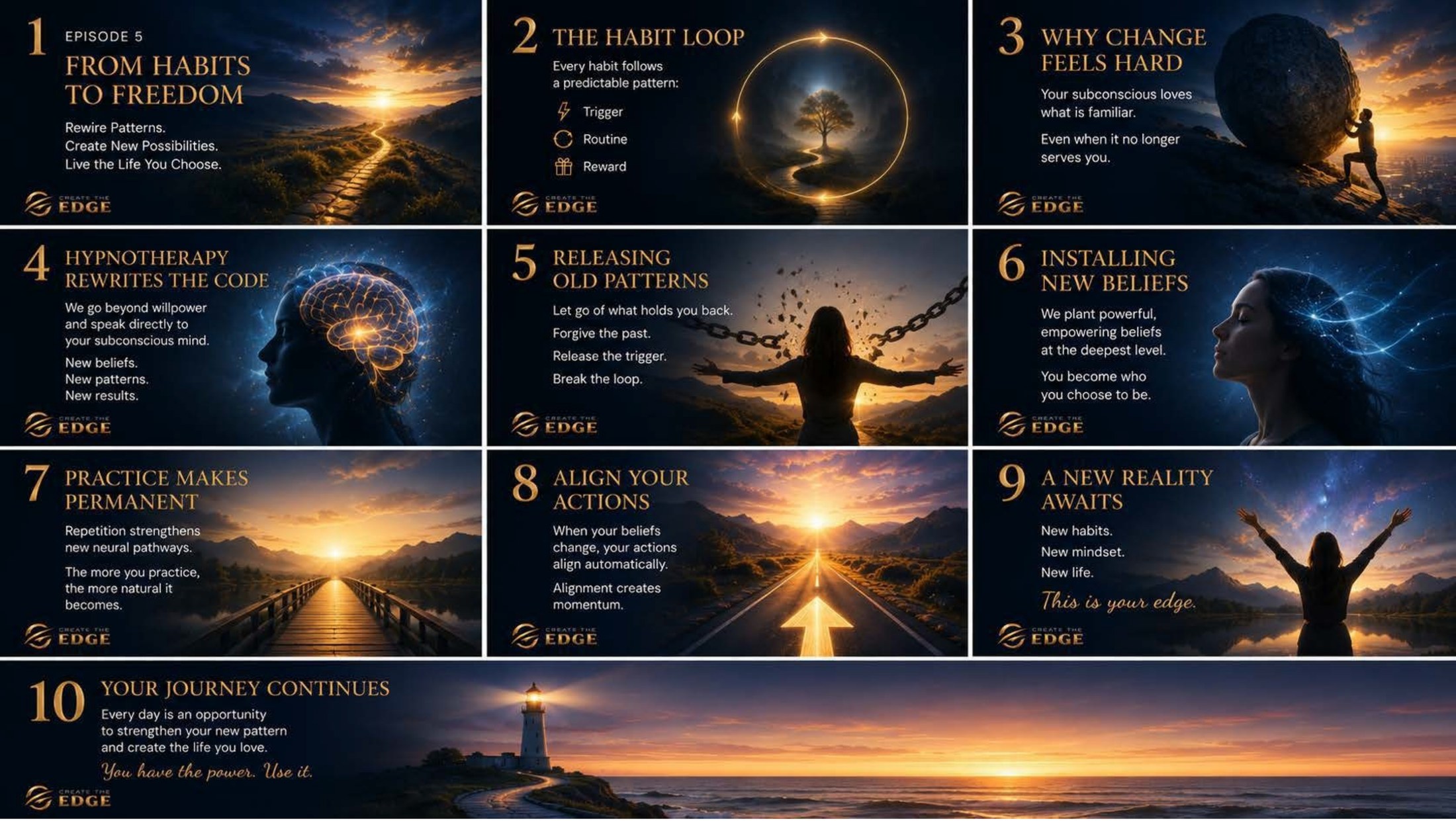
On the slideRewire patterns. Create new possibilities. Live the life you choose.
Episode 5 · Slide 1
From Habits to Freedom
Episode 5 · Slide 1
Look at the path in this image — a golden cobblestone trail winding up through the hills toward a sunrise so bright it spills over the mountains like molten light. And a woman, walking it. Not standing at the trailhead anymore, the way she was in Chapter One. Walking. Mid-journey. Climbing.
That’s you now. Four chapters in, you understand the iceberg, the old programs, the triggers, the wounded child. You’ve done the deep, tender excavation. And now we arrive at the part of the journey that’s a little more… practical. A little more daily. Because all that understanding has to land somewhere, and where it lands is here: in your habits — the small, repeated actions that quietly build, or quietly demolish, the life you actually live.
Here’s a truth that should feel like both a confrontation and a relief: you do not rise to the level of your goals. You fall to the level of your habits. You can want a beautiful life with your whole heart, but if your habits are pointed somewhere else, your habits win. They win every time. They’re the current under the boat. You can dream of crossing the ocean, but if the current runs the other way, you’ll spend your life paddling and ending up back where you started, exhausted and confused about why.
Read the three promises on the slide, because they’re the whole map of this chapter: rewire patterns. Create new possibilities. Live the life you choose.
Rewire patterns — because habits aren’t willpower, they’re wiring, and wiring can be changed. Create new possibilities — because when the old automatic patterns let go, doors you couldn’t even see suddenly open. And live the life you choose — oh, those last three words. The life you choose. Not the life your habits chose for you while you weren’t looking. The one you pick, on purpose.
Most people never get to live a chosen life. They live a defaulted one — a life that simply happened, built brick by unconscious brick out of habits they never decided on. This chapter is how you take the trowel out of autopilot’s hands and start laying the bricks yourself.
The path is golden and it’s climbing toward the light. Let’s walk it together. Freedom is up ahead, and it’s closer than you think.

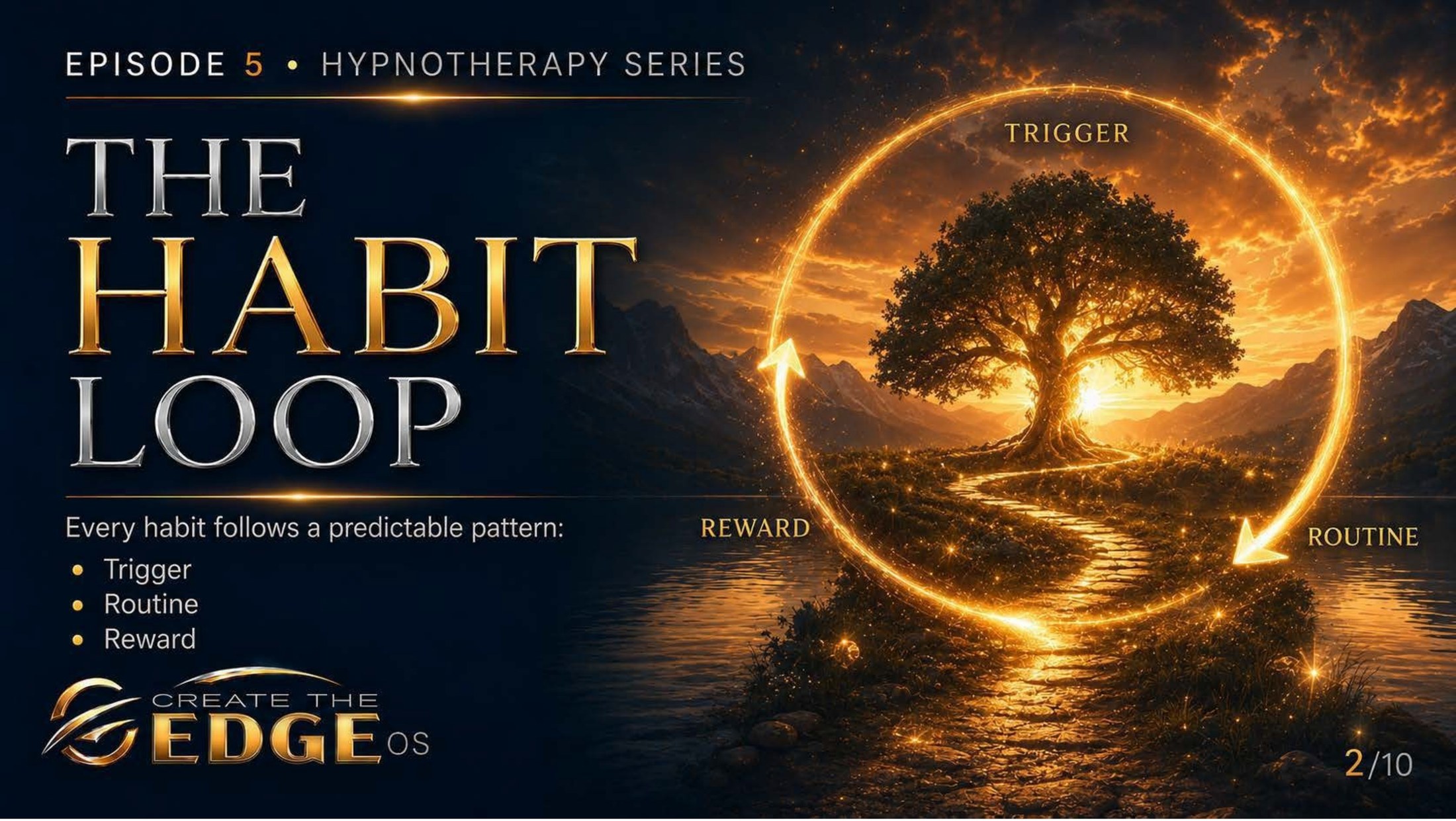
On the slideEvery habit follows a predictable pattern: Trigger → Routine → Reward.
Episode 5 · Slide 2
The Habit Loop
Episode 5 · Slide 2
Before you can change a habit, you have to understand how one is built — and the wonderful news is that every habit on earth, the good ones and the ones quietly wrecking your life, follows the exact same simple loop. Look at the glowing golden circle in this image, a great tree of light at its center, three words around the ring: Trigger. Routine. Reward. That’s the entire machine. Learn it, and you hold the wrench.
The trigger is the cue — the thing that fires the habit off. It can be a time of day, a place, a feeling, a person, a smell. You walk in the door after a hard day (trigger). You feel that flat 3 p.m. slump (trigger). You see a certain name on your phone (trigger). The trigger is the starting gun, and most of the time you don’t even consciously hear it go off.
The routine is the behavior itself — the thing you actually do. The glass of wine. The cigarette. The reach for the phone. The snack you don’t taste. The snapped reply. The scroll that eats an hour. This is the part we usually think is the habit, but it’s really just the middle of the loop.
The reward is the payoff — the reason your brain bothered to build the loop in the first place. Relief. Comfort. A hit of pleasure. A moment of escape. Numbing. And here’s the part that’s crucial to understand without judgment: the reward is real. Your brain is not stupid. It built that loop because it works — the wine really does take the edge off, the scroll really does provide escape. The habit is solving a genuine problem. That’s why “just stop it” never works.
Picture the loop running in real time. Hard day (trigger) → pour a drink (routine) → edge softens, relief floods in (reward). Your brain files it: this works, do it again. And the next hard day, the loop is a little more worn, a little more automatic. Repeat it enough times and it stops being a choice at all. It becomes a groove so deep you fall into it without ever deciding to.
Now — here’s why this matters so much, and why it’s such good news. Once you can see the loop, you can change it. You don’t have to white-knuckle the whole thing. You can keep the trigger, keep the reward your brain is craving, and simply — with the deep mind’s help — swap out the routine in the middle for something that serves you. We’ll build exactly that, together, by the end of this chapter.
The loop isn’t your enemy. It’s a machine. And a machine, once you understand it, can be rebuilt.
On the slideYour subconscious loves what is familiar — even when it no longer serves you.
Episode 5 · Slide 3
Why Change Feels Hard
Episode 5 · Slide 3
Let me take a weight off your shoulders right now, because I think you’ve been carrying it unfairly for years. If change has always felt impossibly hard for you — if you’ve started and stopped, sworn and slipped, tried and “failed” more times than you can count — it is not because you’re weak, lazy, or broken. It’s because of one simple, powerful fact the slide names perfectly: your subconscious loves what is familiar — even when it no longer serves you.
Look at the image — a woman pushing an enormous boulder up a steep hill at sunset, every muscle straining. That’s what change feels like when you fight it with willpower alone, isn’t it? Like shoving a rock uphill while something invisible pushes back. Well, here’s what that invisible something is, and once you understand it, the whole struggle finally makes sense.
To your deep mind, familiar equals safe. This isn’t a character flaw — it’s ancient survival wiring. For most of human history, the known was safe and the unknown could get you killed. The cave you knew, the path you’d walked, the food you’d eaten before — familiar meant you survived this, so it’s safe to do again. Your subconscious is still running that prehistoric software, and it has one overriding job: keep you alive by keeping you in the known.
Which means — and this is the part that explains your whole life — your subconscious will fight to keep even your worst habits, simply because they’re familiar. The old pattern, however miserable, is known. And known feels safe. The new pattern, however wonderful, is unknown. And unknown feels dangerous. So the moment you try to change, your deep mind sounds a quiet alarm and starts pushing the boulder back down the hill, whispering: this is unfamiliar, this is risky, let’s go back to what we know.
Can you feel how much this changes things? You have not been failing at change because something is wrong with you. You’ve been fighting a multi-million-year-old survival mechanism with nothing but gritted teeth and good intentions — and losing, the way anyone would. The boulder was never yours to push uphill by brute strength.
So we’re going to stop pushing the boulder. We’re going to do something far smarter: we’re going to go down to the subconscious itself and make the new pattern feel familiar and safe — so that the same powerful force that’s been dragging you backward starts carrying you forward instead. We don’t defeat the survival instinct. We recruit it.
You were never weak. You were just using the wrong tool. Let’s pick up the right one.

On the slideWe go beyond willpower and speak directly to your subconscious mind. New beliefs. New patterns. New results.
Episode 5 · Slide 4
Hypnotherapy Rewrites the Code
Episode 5 · Slide 4
So if willpower is the wrong tool — the boulder-pushing tool — what’s the right one? The slide says it in five words: we go beyond willpower and speak directly to your subconscious mind. Look at the woman in the image, the golden web of light blazing through her mind like a circuit diagram lighting up. That’s the code. And that’s where we work.
Let’s be honest about willpower, because the self-help world has oversold it for decades. Willpower lives in the conscious mind — the tip of the iceberg, the five to ten percent. And willpower is real, but it’s a small, tired muscle. It works for short bursts and then it’s exhausted. It’s why you can resist the cookie all day and cave at 9 p.m. when you’re depleted. Willpower is a sprinter being asked to run a marathon, and it collapses every time, right on schedule, somewhere around January 9th.
Trying to change a deep habit with willpower is like trying to update software by furiously typing at the screen. The screen isn’t where the program lives. The code is. And the code — your habits, your patterns, your automatic responses — lives down in the subconscious, the ninety to ninety-five percent below the waterline.
This is what hypnotherapy does that gritted-teeth effort never can: it bypasses the exhausted little willpower muscle entirely and goes straight to the code. In that relaxed, focused state, we can actually reach the level where the habit was written and edit it at the source — not by fighting the program from the outside, but by gently rewriting it from the inside.
Read the three lines on the slide, because they’re the whole sequence of transformation: New beliefs. New patterns. New results. And notice they run in that exact order, because it’s the only order that actually works.
It starts with new beliefs — because every habit grows from a belief about who you are. “I’m someone who needs wine to relax.” “I’m just not a disciplined person.” Change the belief at the root, and the behavior above it loses its anchor. New beliefs grow new patterns — the automatic behaviors reorganize around the new identity. And new patterns deliver new results — a genuinely different life, produced not by force but by a rewritten foundation.
We are not going to make you fight your own mind harder. We are going to stop the fight altogether — by going beneath it, to the place where the real change is written. You don’t need more willpower. You need access to the code. And that’s exactly what we’re building.

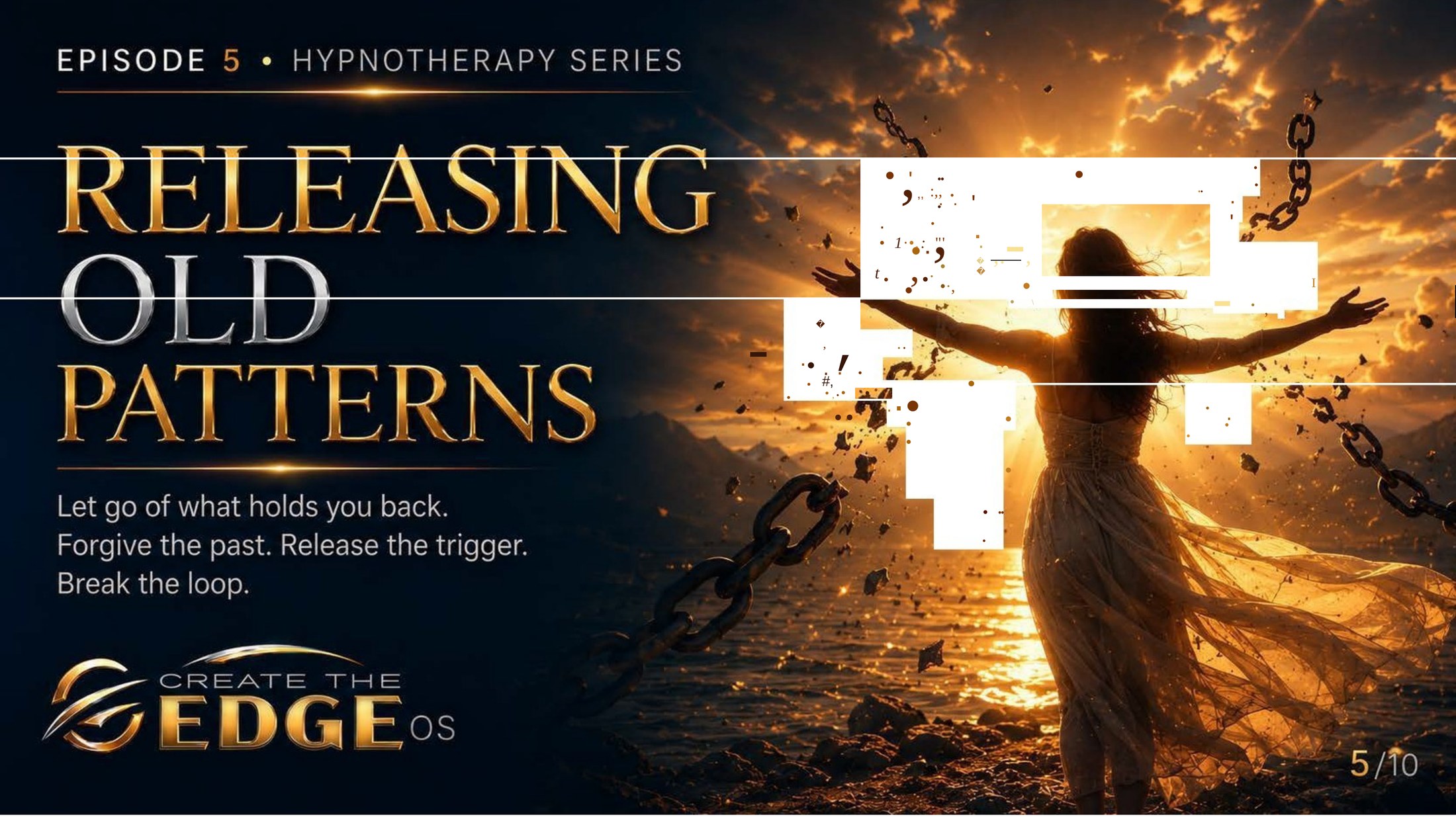
On the slideLet go of what holds you back. Forgive the past. Release the trigger. Break the loop.
Episode 5 · Slide 5
Releasing Old Patterns
Episode 5 · Slide 5
Before you can build the new, you have to make room by releasing the old — and this slide names the work in four clean strokes. Look at her in the image: arms flung open at the water’s edge, chains shattering behind her, the broken links flying off into a blaze of golden light. That’s what releasing actually feels like when it finally happens. Not a struggle. A letting-go. Let me walk you through the four releases.
Let go of what holds you back. First, the honest inventory. What are you still gripping that’s gripping you back? The grudge you’ve rehearsed a thousand times. The identity that no longer fits. The story about yourself that keeps you small. You can’t walk forward while clutching the past with both hands. The first release is simply deciding you’re willing to open your fingers.
Forgive the past. Now, the big one — and let me be clear about what forgiveness actually is, because it’s the most misunderstood word in healing. Forgiveness does not mean what happened was okay. It does not mean you forget, or excuse, or let anyone back in who shouldn’t be. Forgiveness means you stop letting the past keep charging you rent in your present. It’s not a gift you give them. It’s a chain you take off yourself. You can forgive someone and never speak to them again. Forgiveness is you, setting down a weight that was only ever crushing you.
Release the trigger. Remember the alarm from Chapter Three? Here’s where it connects to habits. So many of our worst routines are launched by a trigger — an old emotional alarm that fires and sends us reaching for the wine, the food, the phone, the fight. When we release the trigger at the subconscious level, we cut the wire between the cue and the craving. The starting gun goes quiet.
Break the loop. And with the trigger softened and the past forgiven and the old grip released, the loop itself finally breaks. The automatic chain — cue, craving, collapse — comes apart. The groove you’ve fallen into a thousand times stops being a trap you can’t climb out of and becomes just… an old path you’re choosing not to walk anymore.
Let go. Forgive. Release. Break. Four releases, and notice none of them are about adding more effort or discipline. They’re about subtracting — putting down what you’ve been carrying, unhooking what’s been hooked into you. Sometimes the most powerful thing you can do isn’t to push harder. It’s to finally, gloriously, let go.
Look at those chains shattering in the light. They were never as solid as they felt. Most chains aren’t. Let’s start opening your hands.
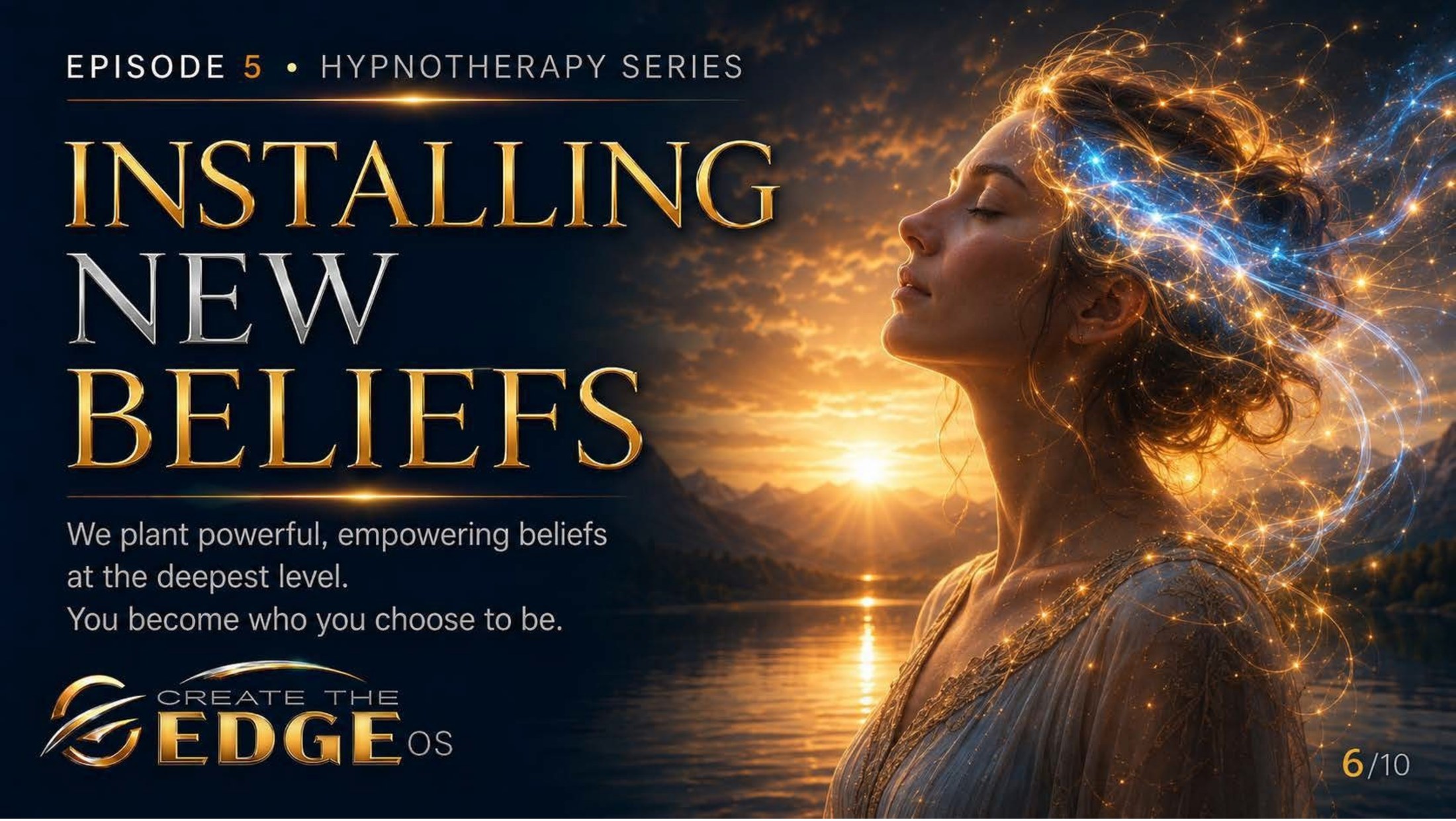
On the slideWe plant powerful, empowering beliefs at the deepest level. You become who you choose to be.
Episode 5 · Slide 6
Installing New Beliefs
Episode 5 · Slide 6
You can’t leave the ground empty after you clear it, or the old weeds grow right back. So the moment we release an old pattern, we plant something new and strong in its place. Look at the woman in this image — the golden and blue light streaming through her, brilliant and alive. That light is a new belief taking root at the deepest level. And the slide tells you what that makes possible: you become who you choose to be.
Sit with that sentence, because it’s a quiet revolution. You become who you choose to be. Not who you were told you were. Not who your old programming insists you are. Not who that loud voice in some long-ago classroom decided you’d always be. Who you choose.
But here’s the catch, and it’s why so many people’s affirmations bounce right off: you can’t install a new belief by simply saying it at the surface. Standing in the mirror repeating “I am confident, I am confident” while your deep mind mutters “yeah, right” doesn’t work — in fact it can backfire, because the subconscious hears the words and immediately produces all the evidence to the contrary. The belief has to be planted at the deepest level, in soil that’s soft enough to receive it.
That’s what “installing at the deepest level” means. In the relaxed, focused state, the chattering critic at the surface quiets down, the soil softens, and the new belief can actually take root where the old one grew. Not “I’m trying to believe I’m worthy” at the surface, but a quiet, settled I am worthy down where it actually governs your behavior.
And think about what kinds of beliefs we get to plant. “I am capable of change.” “I am disciplined and consistent.” “I am safe to succeed.” “I follow through on what matters to me.” “I am the kind of person who keeps promises to myself.” Every one of those is a seed that grows an entire orchard of new behavior — because, as we learned, beliefs grow patterns and patterns grow results.
This is the part of the work that genuinely thrills me, even after all these years. Because clearing out the old pain is necessary and good — but this is where we get to build. This is where you stop being only a recovery project and become a creation project. You get to decide, consciously and on purpose, who you’re becoming — and then plant that person, belief by belief, in the deep ground where they’ll actually grow.
You are not stuck being who the past made you. You get to become who you choose. That’s not a slogan on this slide. It’s the literal mechanism. Let’s choose well — and plant deep.
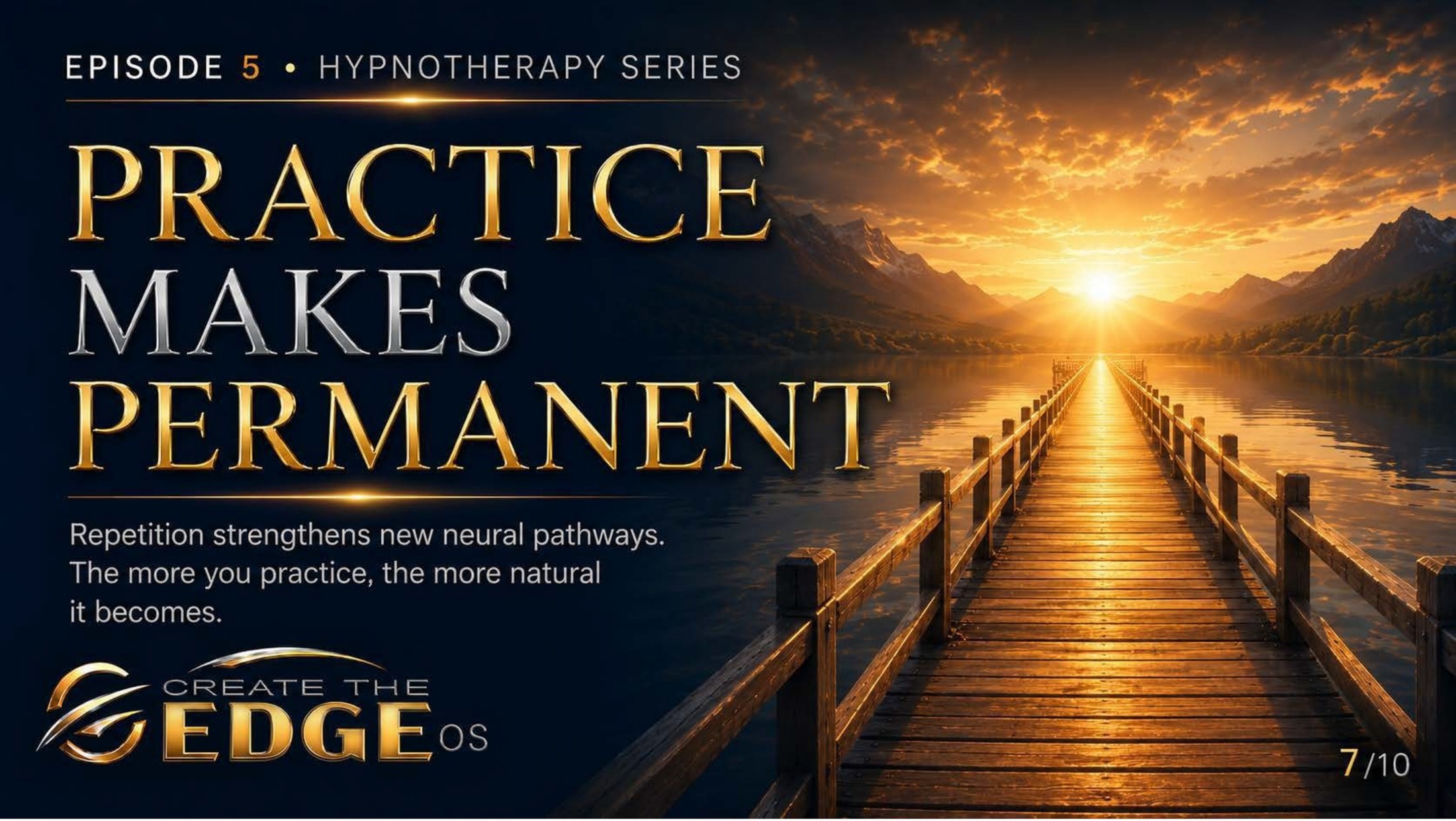
On the slideRepetition strengthens new neural pathways. The more you practice, the more natural it becomes.
Episode 5 · Slide 7
Practice Makes Permanent
Episode 5 · Slide 7
You’ve heard “practice makes perfect” your whole life. I want to give you a truer, more useful version, and it’s the one printed on this slide: practice makes permanent. Look at the long wooden dock stretching across still golden water toward the sunrise — straight, solid, sure underfoot. That’s what a new pathway becomes, with repetition. A road you can walk in the dark without thinking.
Here’s the science, in plain language, because it’s genuinely encouraging. Your brain is not fixed concrete — it’s more like a field of grass, and every thought and action you repeat is a footstep across it. Walk the same route enough times and you wear a clear path. That’s a neural pathway. The habits running your life right now are simply paths you’ve walked ten thousand times — highways worn so deep you fall into them automatically.
And the old worry was that those highways were permanent. They’re not. Here’s the liberating truth: you can grow new paths, and let the old ones grow over. Every time you walk the new route — the new belief, the new response, the new routine — you press the grass down a little more. And every time you don’t walk the old highway, it begins, slowly, to grow back over with grass. The deep groove fills in. The path you stop using fades.
But — and this is the part people quit right before — the new path starts out faint. The first time you walk it, it’s barely visible, and the old highway right next to it looks so much easier, so much more familiar. Of course it does; you’ve walked it ten thousand times and the new one twice. So your foot wants to drift back to the highway. This is the exact moment most people give up and conclude “I guess I just can’t change.”
No — you just hadn’t walked the new path enough times yet. That’s all. The slide says it exactly: the more you practice, the more natural it becomes. Repetition is not the boring part of transformation — repetition is the transformation. Each repetition strengthens the new pathway and weakens the old one. It is literal, physical change, happening in your brain, with every single repetition.
So here’s my plea, the most important practical thing in this whole chapter: be patient on the days the old highway calls. Of course it calls — it’s a ten-thousand-step road. You don’t need to never feel the pull. You just need to keep choosing the new path more often than the old one. Not perfectly. Just more often.
Every repetition is a footstep pressing down the new grass. One ordinary day, you’ll look down and realize the new path has become the clear one — wide and worn and easy — and the old highway has quietly grown over. That day comes. It comes to everyone who keeps walking. Keep walking.
On the slideWhen your beliefs change, your actions align automatically. Alignment creates momentum.
Episode 5 · Slide 8
Align Your Actions
Episode 5 · Slide 8
Here’s where it all starts to feel less like work and more like flow — and it’s the payoff for everything we’ve built. Look at the image: a long straight road running toward a golden sunrise, a glowing arrow lit right up the center of it, pointing forward. That arrow is alignment. And the slide reveals the secret that makes lasting change finally feel effortless: when your beliefs change, your actions align automatically.
Notice that word — automatically. This is the moment the whole approach pays off. When you change a habit by force, you have to fight for every single action, forever, because the underlying belief still points the other way. It’s like driving with the parking brake on — you can do it, but you’re fighting your own machine the whole way, burning out, smelling smoke.
But when you change the belief at the root — the way we’ve been doing — something remarkable happens. The actions stop requiring a fight. They start flowing naturally from who you now believe you are. The person who deeply believes “I am someone who takes care of my body” doesn’t have to white-knuckle herself to the gym — going simply becomes what someone like her does. The action aligns with the identity, automatically, the way water flows downhill.
This is the difference between forcing behavior and becoming the kind of person for whom that behavior is natural. The first is exhausting and temporary. The second is effortless and permanent. You don’t have to constantly drag yourself toward the actions — the actions start arising on their own from the new you.
And then comes the magic word on this slide: alignment creates momentum. When your beliefs, your patterns, and your actions all finally point the same direction — up that golden road — they stop fighting each other and start reinforcing each other. Each aligned action makes the next one easier. Each small win deepens the new belief. The belief makes the next action more natural still. It builds. It compounds. It picks up speed.
This is momentum, and it is the most beautiful experience in all of personal change, because it’s the moment effort turns into flow. For so long, change felt like pushing a boulder uphill. And then one day you notice you’re not pushing anymore — you’re being carried. The current that used to drag you backward is now flowing forward, and you’re riding it.
That’s what alignment gives you. Not a life of endless forcing, but a life where the right actions flow naturally from who you’ve become. The arrow is lit and pointing forward. Get your beliefs aligned with it, and the momentum does the rest.

On the slideNew habits. New mindset. New life. This is your edge.
Episode 5 · Slide 9
A New Reality Awaits
Episode 5 · Slide 9
Lift your eyes for a moment and look at where this path leads. The woman in this image stands on a mountain summit above a sea of clouds, arms thrown wide to a sky scattered with stars, the sunrise breaking over the peaks below her. She climbed to get there. And the slide tells you what waits at that altitude: new habits. New mindset. New life.
I want you to really let yourself imagine it — not as a fantasy, but as a genuine, reachable destination, because it is reachable, and people reach it every day.
New habits. Imagine waking up and the first things you do are the things that build the life you want, not quietly tear it down — and they’re automatic now, easy, just who you are. The morning that used to start with dread and the phone now starts with something that feeds you. The evening that used to dissolve into numbing now holds rest and presence. Small things. They build everything.
New mindset. Imagine the voice in your head having changed its tone — the harsh narrator replaced by a steadier, kinder, more confident inner companion. Imagine meeting a setback and, instead of “see, I always ruin everything,” hearing “okay — what did that teach me, and what’s my next step?” That shift alone changes the entire experience of being alive.
New life. And imagine those new habits and that new mindset, compounded over months and years, producing a life that genuinely looks and feels different from the one you have now. Not because you got lucky. Because you changed the patterns at the source and let the new reality grow from there. This is not wishful thinking. This is cause and effect.
Then read the gold script at the bottom of the slide: This is your edge. That’s the heart of what your whole journey through these chapters has been building. Your edge isn’t luck, or talent, or someone else’s permission. Your edge is that you now understand how change actually works — the loop, the code, the release, the new belief, the repetition, the alignment. You know how to rewire a life from the inside. Most people go their whole lives never learning this. You have it now. That’s your edge.
And here’s the thing about the woman on that summit, arms open to the stars — she is not someone with a different past than yours, or fewer wounds, or better luck. She is simply someone who kept walking the path. Who chose the new grass over the old highway, more often than not, long enough for it to become the clear road. She is who you are becoming.
The new reality isn’t a daydream. It’s a summit, and there’s a path to it, and you’re already on it. Keep climbing. The view from up there is worth every step.

On the slideEvery day is an opportunity to strengthen your new pattern and create the life you love. You have the power. Use it.
Episode 5 · Slide 10
Your Journey Continues
Episode 5 · Slide 10
Look at this final image, and notice it’s different from the others. Not a doorway this time, but a lighthouse — standing tall on the rocks above the sea, its light burning steady and golden against the sunset, a little path winding up to it through the cliffs. A lighthouse doesn’t chase the ships. It simply stands, and shines, and keeps shining, night after night, so that anyone in the dark can find their way home. That’s what you’re becoming. That’s what your new patterns are building — a steady light that doesn’t flicker out when the weather turns.
And the message on this slide is the gentlest, most powerful charge in the whole chapter: every day is an opportunity to strengthen your new pattern and create the life you love.
Every day. Not someday. Not once you’ve got it all figured out. Not after some big dramatic breakthrough. Every ordinary day. Each sunrise hands you another chance to walk the new path one more time, to choose the new belief one more time, to press the new grass down one more step. Transformation isn’t one heroic leap — it’s ten thousand small, faithful choices, and you get a fresh handful of them every single morning you wake up.
And that means the days you stumble — the days you fall back into the old highway, snap at someone you love, reach for the old comfort, skip the thing you meant to do — those days are not failures, and they are not the end of your progress. Remember what we said at the very beginning of this journey: we don’t fail — we fall forward. A stumble is just information, just a teacher, just the path saying “not that way — try again tomorrow.” And tomorrow comes, with its fresh handful of chances. You don’t start over. You continue.
Read the final line on the slide, and let it land in you like a hand on your shoulder: “You have the power. Use it.”
You do. That’s not flattery — it’s the whole conclusion of everything we’ve built together. The power to change your habits was never outside you, in some technique or guru or perfect plan. It was always in you, in the deep mind that builds patterns and the deeper self that gets to choose them. You’ve spent this chapter learning how to reach it. Now the only thing left is the most important thing: use it.
Your journey doesn’t end at the bottom of this page. In a real way, it begins there — because everything we’ve talked about only becomes real when you carry it into your actual, ordinary, beautiful day. So let’s take the first step right now, in the workbook below. One pattern. One new belief. One repetition. Today.
The lighthouse is lit. The power is yours. And I’m right here, cheering you up every step of that winding path. Go on, lighthouse. Shine.