
On the slideHypnotherapy can help change the pattern beneath the pattern — so healthier choices begin to feel more natural.
Episode 6 · Slide 1
From Weight Struggle to Food Freedom
Episode 6 · Slide 1
I have to be honest with you about this chapter before we take a single step, because I’ve lived inside this exact struggle and I won’t pretend I haven’t.
There was a season of my life when I didn’t recognize the woman in my own mirror. I had always been thin — it was simply my normal — and then, in the wreckage of a divorce and a season of feeling utterly lost, the weight came. Quietly at first. Then not quietly at all. And the heaviest part, I promise you, was never on my body. It was the shame. The aloneness. The way I knew how to offer compassion to everyone in my chair and couldn’t find a single drop of it for myself. So when I talk to you about this, I’m not talking down from some tidy mountaintop. I’m talking across a kitchen table, as someone who has sat where you might be sitting.
Look at the woman in this image — walking a golden path up through the mountains toward the sunrise, moving forward, climbing. Not standing still in the struggle. Moving through it. That’s where we’re headed together: from weight struggle to food freedom.
And I want to be very clear about what this chapter is, and what it is not. This is not a diet. I will not hand you a meal plan, a number to hit, a list of forbidden foods, or one more set of rules to white-knuckle and fail and feel ashamed about. Heaven knows you’ve had enough of those, and so had I. The diet industry has made billions selling us the same lie on a loop: that the problem is your willpower, and the solution is more restriction. If that worked, you’d have been free a long time ago.
Read the promise on the slide instead, because it points somewhere entirely different: hypnotherapy helps change the pattern beneath the pattern — so healthier choices begin to feel more natural.
The pattern beneath the pattern. That’s the whole key. Your relationship with food was never really about food. It’s about what the food is doing for you — the comfort, the soothing, the escape, the love you’re reaching for in the only language some old part of you knows. We are not going to fight the eating. We are going to go beneath it, to the real pattern underneath, and tend that. Because when the thing underneath finally gets what it actually needs, the eating changes on its own — not through force, but because it’s no longer carrying a job that was never food’s to do.
This is the gentlest possible approach to the hardest possible struggle. No shame. No rules. Just the truth, and a path forward, and my hand in yours. Let’s walk it.

On the slideIf stress, emotion, and routine are driving the behavior, force alone rarely creates lasting change: stress triggers choices · old routines take over · shame drains motivation.
Episode 6 · Slide 2
Why Willpower Alone Fails
Episode 6 · Slide 2
Let me lift a weight off your shoulders that you’ve been carrying unfairly, probably for most of your life. Every time a diet “failed,” you almost certainly concluded the same thing: I failed. I have no willpower. There’s something wrong with me. Look at the woman in the image, straining to push that enormous boulder up the hill. That’s exactly what relying on willpower feels like — and the slide tells you the truth nobody selling diets wants you to hear: if stress, emotion, and routine are driving the behavior, force alone rarely creates lasting change.
You weren’t failing. You were bringing the wrong tool to the fight. Let me show you the three forces that quietly defeat willpower every single time.
Stress triggers choices. When you’re stressed, frightened, or overwhelmed, your body floods with chemistry that practically demands quick comfort and quick fuel. This isn’t weakness — it’s biology, older than you, older than civilization. Asking your tired conscious willpower to override a stress response is like asking a polite request to stop a stampede. The stress reaches for relief long before your good intentions get a vote.
Old routines take over. Remember the habit loop from the last chapter? So much of eating runs on pure autopilot — the same snack at the same time in the same chair in front of the same screen, a groove worn so deep you’re halfway through before you even notice you started. Willpower can’t fight a routine it never sees coming. By the time you’re aware, the loop has already run.
Shame drains motivation. And here’s the cruelest one, the trap that keeps so many people stuck for decades. You slip, then you shame yourself, and shame doesn’t motivate — it depletes. It whispers “what’s the point, you always do this, you’ll never change,” and that despair sends you right back to the only comfort nearby: more of the very thing you’re ashamed of. Shame and the struggle feed each other in a closed loop, around and around, and it has nothing to do with willpower at all.
Do you feel the relief in seeing this clearly? You are not a weak-willed person who keeps failing. You are a perfectly normal human being who has been trying to solve an emotional problem with a willpower tool — and losing, the way anyone would. The boulder was never yours to shove uphill by brute force.
So we’re going to put the boulder down. We’re going to stop fighting at the surface, where willpower lives and dies, and go down to where the behavior is actually driven — the stress, the emotion, the routine underneath. That’s the only place lasting change has ever come from. And it’s a place willpower could never reach.

On the slideMany eating patterns run automatically beneath awareness: Trigger → Routine → Reward.
Episode 6 · Slide 3
The Subconscious Drives Habits
Episode 6 · Slide 3
Here’s the habit loop again — the great golden ring circling the tree of light — because it governs eating just as powerfully as any other habit, and seeing it clearly is half the freedom. The slide names the hard truth plainly: many eating patterns run automatically beneath awareness. Trigger. Routine. Reward.
Let me make this real, gently, with no judgment, because you’ve probably lived every version of it.
The trigger fires — and notice how rarely it’s actual hunger. It’s 9 p.m. and the house is finally quiet. It’s a hard conversation that left you rattled. It’s the particular loneliness of a Sunday evening. It’s simply walking past the kitchen on the way to somewhere else. The cue rings a bell, often one you don’t consciously hear.
The routine runs — you find yourself eating, often before you even decided to. Standing at the counter. Reaching into the bag without remembering opening it. Halfway through before any conscious choice was ever made. This is the part we blame ourselves for, but it’s really just the automatic middle of a loop that started with the trigger.
The reward lands — and here’s the part I need you to receive without an ounce of shame: the reward is real. The food genuinely does something. It soothes. It comforts. It fills a space. It quiets an ache, even if only for a moment. Your subconscious built this loop because, in its own way, it works. The food is doing a job. That’s precisely why “just stop” has never once worked — because you’d be removing the only comfort some part of you knows, and getting nothing in its place.
Sit with how freeing this is. The loop running beneath your awareness is not proof of weakness. It’s proof that some part of you found a way to cope, to self-soothe, to survive a feeling it didn’t have other tools for. That deserves compassion, not contempt.
And here’s the door it opens, the same door from last chapter: once you can see the loop, you can change it — gently, intelligently. We don’t rip away the comfort and leave you bereft. We honor the real need underneath, keep the trigger and the reward your deep self is reaching for, and help you find a routine in the middle that actually nourishes instead of one that leaves you ashamed. We don’t starve the need. We feed it better.
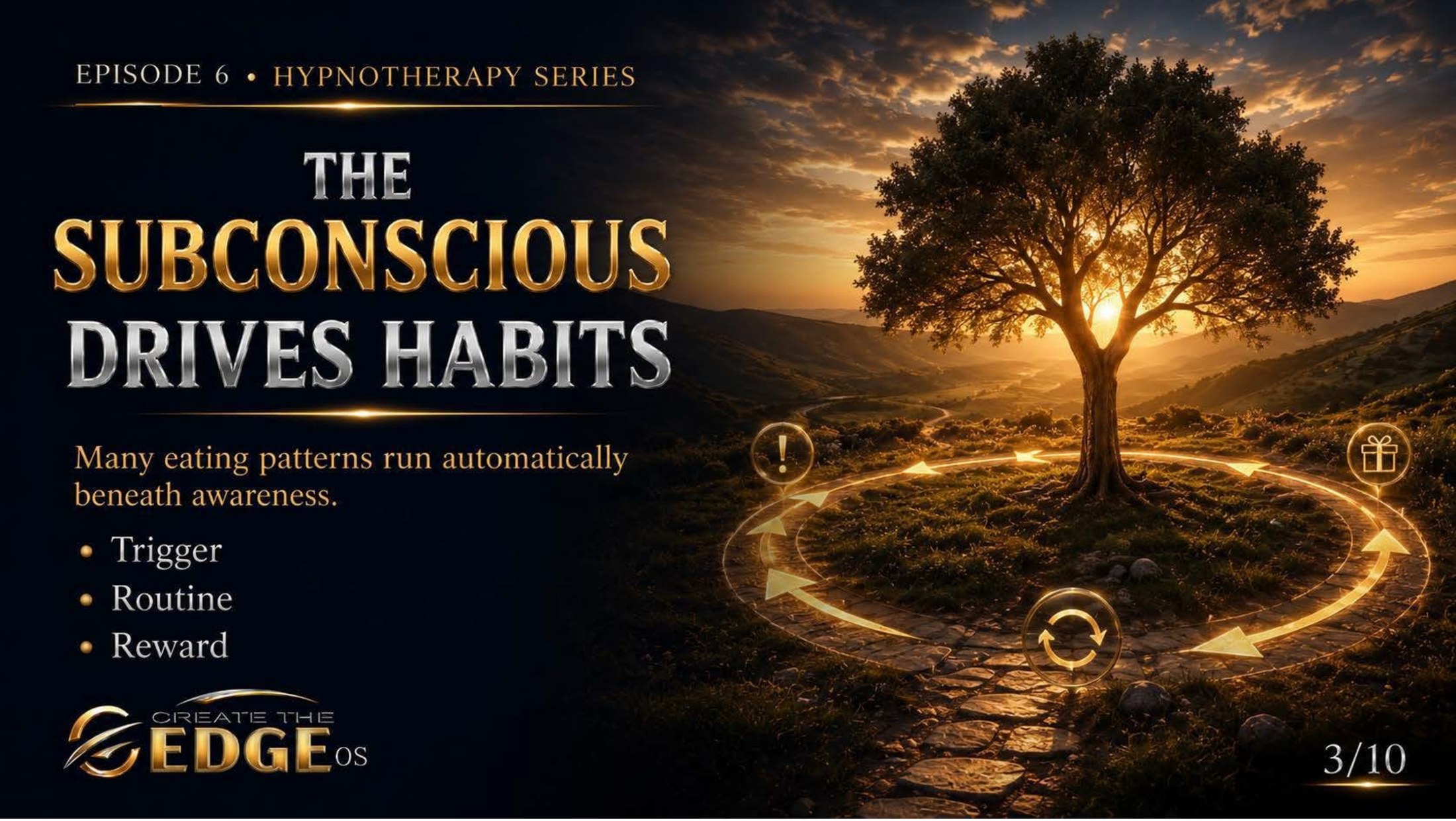
On the slideCravings often point to stress, loneliness, overwhelm, or the need for comfort: stress · boredom · loneliness · self-soothing.
Episode 6 · Slide 4
Emotional Eating Has a Message
Episode 6 · Slide 4
This may be the most important slide in the whole chapter, so let it land softly and completely. Look at the woman in the image — hands pressed to her heart, golden light blooming there in the shape of warmth and care. The title says it: emotional eating has a message. And once you can hear the message, everything changes.
We’ve been taught to treat cravings as the enemy — as evidence of weakness, as urges to crush and conquer. But what if a craving isn’t an enemy at all? What if it’s a messenger — a knock on the door from a part of you that needs something it doesn’t have words for? The slide tells us where cravings so often point: stress, loneliness, overwhelm, or the need for comfort. Look at the four messengers it names.
Stress. Sometimes the craving isn’t for food at all — it’s for relief. The body is wound tight and reaching for the fastest comfort it knows. The real message is: I am overwhelmed, and I need to feel soothed.
Boredom. Sometimes it’s a reaching for stimulation, for something to fill an empty hour or an empty feeling. The real message is: I am restless or unfulfilled, and I’m looking for something to feel.
Loneliness. This one breaks my heart a little, because I’ve lived it. Sometimes food becomes a companion when no one else is there — a warmth, a presence, a comfort that never says no and never leaves. The real message is the tenderest of all: I am lonely, and I am aching to feel held.
Self-soothing. And underneath all of them runs this single thread — the need to comfort oneself, to feel okay, to be cared for. The real message is: I am hurting somewhere, and I don’t know another way to tend it.
Do you see what this means? When you reach for food and it isn’t really hunger, you are not being greedy or broken or out of control. You are a person in need, reaching for the only comfort within arm’s reach. The behavior is misdirected, yes — but the need underneath is completely valid. Real. Worthy of care.
So here is the gentlest, most powerful question this chapter will teach you to ask — and I want you to practice it not with a fist, but with an open hand on your own heart: the next time a craving rises that isn’t hunger, pause and ask, softly, “what do I actually need right now?” Not “what’s wrong with me.” Just — what do I need? Because once you can hear the real message, you can finally answer it for real. And food was never going to answer it anyway.
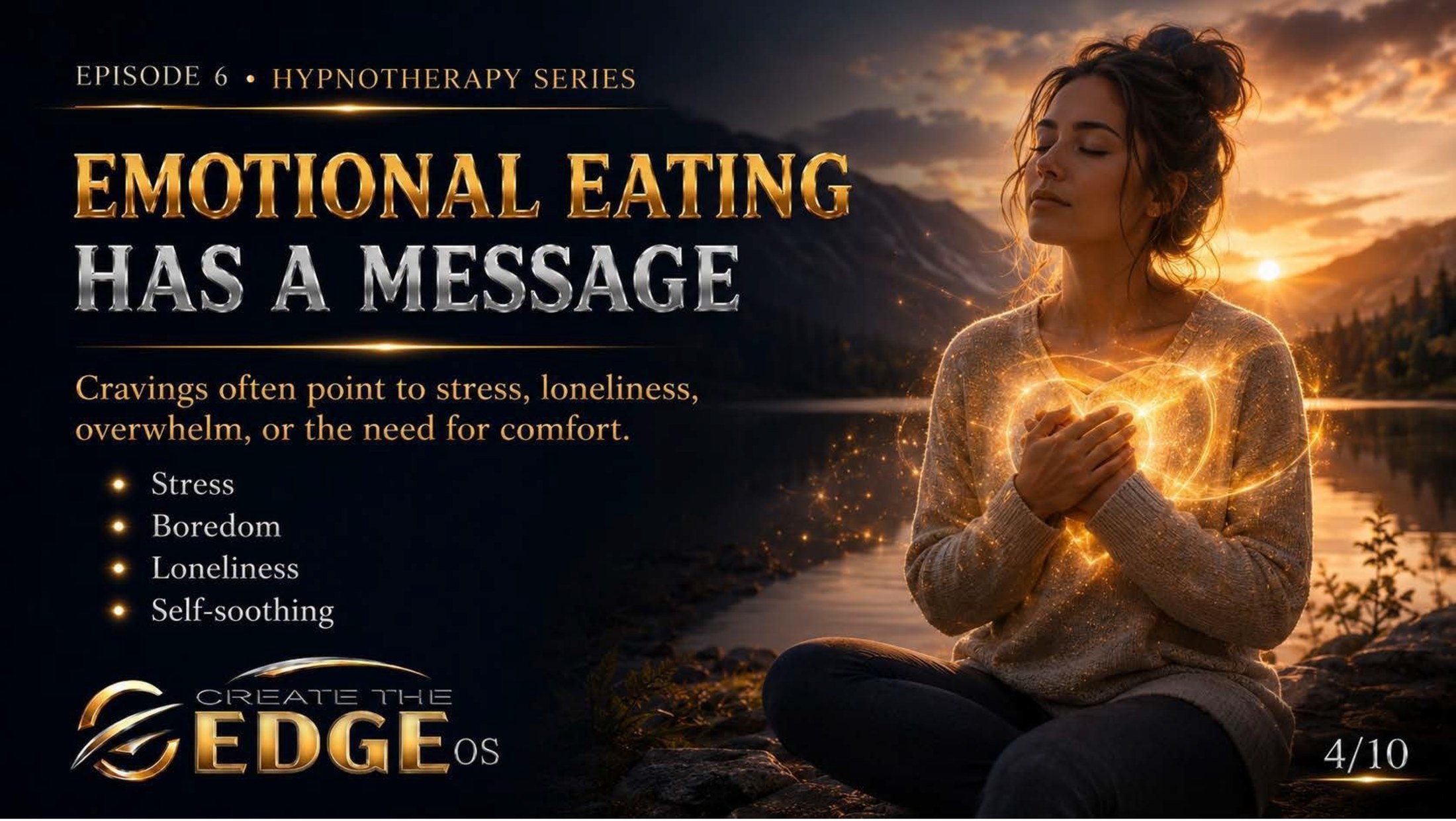
On the slideRelax the nervous system. Slow the impulse. Create space for a new choice. Pause · Reset · Reframe · Choose.
Episode 6 · Slide 5
Hypnotherapy Interrupts the Craving Loop
Episode 6 · Slide 5
So how do we actually change a pattern that runs faster than thought? Look at the woman in the image — chains breaking and scattering into golden light all around her as she opens her arms. The slide shows the four steps that shatter them: Pause. Reset. Reframe. Choose. And the gentle instruction beneath the title: relax the nervous system, slow the impulse, create space for a new choice. Let me walk you through how the loop gets interrupted.
Pause. A craving feels instant and overwhelming — trigger to mouth in a blink, no gap, no choice. So the very first thing we create is a pause. Even a few seconds. In that relaxed, focused state, we teach the nervous system to slow down at the trigger instead of bolting straight to the routine. That tiny pause is everything, because it’s the first crack of daylight between the urge and the action — the first place choice becomes possible.
Reset. In the pause, we calm the body. Remember, stress is often the real driver, and you cannot make a free choice from inside a stress response. So we relax the nervous system — a few slow breaths, a settling — and the desperate urgency of the craving begins to soften. What felt like a five-alarm fire reveals itself as a feeling that can actually be sat with.
Reframe. Now, with space and calm, we ask the real question: what do I actually need right now? We reframe the craving from “a thing to obey or fight” into “a message to listen to.” Is this hunger — or is it loneliness, stress, exhaustion, a need to be comforted? Naming the true need, in that open state, takes the white-hot power out of the craving almost instantly.
Choose. And now — only now, with a pause created, the body calmed, and the real need named — a genuine choice becomes possible. Maybe the choice is to tend the real need directly. Maybe it’s to eat, but from calm and presence rather than urgency and autopilot. Either way, for perhaps the first time, you are choosing instead of being driven. And that is the whole difference between a struggle and freedom.
Pause. Reset. Reframe. Choose. Notice this isn’t about resisting harder or wanting it less through sheer force. It’s about inserting freedom back into a process that had become automatic — reopening the gap where choice lives. The chains in that image aren’t breaking because she’s straining against them. They’re breaking because she finally found the space to step free.
That space is available to you. We build it gently, and we strengthen it with practice, until the pause that once took effort becomes simply how you meet a craving. Not a battle. A breath, and then a choice.
On the slideLasting weight loss grows when identity shifts from criticism to self-respect. “I care for my body. I can trust myself.”
Episode 6 · Slide 6
Build a Healthier Self-Image
Episode 6 · Slide 6
Here is the truth that the entire diet industry gets exactly backward, and it’s the heart of everything I want you to carry out of this chapter. Look at the woman in the image — standing on a high place, arms open to the valley and the light, a golden ribbon of energy spiraling up around her body. The slide tells you the secret: lasting change grows when identity shifts from criticism to self-respect.
We’ve been sold the idea that you have to hate your body into changing. That self-criticism is the engine of transformation — that if you just despise yourself enough, shame yourself enough, pick yourself apart in the mirror enough, you’ll finally be motivated to change. Let me tell you, as someone who tried that road for years: it is a lie, and it is a cruel one. You cannot hate yourself into a body you love. It has never once worked, for anyone, in the history of the world.
Think about it honestly. When have you ever taken truly loving care of something you despised? We protect, nourish, and tend the things we cherish. We neglect and punish the things we resent. So when you treat your body as an enemy to be conquered, every “healthy” act becomes a punishment — and punishment is not sustainable. No one keeps punishing themselves forever. Eventually they rebel, or they collapse, and the shame loop tightens another notch.
But watch what happens when the identity shifts. Read the two declarations on the slide: “I care for my body. I can trust myself.”
“I care for my body.” Not I’m disgusted by my body. When you genuinely begin to care for your body — the way you’d care for someone you love — nourishing it stops being punishment and starts being kindness. Moving it stops being penance and starts being joy. You’re not attacking an enemy anymore. You’re tending a home.
“I can trust myself.” This one rebuilds something that years of dieting destroyed — the trust between you and your own body, your own choices, your own hunger and fullness. Diets teach you that your body can’t be trusted, that you need external rules to control it. Healing teaches you the opposite: that as the noise quiets and the shame lifts, you can actually begin to trust yourself again.
This is why we plant these new beliefs at the deepest level, in that receptive state where they can actually take root. Because the body you live in for the rest of your life will be cared for by the person you believe yourself to be. Shift the identity from critic to caretaker — and the lasting change finally has somewhere solid to grow from. Not from hatred. From respect. From, at long last, a little love.

On the slideReduce shame. Increase awareness. Make choices from calm instead of urgency: mindful eating · body respect · less guilt · more presence.
Episode 6 · Slide 7
Calm Around Food and Your Body
Episode 6 · Slide 7
Imagine, for a moment, what it would feel like to be calm around food. Not at war with it. Not afraid of it. Not white-knuckling past the kitchen or spiraling into guilt after a meal. Just… calm. Look at the woman in the image — one hand on her heart, one on her belly, eyes closed, a peaceful meal before her, the lake glowing gold behind her. That peace is not a fantasy. It’s a destination, and the slide names the four landmarks that lead there.
Mindful eating. So much of our struggle happens on autopilot — eating while distracted, rushed, half-present, barely tasting. Mindful eating is simply the radical act of being there while you eat. Slowing down. Actually tasting. Noticing. When you’re present with your food, two beautiful things happen: you enjoy it far more, and your body finally has the chance to tell you, clearly, what it actually needs.
Body respect. This is the shift we just talked about, lived out daily — treating your body as a home to honor rather than an enemy to subdue. Respect doesn’t mean you have to love every angle in the mirror today. It means you treat your body with basic kindness while you heal, the way you’d treat a dear friend who was going through something hard.
Less guilt. Read that one twice, because guilt has been a constant, exhausting companion for so many of us. The guilt after eating. The guilt about the body. The guilt about the guilt. Here’s what I need you to know: guilt has never made anyone healthier. Not once. It only feeds the shame loop that keeps the whole struggle spinning. Releasing guilt isn’t giving up — it’s removing the single biggest obstacle to actual change.
More presence. And underneath it all — presence. Being here, in your body, in this moment, instead of lost in anxiety about the past meal or the next one. So much disordered eating is really a way of leaving — escaping a feeling, numbing out, disappearing. Presence is the gentle practice of staying. Of being home in yourself.
Read the instruction at the center of the slide, because it’s the through-line of everything: reduce shame, increase awareness, make choices from calm instead of urgency.
Calm instead of urgency. That phrase is the whole transformation in five words. Almost every painful eating choice is made from urgency — the desperate, now-now-now grip of a craving or a stress response. And almost every choice you’d be proud of comes from calm. So the work was never really about food at all. It was about building enough inner calm that you could finally make your choices from peace instead of panic. Do that, and freedom around food stops being something you chase — and starts being simply how you live.

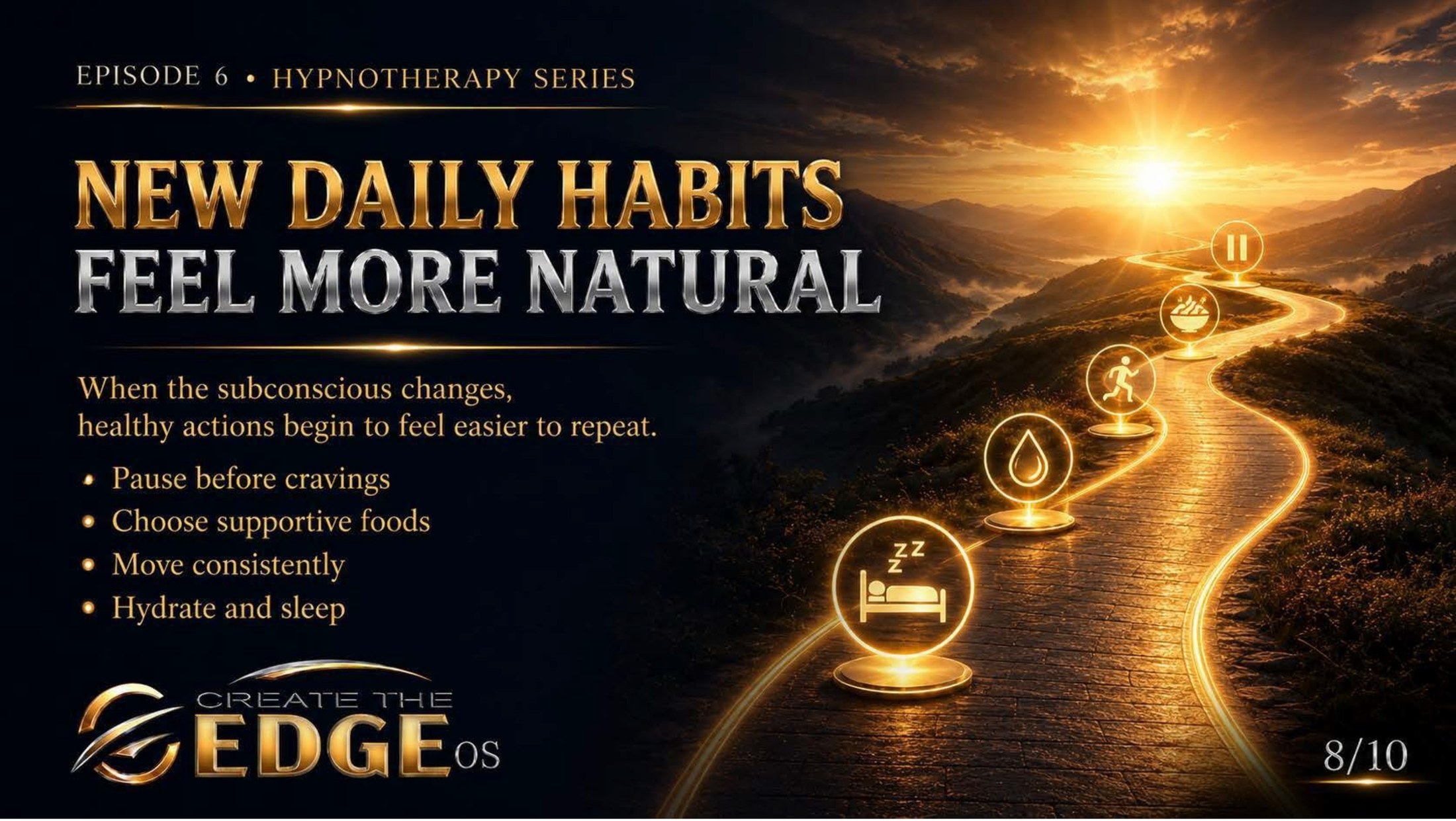
On the slideWhen the subconscious changes, healthy actions begin to feel easier to repeat: pause before cravings · choose supportive foods · move consistently · hydrate and sleep.
Episode 6 · Slide 8
New Daily Habits Feel More Natural
Episode 6 · Slide 8
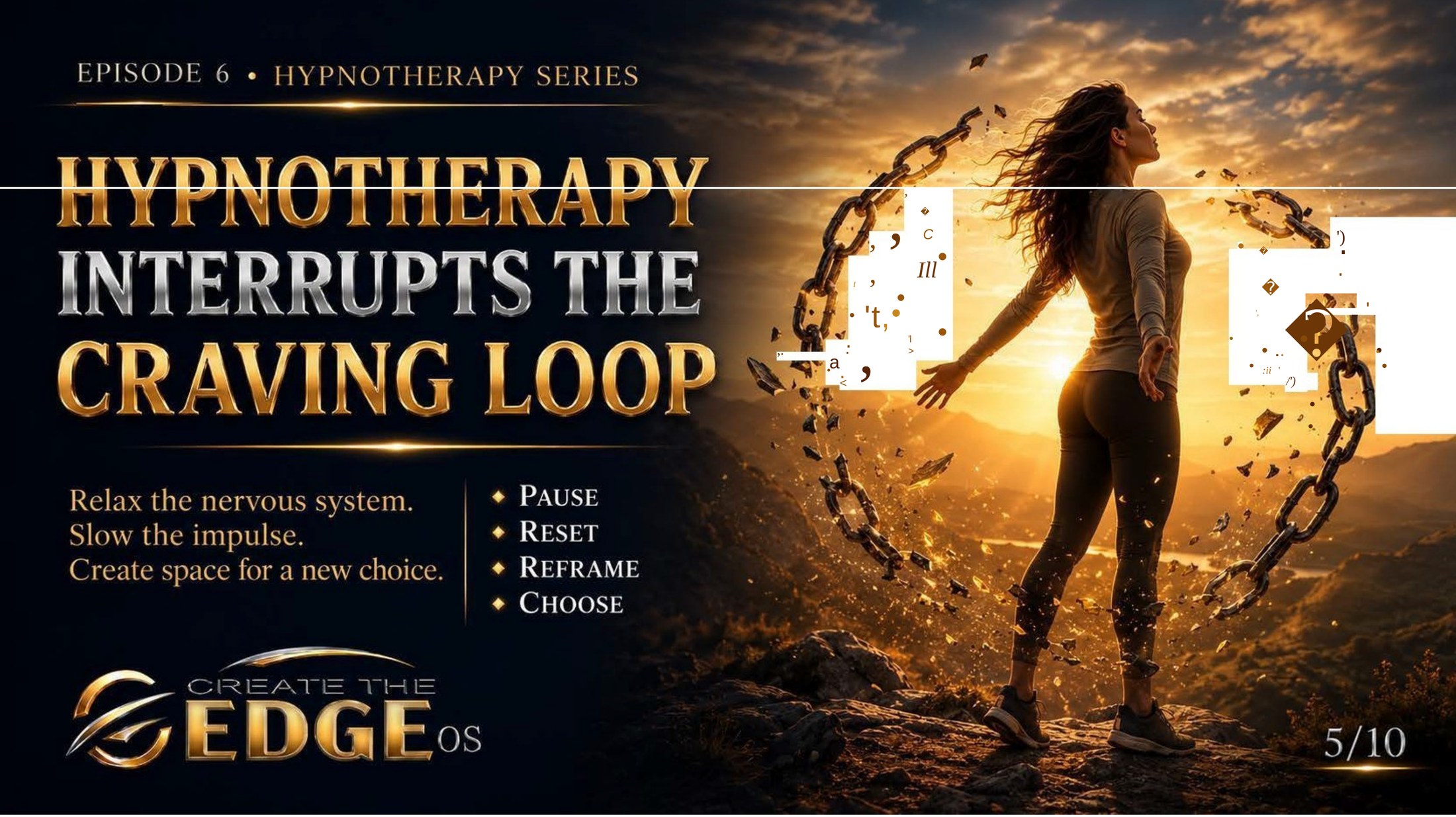
Here’s the payoff for doing the deep work first — the part where healthy living stops feeling like a grim daily battle and starts feeling, well, natural. Look at the image: a winding golden path lit with glowing stepping-stones, each one a simple act of self-care. The slide tells you the secret behind them: when the subconscious changes, healthy actions begin to feel easier to repeat.
This is the whole difference between people who struggle with healthy habits forever and people for whom those habits eventually feel easy. It was never about discipline or superior willpower. It’s that they changed the identity underneath — so the healthy actions started flowing from who they believed themselves to be, instead of requiring a fight against who they thought they were. Look at the four glowing stones on the path, and notice how gentle and humane they are — no extremes, no punishment, just kindness made into routine.
Pause before cravings. The skill we built earlier, now a daily habit — that small, freeing breath of space between the urge and the action, where choice lives. It gets easier every time you practice it, until one day it’s simply how you meet a craving.
Choose supportive foods. Notice the word — supportive, not “good” or “clean” or “allowed.” There are no forbidden foods here, no morality assigned to a plate. Just a gentle, growing tendency to choose what genuinely supports you — what makes your body feel cared for and energized — because you’ve become someone who cares for her body. The choice flows from the identity.
Move consistently. Not punishing exercise to “earn” food or burn off guilt — just movement that feels good, done consistently, because your body is a thing you live in and tending it feels like kindness now. When I finally lost the weight, what I treasured most wasn’t the number — it was being able to dance again, to ride a bike, to move through the world freely. Movement as joy, not penance.
Hydrate and sleep. The quietest, most overlooked foundations — and often the most powerful. So much of what we mistake for hunger is thirst or exhaustion in disguise. Caring for these humble basics changes everything, gently, from underneath.
Pause. Choose. Move. Rest. Four simple stones on a lit path. And here is the promise the slide makes that I want you to truly believe: these begin to feel easier to repeat. Not because you’ll have more willpower, but because you’ll have changed the person doing the choosing. The healthy life stops being a wall you climb every single day — and becomes, simply, the path you naturally walk.
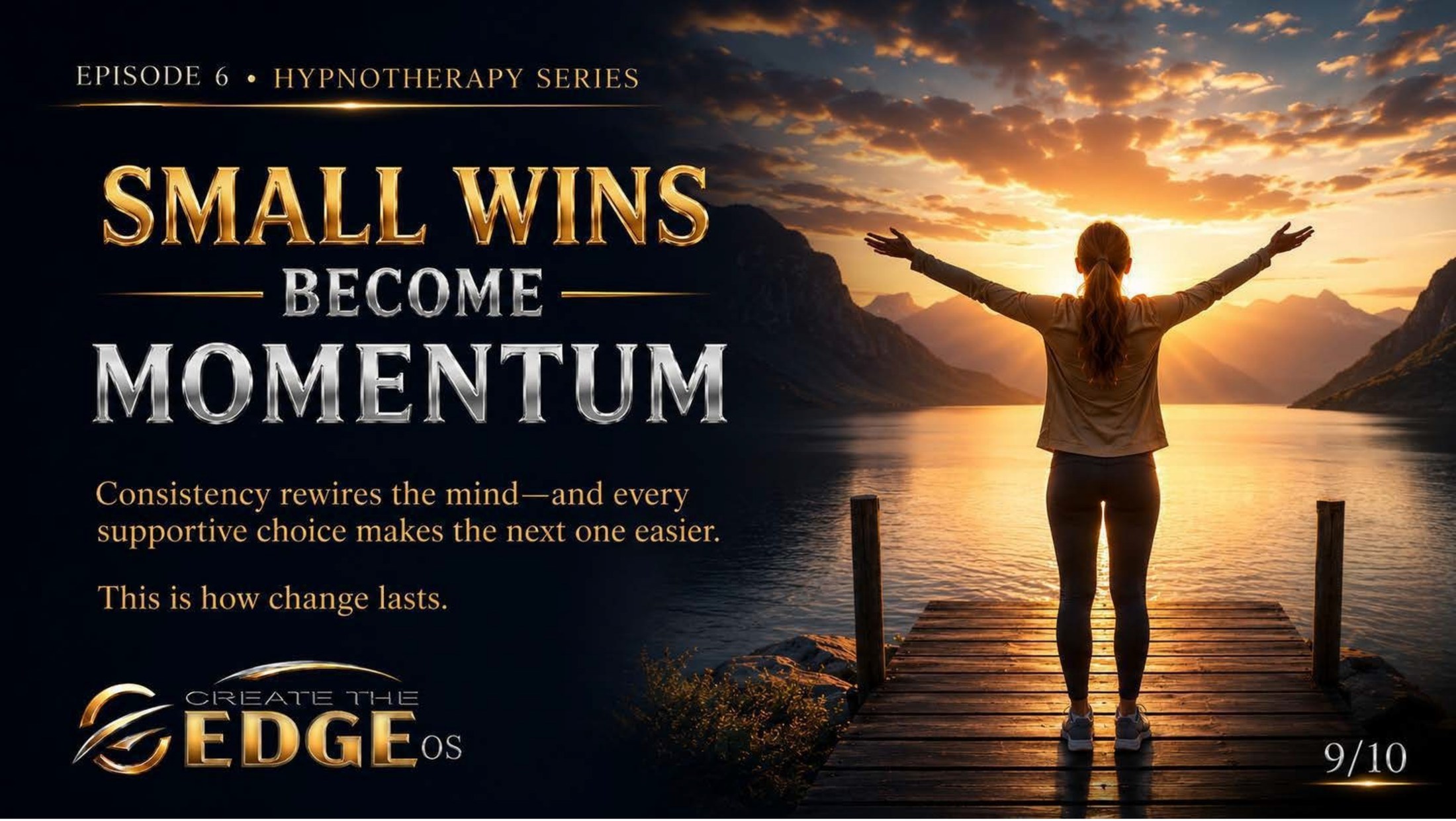
On the slideConsistency rewires the mind — and every supportive choice makes the next one easier. This is how change lasts.
Episode 6 · Slide 9
Small Wins Become Momentum
Episode 6 · Slide 9
If you’ve ever felt like change has to be enormous and dramatic to count — a total overhaul, a perfect transformation, a brand-new you by Monday — this slide is here to set you free from that exhausting lie. Look at the woman in the image, arms open at the end of the dock, the lake and mountains glowing before her. And read the title: small wins become momentum.
Small. That’s the word that changes everything. We so often despise small wins. We pour a glass of water instead of reaching for the old comfort, and we think “that’s nothing, that doesn’t count, look how far I still have to go.” But the slide tells the truth that the despair was hiding: consistency rewires the mind, and every supportive choice makes the next one easier.
Here is how change actually works — not the fantasy version, the real one. Every single supportive choice, no matter how small, does two quiet, powerful things. First, it lays down a little more of that new neural pathway we talked about — it presses the new grass down one more step. And second, it gives your deep mind a tiny piece of evidence: “I am someone who makes choices like this.” And that evidence, collected over time, is what rebuilds your identity from the inside.
So the small win was never small. The glass of water instead of the wine. The pause before the craving. The one walk. The kind word to yourself in the mirror instead of the cruel one. Each of these is a vote — a vote for the person you’re becoming. And you don’t need to win every vote. You just need to cast more of them, more often, than you used to.
Watch what happens then: every supportive choice makes the next one easier. This is momentum, and it’s the most encouraging force in all of change. The first kind choice is the hardest. The next is a little easier, because now there’s evidence behind it. The next, easier still. Small wins stack into momentum, and momentum is what carries you when motivation flags — which it will, because motivation always does. Momentum doesn’t need motivation. It just needs you to keep stacking small wins.
And read the final line on the slide, because it’s the answer to every diet that ever failed you: this is how change lasts. Not through dramatic, unsustainable overhauls that burn bright and collapse. Through small, consistent, compassionate choices that rewire the mind and build on each other until the new way of being is simply… you.
So please — stop waiting for the big, perfect transformation, and start honoring the small wins. They are not the consolation prize. They are the actual mechanism. Cast one small vote today for the person you’re becoming. Then another tomorrow. That, and nothing more dramatic than that, is how a whole life quietly changes.
On the slideYou do not need more shame. You need deeper support, repetition, and belief: notice the trigger · interrupt the pattern · practice the new response · repeat until it feels natural.
Episode 6 · Slide 10
Your Next Step
Episode 6 · Slide 10
Look at this final image — a great wooden door standing open in an old stone wall, a path of warm flagstones leading out through it into a glowing valley of hills and light. That’s your next step, and it leads somewhere beautiful. But before we walk the four practical steps, I need you to read the single most important sentence in this entire chapter, printed right there on the slide, and I want you to read it with your hand on your heart: “You do not need more shame. You need deeper support, repetition, and belief.”
Please. Let that one all the way in. For years — maybe your whole life — you’ve been told, by the world and by the cruel voice in your own head, that what you needed was more shame. More discipline. More self-criticism. More punishment. And it never worked, because it was never what you needed. What you needed was support, gentle repetition, and a new belief about who you are. That’s it. That’s the whole medicine. Not a bigger stick — a kinder, steadier hand. Now let’s walk the steps, in the workbook below.
One: Notice the trigger. With the curiosity of a gentle scientist, not the judgment of a critic, begin to notice what sets off the pattern. When do you reach for food that isn’t hunger? What’s the feeling, the time, the situation just before? You can’t change a pattern you can’t see. Noticing, without shame, is the entire beginning.
Two: Interrupt the pattern. Then, the pause. When you catch the trigger, create that small breath of space — even a few seconds. Calm the body. And ask the freeing question we’ve been practicing: “what do I actually need right now?” That pause is where the loop breaks and the choice returns.
Three: Practice the new response. In the space you’ve created, choose to tend the real need — or to eat with calm and presence instead of urgency and shame. Either is a win. You’re not aiming for a perfect response. You’re aiming for a conscious one, made by you instead of by the autopilot.
Four: Repeat until it feels natural. And then — the faithful friend, repetition. You practice this again and again, not on the perfect day but in the ordinary triggered moments, and you do it with patience and self-compassion on the days you stumble. Because you will stumble, and — say it with me one more time — we don’t fail, we fall forward. A slip is not the end of your progress. It’s just a teacher. Tomorrow brings a fresh handful of chances, and you don’t start over — you continue.
Notice. Interrupt. Practice. Repeat — all of it wrapped in support and belief instead of shame. That’s the path through the open door.
And friend — I have walked this exact road, from the weight and the shame and the aloneness, all the way to freedom and a body I could dance in again. If I can find my way through that door, so can you. Not because you’ll finally muster enough shame to force it. Because you’ll finally give yourself enough support to walk it. So let’s take the first step right now, in your own handwriting below. The door is open. The valley is glowing. And I’m right here, walking beside you. No shame between us. Just the path, and the light, and your next gentle step.