
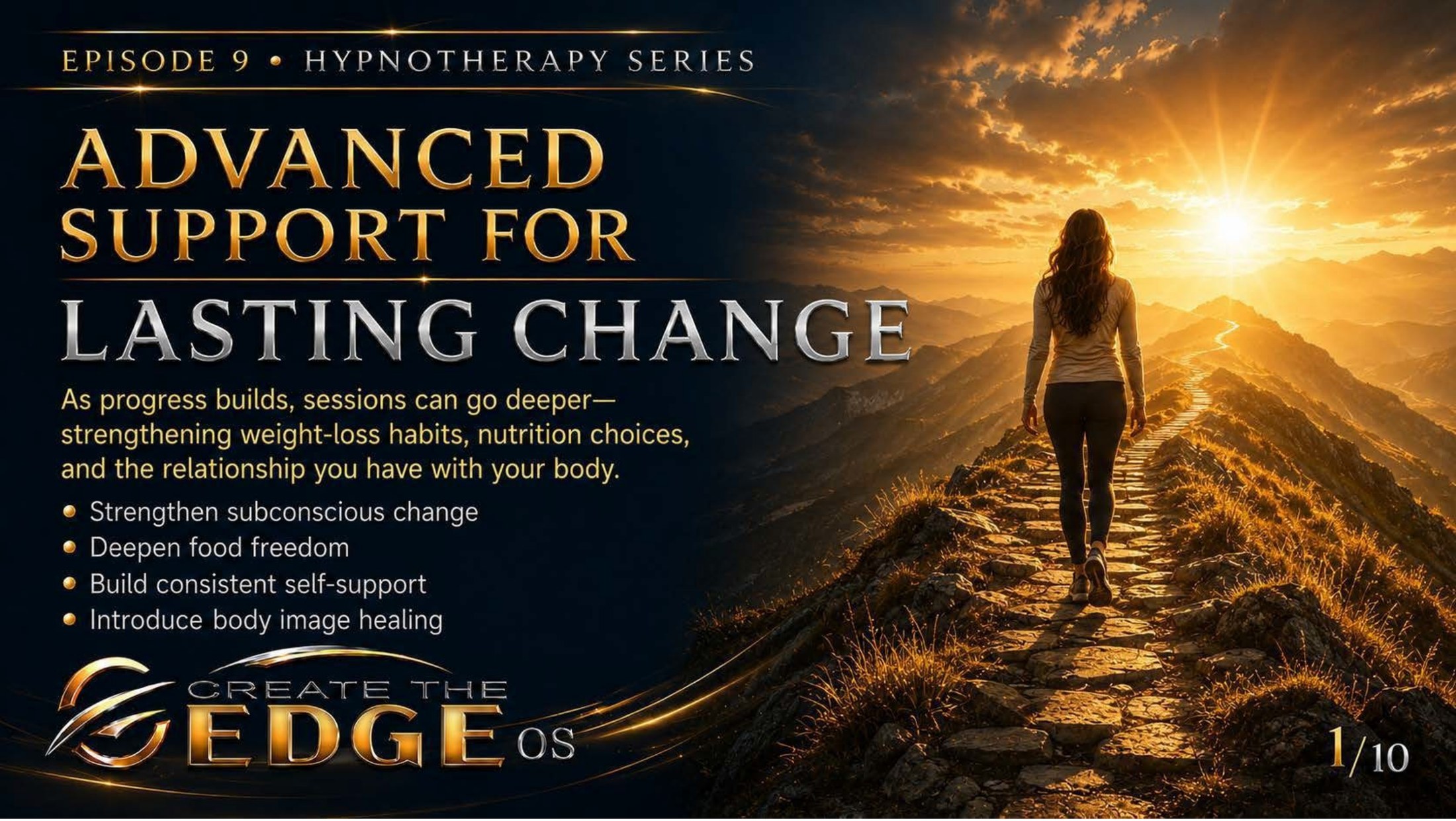
On the slideAs progress builds, sessions can go deeper — strengthening weight-loss habits, nutrition choices, and the relationship you have with your body: strengthen subconscious change · deepen food freedom · build consistent self-support · introduce body image healing.
Episode 9 · Slide 1
Advanced Support for Lasting Change
Episode 9 · Slide 1
There comes a point in any real journey where you’ve done the foundational work — you understand your patterns, you’ve interrupted some cravings, you’ve started to trust yourself a little — and you’re ready to go deeper. Not back to the basics, but down to the bedrock. That’s where this chapter takes you.
Look at the woman in this image, walking a golden mountain path that climbs toward a brilliant sunrise. Notice she’s higher up the mountain now than she was in the early chapters. She’s been climbing. She’s ready for the steeper, more rewarding stretch of trail — the part with the real view. The slide names where we’re going: as progress builds, sessions can go deeper — strengthening weight-loss habits, nutrition choices, and the relationship you have with your body.
That last phrase is the heart of this chapter, and it’s something the early work only began to touch: the relationship you have with your body. Because here’s a truth that took me years to learn in my own life — you can change your habits, you can change your eating, you can even change your body, and still be at war with yourself. Still flinch at the mirror. Still talk to yourself in a voice you’d never use on someone you loved. And as long as that war is raging underneath, the changes never quite feel safe, and they never quite last.
So advanced work goes after the war itself. Read the four deeper aims on the slide: strengthen subconscious change, deepen food freedom, build consistent self-support, and — the new frontier — introduce body image healing.
Body image healing. That’s the territory we haven’t fully entered yet, and it may be the most important of all. Because the relationship you have with your own reflection — the things you think when you catch yourself in a mirror, the voice that narrates your body — shapes everything. It shapes whether you care for your body or punish it. Whether change feels like self-love or self-attack. Whether any of this lasts.
I know this terrain personally. There was a season I looked in the mirror and didn’t recognize the woman looking back — and the cruelty I aimed at her was the heaviest thing I carried, heavier by far than any number on a scale. So when we walk into the mirror together in this chapter, know that I’m walking in with you as someone who has stood exactly there.
This is the next level of the journey — deeper, gentler, and more freeing than anything we’ve done so far. Not just changing what you do, but healing how you see yourself. Take my hand. The view from up here is worth the climb.
On the slideAdvanced sessions explore the beliefs, emotions, and old stories that keep weight and food struggles in place: emotional roots · protective patterns · identity-level beliefs · more lasting change.
Episode 9 · Slide 2
Going Deeper Than Surface Habits
Episode 9 · Slide 2
Look at the woman in this image, standing at the edge of a vast canyon as a golden river winds far below through the depths. That canyon is the perfect picture of this slide’s message: there is so much more beneath the surface than we usually dare to look at — and that depth is exactly where the lasting change lives. The slide says it: advanced sessions explore the beliefs, emotions, and old stories that keep weight and food struggles in place.
In the early work, we addressed the habits — the cravings, the triggers, the routines. That work is real and necessary. But habits are the surface of the canyon. Underneath them runs a deeper river — the beliefs, emotions, and old stories that have been quietly powering the struggle all along. And until we go down to that river, the surface keeps refilling. Look at the four depths the slide names.
Emotional roots. Every persistent pattern has an emotional root — a feeling, often very old, that the behavior was trying to manage. The eating was never really about food; it was about an emotion underneath. Advanced work follows the pattern down to its emotional root and tends it there, where it actually grows.
Protective patterns. Remember from the inner-child work — so many of our struggles were once protection. Sometimes weight itself, or the relationship with food, served a protective purpose a part of us still believes in: a buffer, a comfort, a shield, a way to feel safe. We can’t simply rip away a protection; we have to understand what it’s guarding and offer that part safety another way. Otherwise the deep mind clings to the pattern, because to it, the pattern equals survival.
Identity-level beliefs. This is the deepest river of all — the beliefs about who you are. “I’m someone who struggles. I’m not a disciplined person. This is just how I am.” As long as those identity-beliefs run underneath, they pull every surface change back toward the old self. Advanced work goes all the way down to rewrite the identity itself.
More lasting change. And this is the reward for going deeper: more lasting change. Surface work produces surface results that often slip. Deep work — emotional roots tended, protective patterns honored and updated, identity rewritten — produces change that holds, because you’ve changed the thing the behavior was growing from.
I won’t pretend the descent into the canyon is always easy. Going deeper means feeling more, looking at the old stories honestly, meeting the protective parts with compassion. But it is done gently, safely, at your pace — and it is where the real, lasting freedom is found. The surface was never going to be enough. The treasure was always at the bottom of the canyon, by the river. That’s where we’re going.

On the slideSustainable change is easier when the mind stops fighting the body and begins building respect, safety, and trust: body image shapes behavior · shame drives struggle · respect supports healing · trust supports consistency.
Episode 9 · Slide 3
The Role of Body Image
Episode 9 · Slide 3
Now we enter the territory at the heart of this whole chapter — and it’s one the diet world almost entirely ignores, to everyone’s harm. Look at the woman in the image, standing by a still golden lake, gazing at her own reflection in a tall mirror. That relationship — between a woman and her reflection — is one of the most powerful forces in her life. The slide tells the truth: sustainable change is easier when the mind stops fighting the body and begins building respect, safety, and trust.
Stops fighting the body. Sit with that, because most people have been at war with their own body for so long they don’t even notice the fighting anymore — it’s just the constant background hum of being alive. The critical glance in every reflective surface. The running commentary of everything “wrong.” The body experienced as an opponent, a problem, an enemy. Look at the four truths the slide names about why this matters so much.
Body image shapes behavior. This is the key insight. How you see your body directly shapes how you treat it. We tend the things we cherish and neglect the things we despise. So a person at war with her body will, underneath, keep treating it like an enemy — punishing it, neglecting it, or numbing the pain of it with the very behaviors she’s trying to change. Body image isn’t a cosmetic side issue. It’s a driver of behavior.
Shame drives struggle. Here’s the cruel engine of the whole thing. We’ve been taught that shame about our body will motivate us to change it. The exact opposite is true. Shame drives the struggle deeper — it sends us back to the comfort behaviors, it depletes our motivation, it keeps the war raging. Body shame has never once produced lasting health. It only produces more struggle.
Respect supports healing. And here is the turn, the way out. When you begin to respect your body — even before you love it, even while you’re still healing — something fundamental shifts. Respect means basic care, basic kindness, treating your body as a home worth tending rather than an enemy worth attacking. And from respect, healing becomes possible, because you don’t heal what you’re attacking.
Trust supports consistency. And as respect grows into trust — trust in your body’s signals, your hunger, your fullness, your own wisdom — consistency follows naturally. You stop needing to control an enemy and start partnering with an ally.
This is why advanced work must include body image. You cannot fully heal your relationship with food while remaining at war with the body that eats it. The two are one. So we lay down the weapons. We end the war. We begin, gently, to build respect, safety, and trust with the body you live in — because that peace is the ground all lasting change grows from. The reflection in the mirror was never your enemy. It was always just you, waiting to be treated kindly.

On the slideAdvanced hypnotherapy can help loosen the grip of harsh self-judgment, so the mirror becomes less painful and more neutral or compassionate: notice harsh self-talk · release old criticism · build compassion · create inner safety.
Episode 9 · Slide 4
Releasing Shame From the Mirror
Episode 9 · Slide 4
The mirror. For so many of us, it’s become a place of quiet daily pain — a gauntlet we run, a judge we face, a moment we brace for. Look at the woman in this image, standing before a mirror with her hand on her heart, her reflection meeting her with something that looks almost like gentleness. That is the healing this slide offers: advanced hypnotherapy can help loosen the grip of harsh self-judgment, so the mirror becomes less painful and more neutral or compassionate.
Let me be honest about how cruel the mirror can become, because I’ve lived it, and naming it takes away some of its power. There was a time I would catch my reflection and a voice would start instantly — harsh, automatic, merciless. Cataloging every flaw. Speaking to me in a tone I would never, ever use on another living soul, least of all someone I loved. And I’d walk away from the mirror a little smaller, a little more defeated, every single time. Maybe you know that exact walk away.
Here’s what I came to understand: that voice was not the truth, and it was not even fully mine. It was a recording — assembled over years from every criticism, every comparison, every cruel word that ever landed, played back on automatic whenever I faced my reflection. And a recording can be changed. Look at the four steps the slide offers for loosening its grip.
Notice harsh self-talk. First, awareness — simply catching the voice in the act. Most of us are so used to the cruel inner commentary that we don’t even register it as a choice; it’s just the water we swim in. Noticing it — “oh, there’s that harsh voice again” — is the first crack of freedom. You can’t change what you can’t hear.
Release old criticism. Then, in the relaxed state, we begin to release the old criticism at its root — the absorbed voices, the internalized judgments, the recordings that were never yours to begin with. We don’t fight the voice; we loosen its grip and let the old criticism go, the way you’d finally delete a recording that only ever caused pain.
Build compassion. And in the space where the criticism was, we build something new — compassion. We practice meeting your reflection the way you’d meet a dear friend, or a child you loved. Not harsh judgment, but warmth. Not “look at everything wrong with you,” but “there you are — you’re doing your best, and you’re worthy of kindness.”
Create inner safety. And underneath it all, we create safety — so the mirror stops being a threat to brace against and becomes simply a neutral surface, or even a place of gentleness. Imagine that. Imagine catching your reflection and feeling… nothing harsh. Or even something kind.
Notice. Release. Build. Soften. The goal isn’t that you have to suddenly love every angle — we’re not forcing false adoration. The goal, as the slide says, is that the mirror becomes less painful, more neutral or compassionate. That alone is a profound freedom. To be able to face your own reflection without flinching, without the cruel voice, with even a flicker of kindness — that changes the texture of every single day. You deserve to walk away from the mirror feeling no smaller than when you approached it. Let’s make that possible.

On the slideWhen subconscious self-talk changes, food choices, motivation, and consistency often become easier to maintain: new self-talk · stronger self-worth · better follow-through · healthier motivation.
Episode 9 · Slide 5
Rewriting Your Inner Image
Episode 9 · Slide 5
If the last slide was about releasing the old cruel voice, this one is about what we plant in its place — and it changes everything downstream. Look at the woman in the image, walking through an open golden door toward sunrise, surrounded by glowing affirmations in flowing script: I am strong. I am enough. I choose health. I trust myself. I am capable. I create change. That’s the new inner image taking root. The slide tells you why it matters so much: when subconscious self-talk changes, food choices, motivation, and consistency often become easier to maintain.
Here’s the principle that makes this so powerful: your inner self-talk isn’t just commentary — it’s instruction. The deep mind is always listening to how you speak to yourself, and it organizes your behavior to match. Tell yourself a hundred times a day that you’re weak, undisciplined, hopeless around food — and the deep mind faithfully produces a life that proves you right. The self-talk isn’t describing your reality. It’s creating it.
Which means rewriting the inner image isn’t vanity or empty positivity — it’s changing the instructions your whole life is being built from. Look at the four things that shift when the inner image changes.
New self-talk. The cruel automatic narrator gets replaced, gradually, with a kinder, steadier, more empowering inner voice — one that speaks to you the way a wise, loving mentor would. Not delusional cheerleading, but genuine, grounded encouragement. This new voice becomes the soundtrack of your days.
Stronger self-worth. As the self-talk shifts, self-worth grows from the inside — not the fragile worth that depends on a number or a reflection, but the solid kind that comes from finally being on your own side. And a person with real self-worth treats herself well, naturally, because you care for what you value.
Better follow-through. Watch this one, because it surprises people: follow-through improves not through more discipline, but through better self-talk. When the inner voice says “you’ve got this, you’re someone who keeps promises to yourself,” you actually do — because you’re acting from a self-image that expects it.
Healthier motivation. And the whole engine of your motivation changes fuel — from the toxic fuel of shame and self-hatred (which always runs out and poisons everything) to the clean, renewable fuel of self-respect and care. You stop trying to punish yourself toward health and start caring yourself toward it. That motivation doesn’t burn out, because it isn’t burning you.
New voice. Stronger worth. Better follow-through. Healthier fuel. Do you see how the inner image sits underneath everything? Change the way you talk to yourself at the deepest level, and the food choices, the motivation, the consistency all become easier to maintain — not through force, but because they’re now flowing from a self that believes in itself. Walk through that golden door. The new image of you is waiting on the other side, written in light.

On the slideAs you progress, sessions may blend food triggers, nutrition habits, body image work, and future-focused reinforcement: review progress · explore deeper triggers · hypnotic reconditioning · reinforce next-step actions.
Episode 9 · Slide 6
What an Advanced Session May Include
Episode 9 · Slide 6
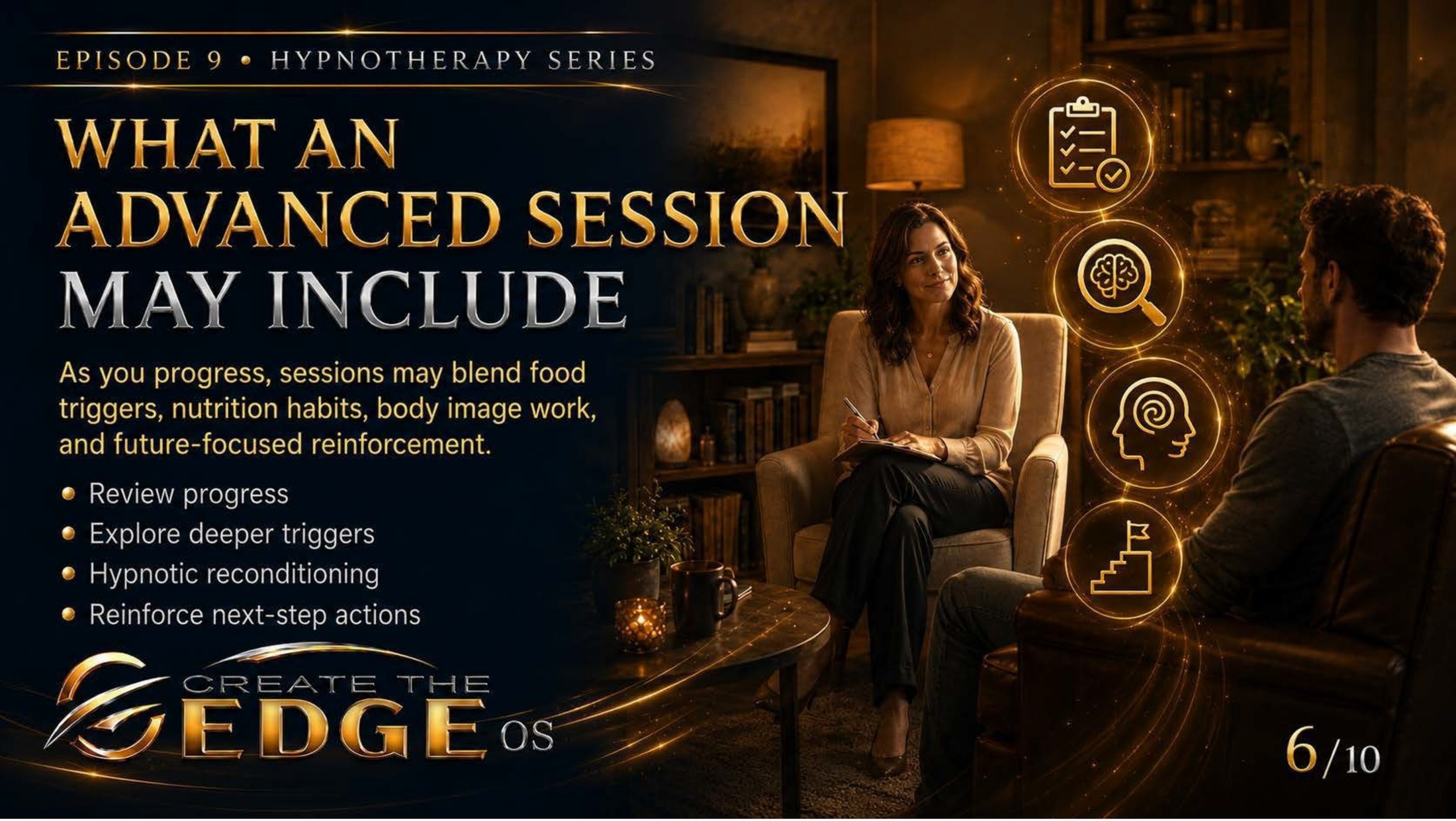
Let me show you what the deeper work actually looks like in the room, now that you’re ready for it. Look at the image — the warm, lamp-lit session space, the attentive guide, the relaxed client, and the glowing symbols of the work tracing up the side. The slide describes how an advanced session weaves the threads together: sessions may blend food triggers, nutrition habits, body image work, and future-focused reinforcement.
Notice that word — blend. In the early work, we often focused on one thing at a time: a craving here, a trigger there. In advanced work, the threads weave together into something richer, because by now you can hold more, go deeper, integrate more. Look at the four movements of an advanced session.
Review progress. We begin by honoring how far you’ve come — and this matters more than it sounds. Acknowledging your progress isn’t a formality; it’s fuel. It builds the evidence your deep mind needs that you are someone who changes, someone who follows through. We notice the wins, especially the quiet ones you might be tempted to dismiss.
Explore deeper triggers. Then we go down to the canyon floor — the deeper emotional roots, the protective patterns, the identity beliefs we talked about. The triggers that were too deep to reach in the early work become reachable now, because you’ve built the safety and the trust to go there. This is the descent to the river, done gently.
Hypnotic reconditioning. In the relaxed, focused state, we recondition at this deeper level — releasing old shame, rewriting the inner image, healing the relationship with the body, planting the empowering new beliefs in soil that’s now soft and ready. This is where the body-image healing and the deeper identity work actually happen.
Reinforce next-step actions. And we close by pointing the work forward — reinforcing the specific next steps, the practices, the new responses you’ll carry into your real life. We don’t just heal the past; we rehearse the future, so the deeper change has somewhere concrete to land.
Review. Explore. Recondition. Reinforce. Notice how this builds on everything that came before — it’s not a different method, it’s the same method gone deeper, applied to the roots instead of just the surface. And through it all, the same safety holds: you remain aware, in control, supported, never pushed faster than you’re ready to go. Advanced work isn’t harder or scarier. It’s simply deeper — and at that depth, the change finally reaches the place it’s been trying to reach all along.
On the slideAdvanced hypnotherapy often uses visualization to help the mind rehearse healthier eating, better self-care, and a more confident body relationship: see the healthier self · rehearse new choices · feel the emotion now · make change more familiar.
Episode 9 · Slide 7
Meeting Your Future Self
Episode 9 · Slide 7
This may be the most beautiful technique in all of this work, and it never fails to move me. Look at the image — a woman on a mountain path, and walking toward her out of the golden light, a radiant version of herself: her future self, healed, confident, free. The slide describes it: advanced hypnotherapy often uses visualization to help the mind rehearse healthier eating, better self-care, and a more confident body relationship.
Here’s the remarkable science underneath it, which we touched on before and now put to its fullest use: the deep mind doesn’t fully distinguish between a vividly imagined experience and a real one. When you vividly rehearse something — with all your senses, with real emotion — your deep mind files it as something you’ve actually lived. Which means you can practice being your future self until your deep mind treats that future self as familiar, known, already real. Look at the four steps of this meeting.
See the healthier self. First, we vividly imagine her — the future you who has walked this path. Not a fantasy of someone else, but the real you, healed. How does she stand? How does she move through her day? How does she relate to food, to her body, to her own reflection? We make her vivid, detailed, real — the woman walking toward you out of the light.
Rehearse new choices. Then we step into her and rehearse her choices — the calm pause before a craving, the nourishing meal eaten with presence, the kind glance in the mirror, the boundary held with ease. We practice being her, making her choices, until those choices start to feel like yours — because in the deep mind, you’ve now done them many times.
Feel the emotion now. This is the key that makes it work — we don’t just picture it, we feel it. The freedom. The calm. The self-respect. The lightness of no longer being at war with yourself. Feeling the emotion now, in the present, is what convinces the deep mind this future is real and reachable — and emotion is the deep mind’s native language.
Make change more familiar. And through all of it, the change becomes familiar. Remember how the subconscious clings to the familiar and resists the unknown? This is how we make the new, healthier life familiar before you even fully live it — so that instead of resisting it as something strange and dangerous, your deep mind welcomes it as something it already knows. We turn the future self from a stranger into someone you recognize.
See her. Rehearse her. Feel her. Know her. There is something genuinely moving about meeting your future self this way — the you who made it through, who found the peace, who came out the other side. She’s not a fantasy. She’s a real possibility, and every time you meet her in the relaxed state, you make her a little more inevitable. She’s walking toward you out of the light. All you have to do is keep walking toward her.

On the slideFood freedom deepens when nutrition is guided by care rather than punishment, and when the body is treated as an ally: choose nourishment · reduce all-or-nothing thinking · build gentle structure · support the body kindly.
Episode 9 · Slide 8
Nutrition With Body Respect
Episode 9 · Slide 8
Now that the body-image war is easing, nutrition itself transforms — because how you eat flows from how you see the body you’re feeding. Look at the woman in the image, eating a beautiful meal in peace as the sun sets over a golden harbor, utterly at ease. The slide names the shift: food freedom deepens when nutrition is guided by care rather than punishment, and when the body is treated as an ally.
An ally. Hold onto that word, because it’s the whole transformation. For most of the dieting years, the body is treated as an enemy — something to control, fight, deprive, force into submission. But you cannot nourish an enemy; you can only wage war on it. When the body becomes an ally instead — a partner you’re caring for, a home you’re tending — nutrition stops being a battlefield and becomes an act of love. Look at the four gentle practices the slide names, and notice not one is a rule or a restriction.
Choose nourishment. Again that word — nourishment, not restriction. When the body is an ally, you naturally want to nourish it, the way you’d want to feed someone you love good, sustaining food. The choices flow from care, not from a forbidden list. You feed your ally well because you want it to thrive.
Reduce all-or-nothing thinking. The perfectionist trap, eased at last. When nutrition is guided by care rather than punishment, one “imperfect” choice no longer means you’ve “blown it” and must abandon everything. There’s no wagon to fall off of when you’re simply, kindly, caring for your body across a whole life. One meal is just one meal. The next nourishing choice is always right there.
Build gentle structure. Notice it says gentle structure, not rigid rules. A little supportive rhythm — regular meals, some forethought, a few simple anchors of nourishment — not as a cage, but as kindness to yourself, the way you’d build a gentle routine for someone in your care. Structure as support, never as punishment.
Support the body kindly. And the thread through it all — kindness. Treating the body as an ally to support rather than an enemy to subdue. Feeding it when hungry, resting it when tired, moving it for joy, speaking to it with respect. Kindness, in place of the long war.
Nourish. Ease. Gentle structure. Kindness. This is what nutrition becomes on the far side of the body-image healing — not a grim regimen you white-knuckle, but a natural expression of caring for a body you’ve finally stopped fighting. And because it flows from care rather than force, it lasts. You’ll notice I’m still giving you no numbers, no forbidden foods, no diet — because that was never the answer. The answer was always to make peace with your body and let nourishment flow from that peace. That’s food freedom, deepened.

On the slideChange is often subtle at first — more pauses, fewer binges, less shame, better choices, and more connection to your goals: more awareness · fewer impulsive choices · greater calm · growing self-trust.
Episode 9 · Slide 9
How Progress Shows Up
Episode 9 · Slide 9
Let me set your expectations honestly and kindly, because how you measure your progress can make or break your journey. Look at the woman in the image, journaling peacefully by a window as the sun sets golden over the lake, reflecting on how far she’s come. The slide tells the gentle truth: change is often subtle at first — more pauses, fewer binges, less shame, better choices, and more connection to your goals.
Here’s the trap I want to save you from: most people measure progress in only one way — a number on a scale — and so they completely miss the real progress, which is happening everywhere else first. They could be transforming from the inside out, and because one number hasn’t moved as fast as they wanted, they conclude they’re failing and they quit — right before the breakthrough. Don’t let that be you. Learn to see the real progress. Look at the four ways it actually shows up.
More awareness. One of the very first signs — you start noticing. Catching the trigger as it fires. Recognizing a craving for what it is. Seeing the pattern in real time instead of only afterward. This awareness is enormous progress, even before any behavior changes, because all change begins with seeing clearly.
Fewer impulsive choices. Gradually, the gap between impulse and action widens. You pause where you used to react. The impulsive choices decrease — not through white-knuckling, but because the pattern is genuinely reconditioning. You might not even notice it happening until you look back and realize how much calmer your choices have become.
Greater calm. A growing peace — around food, around your body, in your nervous system generally. Since so much of the struggle was driven by stress and inner war, this calm is profound progress. The absence of the old frantic urgency. The quieting of the cruel mirror-voice. A settledness that wasn’t there before.
Growing self-trust. And perhaps the deepest marker — you begin to trust yourself again. Trust your hunger, your fullness, your choices, your own wisdom. The trust that years of dieting destroyed, slowly rebuilding. This is the foundation everything else stands on, and watching it return is one of the most beautiful kinds of progress there is.
More awareness. Fewer impulses. Greater calm. Growing trust. Notice that not one of these is a number on a scale — and yet every one of them is the real, deep change that makes lasting transformation possible. So please, measure your progress by these. Celebrate the extra pause, the binge that didn’t happen, the kinder thought in the mirror, the moment of calm where there used to be panic. These subtle shifts are the foundation being laid, brick by brick, beneath the surface. The visible changes grow from these. Honor them, and you’ll have the heart to keep going all the way to the freedom that’s coming.

On the slideYou do not have to choose between weight loss, nutrition, and body image healing. Advanced hypnotherapy helps all three work together: continue the work · reinforce new patterns · deepen self-respect · create lasting change.
Episode 9 · Slide 10
The Next Level of Healing
Episode 9 · Slide 10
Look at this final image — a great wooden door standing open in a stone wall, golden light pouring through, a flagstone path climbing up through a glowing garden toward stairs that lead to the sunrise. This is the next level of healing, and it leads up, toward more light. But before we walk the four steps in the workbook below, let the slide’s central promise land, because it heals a false choice that has tormented so many: “You do not have to choose between weight loss, nutrition, and body image healing. Advanced hypnotherapy helps all three work together.”
For so long, these were treated as separate — even at war with each other. “Love your body” versus “change your body.” “Accept yourself” versus “improve yourself.” As if you had to pick a side. As if wanting to be healthier meant you couldn’t also make peace with yourself, and making peace with yourself meant giving up on health. What a cruel, false choice that always was. The truth this whole chapter has been building toward is that they heal together. The body respect makes the nutrition sustainable. The released shame makes the change possible. The self-trust makes the consistency natural. They are not enemies. They are one healing. Now, the four steps.
One: Continue the work. Lasting change at this depth is built through continued, patient practice — not a single breakthrough but a steady deepening. You keep walking the path, keep doing the work, and it keeps going deeper and holding more firmly. Continuation is itself the practice.
Two: Reinforce new patterns. The new patterns — the kinder self-talk, the body respect, the calm responses, the empowering beliefs — grow stronger every time you reinforce them. Like a path walked daily, they become the clear, easy road while the old ones grow over.
Three: Deepen self-respect. This is the heart of the advanced work — the steady deepening of respect for yourself and your body. Not waiting until you’ve “earned” it, but practicing it now, today, as you are — and watching it grow into the solid ground all the rest stands on.
Four: Create lasting change. And all of it together — the deeper work, the reinforced patterns, the growing self-respect — creates change that finally lasts, because it’s rooted in a transformed relationship with yourself, not forced against a self still at war.
Continue. Reinforce. Deepen. Last. And on the days you stumble — because you still will, even at this level — remember the words that have carried us the whole way: we don’t fail, we fall forward. A hard day at this depth isn’t a collapse; it’s just the next bit of trail. You don’t start over. You continue, kinder to yourself than you were before.
And friend — I have walked this exact climb, from the war with the mirror and the body I didn’t recognize, up to a peace I genuinely didn’t believe was possible for me. I stopped having to choose between changing and loving myself, and found they were always meant to heal together. If I made it up this part of the mountain, so can you. So let’s take the next step right now, in your own handwriting below. The door is open. The garden is glowing. The stairs lead up toward the light. And I’m right here beside you, climbing together — toward the next level of healing, and the freedom waiting at the top.