
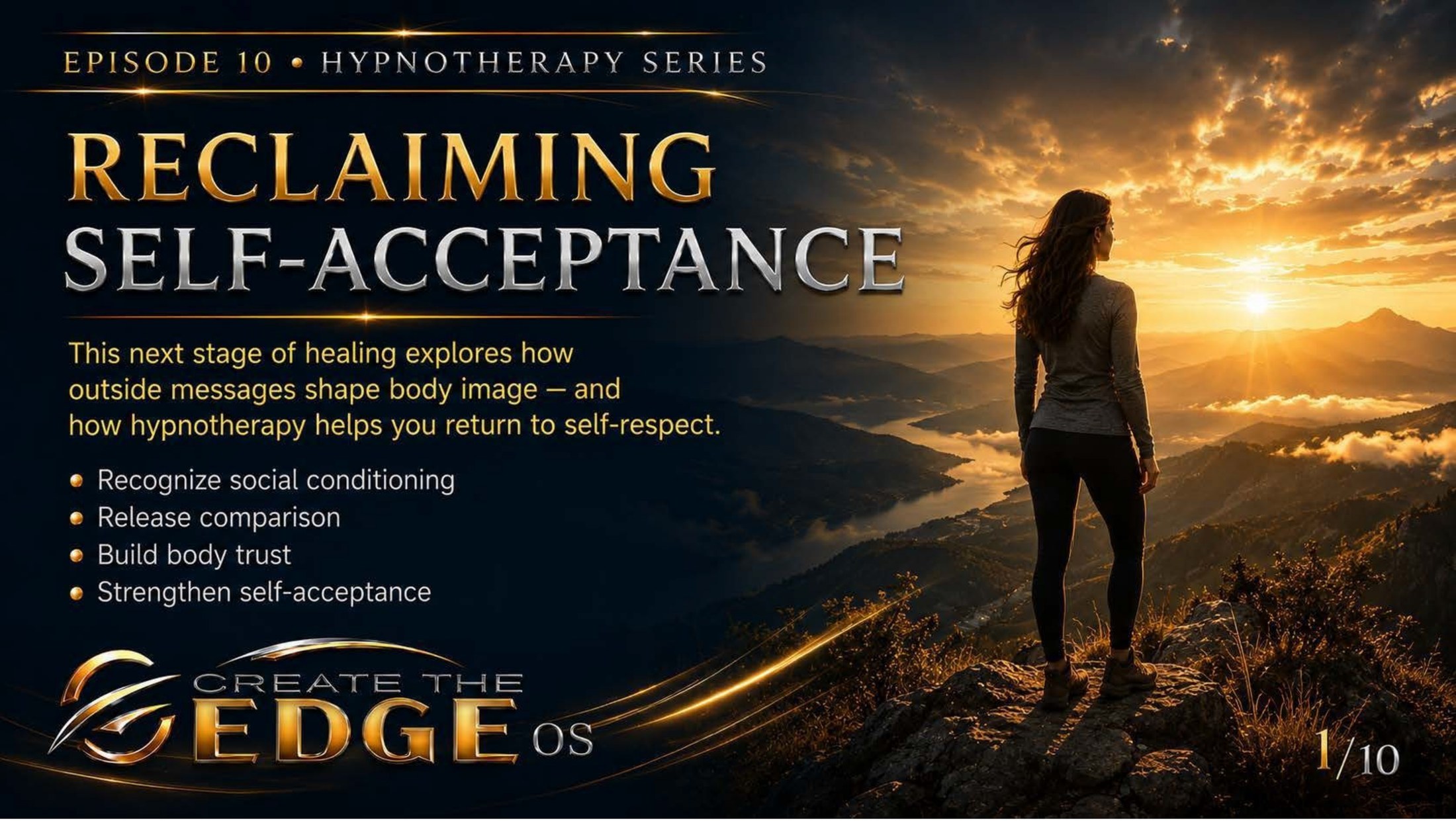
On the slideThis next stage of healing explores how outside messages shape body image — and how hypnotherapy helps you return to self-respect: recognize social conditioning · release comparison · build body trust · strengthen self-acceptance.
Episode 10 · Slide 1
Reclaiming Self-Acceptance
Episode 10 · Slide 1
Let me ask you something that might land harder than you expect: where did you first learn that there was something wrong with your body?
Sit with that, because I’d be willing to bet the answer isn’t “I figured it out myself.” Almost no one is born believing their body is a problem. A small child runs and jumps and eats and rests in a body she simply lives in, with no commentary, no shame, no measuring. And then… somewhere along the way, the messages start. A comment. A comparison. A magazine. A look. A thousand tiny lessons that this body — your good, faithful, only body — is somehow not enough. And you learned it. You weren’t born ashamed. You were taught.
Look at the woman in this image, standing on a mountaintop at sunrise, gazing out over a vast valley of clouds and light. She’s not measuring herself against anything up there. She’s simply present, in her body, in the dawn. That’s where this chapter leads — the slide calls it reclaiming self-acceptance.
Notice that word — reclaiming. Not building something foreign, not forcing a feeling you’ve never had. Reclaiming. Taking back something that was always rightfully yours and got taken from you, message by message, year by year. The self-acceptance you were born with, before the world taught you to doubt yourself. We’re going to go get it back.
Read the four steps on the slide: recognize social conditioning, release comparison, build body trust, strengthen self-acceptance. Notice the shape of the journey — first we recognize where the harsh messages came from (spoiler: not from you), then we release the comparison trap, then we rebuild trust with the body, and finally we strengthen the self-acceptance that was yours all along.
This is the capstone of all the body work we’ve done. In the last chapter we healed the mirror and met the future self. Here we go to the very source of the wound — the outside voices that wrote the cruel script in the first place — and we take the pen back. Because you cannot be free while living by standards that were handed to you by people who didn’t love you, sold to you by industries that profit from your insecurity, and absorbed by a younger you who didn’t know she had a choice.
You have a choice now. And this chapter is about making it. Take my hand. Let’s go reclaim what was always yours.
On the slideMany body-image struggles begin with outside messages — comparison, criticism, unrealistic standards, and pressure to fit: media and comparison · unrealistic ideals · pressure to be accepted · learned self-judgment.
Episode 10 · Slide 2
When Society Writes the Script
Episode 10 · Slide 2
Look closely at the image on this slide — a woman walking away from a swirling storm of magazine covers and screens, each one screaming a message: Perfect You. Timeless Beauty. Flawless. You should look like this. And as she walks toward the light, they shatter and fall away behind her. That image is the whole truth of where so much of our pain begins. The slide names it: when society writes the script.
Here’s something I need you to really understand, because it changes everything about how you carry your body-image struggle: most of the cruel things you believe about your body were not your original thoughts. They were scripts, handed to you from the outside. Look at the four sources the slide names.
Media and comparison. From the time you were small, you’ve been shown thousands upon thousands of images of bodies — curated, filtered, lit, posed, edited, often digitally altered beyond what’s even physically possible. And your mind, doing what minds do, compared. It held your real, three-dimensional, living body up against a flat, fake, impossible image — and concluded you fell short. But you were never comparing yourself to a real person. You were comparing yourself to an illusion designed to make you feel exactly that lack.
Unrealistic ideals. The “ideal” body you’ve been taught to chase isn’t just rare — it’s often literally impossible, or achievable only through measures that harm health and happiness. The goalpost was rigged from the start. It was never a standard you could meet, because it was never meant to be met. It was meant to keep you reaching, and buying, forever.
Pressure to be accepted. Underneath it all is one of the deepest human needs — to belong, to be accepted, to not be cast out. And the script weaponizes that need: look like this, or risk not being accepted. For a social creature, that pressure is enormous, and it bypasses logic entirely. It hooks the ancient part of us that knows being rejected from the tribe once meant danger.
Learned self-judgment. And here’s the cruelest part — over time, you internalized the outside voices until they became your own inner voice. The judgment that started outside moved inside, and now it runs automatically, and it feels like it’s simply you. But it was learned. Every bit of it was learned.
Do you feel the weight lifting, just from seeing this clearly? You did not invent the belief that your body is wrong. It was written for you, by a script you never auditioned for. And here is the liberating truth that follows: a script that was written by others can be rewritten by you. You are not stuck performing someone else’s cruel screenplay for the rest of your life. You can set it down. You can walk toward the light and let the covers shatter behind you, exactly like the woman in the image. The pen was always yours to take back.

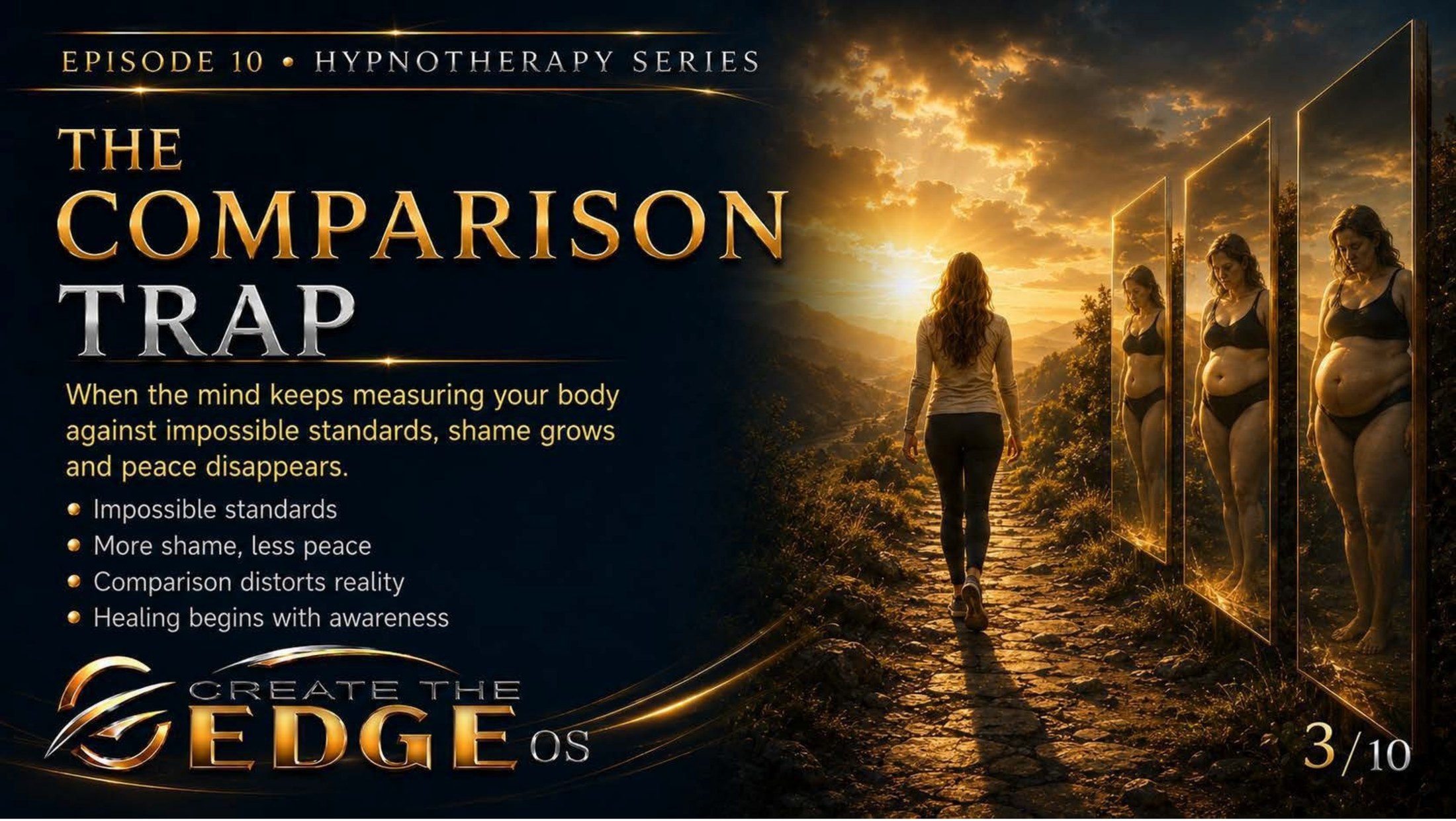
On the slideWhen the mind keeps measuring your body against impossible standards, shame grows and peace disappears: impossible standards · more shame, less peace · comparison distorts reality · healing begins with awareness.
Episode 10 · Slide 3
The Comparison Trap
Episode 10 · Slide 3
There is one particular mental habit that does more damage to self-acceptance than almost anything else, and this slide names it: the comparison trap. Look at the image — a woman walking a path toward the sunrise, while beside her stand mirrors showing distorted, warped reflections of her body. That’s comparison: it doesn’t show you the truth. It shows you a funhouse distortion. The slide says it plainly: when the mind keeps measuring your body against impossible standards, shame grows and peace disappears.
Comparison is a trap because it can never, ever be won — and it’s rigged so that you always lose. Let me show you the mechanics of it through the four truths on the slide.
Impossible standards. You’re measuring against standards that, as we just saw, were rigged to be unreachable. So no matter how you actually look, the comparison always comes back “not enough,” because the bar was set above where any real human could stand. You’re playing a game designed for you to lose, which means you could be objectively magnificent and still feel like you’re failing.
More shame, less peace. Every act of comparison deposits a little more shame and withdraws a little more peace. And it’s relentless — the mind in the comparison trap compares constantly, in every reflective surface, every photo, every room, every scroll. Drip by drip, it drains your peace and fills you with shame, all day, every day. No wonder you’re exhausted.
Comparison distorts reality. This is crucial — comparison literally warps how you see yourself, just like those funhouse mirrors. It magnifies every perceived flaw and erases every good thing. It compares your insides to everyone else’s outsides, your worst angle to their best filtered one, your whole messy reality to their curated highlight. The picture comparison paints of you is not real. It’s a distortion, every time.
Healing begins with awareness. And here is the doorway out, the same one we keep finding: healing begins with awareness. You can’t escape a trap you don’t know you’re in. So the first, powerful step is simply to catch the comparison as it happens — “ah, I’m comparing again, I’m looking in the funhouse mirror.” That awareness alone begins to break the spell, because the moment you see comparison for the rigged, distorting trap it is, it starts to lose its grip on you.
Here’s the freedom I want you to walk away with: you do not have to play. The comparison game is optional. No one can make you measure yourself against an illusion — only your own conditioned habit does that, and habits can be unlearned. Imagine moving through your day without the constant measuring, the constant ranking, the constant “not enough.” Imagine just… living in your body, like that child who ran and jumped and never once compared. That peace is reachable. It starts the moment you notice the trap and choose, gently, to step out of it.
On the slideHealing body image means recognizing which thoughts were inherited — and choosing a kinder truth: notice the inner critic · separate truth from conditioning · choose new language · create emotional safety.
Episode 10 · Slide 4
Unlearning the Outside Voice
Episode 10 · Slide 4
If the harsh voice was learned from the outside, then it can be unlearned — and that’s exactly what this slide is about. Look at the image: a woman at a mirror, and where her reflection used to show cruel words — not enough, too much, not pretty, not worthy, never good enough — she is wiping them away with her hand, and underneath, a gentler, smiling reflection emerges in golden light. The slide names the work: healing body image means recognizing which thoughts were inherited — and choosing a kinder truth.
I love that phrase — choosing a kinder truth. Because the cruel voice always presents itself as “just being realistic,” “just telling the truth.” But it was never truth. It was conditioning, wearing truth’s clothes. And you get to choose a kinder, and frankly more accurate, truth instead. Look at the four steps of unlearning.
Notice the inner critic. First, awareness again — catching the critic in the act. Most of us have lived with the harsh inner voice so long it’s become invisible, just the background narration of our lives. The first step is to make it visible: “there’s the critic. There’s that voice again.” You can’t question a voice you can’t hear.
Separate truth from conditioning. This is the heart of it. Once you can hear the critic, you can ask the liberating question: “is this actually true — or is this just something I was taught to believe?” That single question begins to peel the inherited conditioning away from any real truth. And you’ll find that almost all of the cruelty is conditioning — absorbed voices, old comparisons, scripts written by others. Naming it as conditioning robs it of its authority. It’s no longer “the truth about me.” It’s just “something I was taught, that I can now unlearn.”
Choose new language. Then you consciously choose kinder words — a new inner language to replace the old cruel one. Not delusion, but a truer, gentler way of speaking to yourself. Where the old voice said “not enough,” the new one says “I am worthy as I am.” Where it said “never good enough,” the new one says “I am growing, and I am already worthy of kindness.” You are literally wiping the old words off the mirror and writing new ones, like the woman in the image.
Create emotional safety. And underneath it all, we create safety — because the harsh voice often persists out of a misguided attempt to protect you (“if I criticize you first, maybe it’ll hurt less when others do”). When the deep self finally feels safe, it no longer needs the cruel armor, and the kinder voice can take root and stay.
Notice. Separate. Choose. Soften. This is how you unlearn a voice that was never yours to begin with. And here’s the beautiful thing — underneath all that inherited cruelty, there was always a kinder truth waiting, the one the smiling reflection shows when the harsh words are wiped away. That gentler truth isn’t something we invent. It’s something we uncover, once we clear away the conditioning that buried it. The kind reflection was there all along. We’re just wiping the mirror clean.

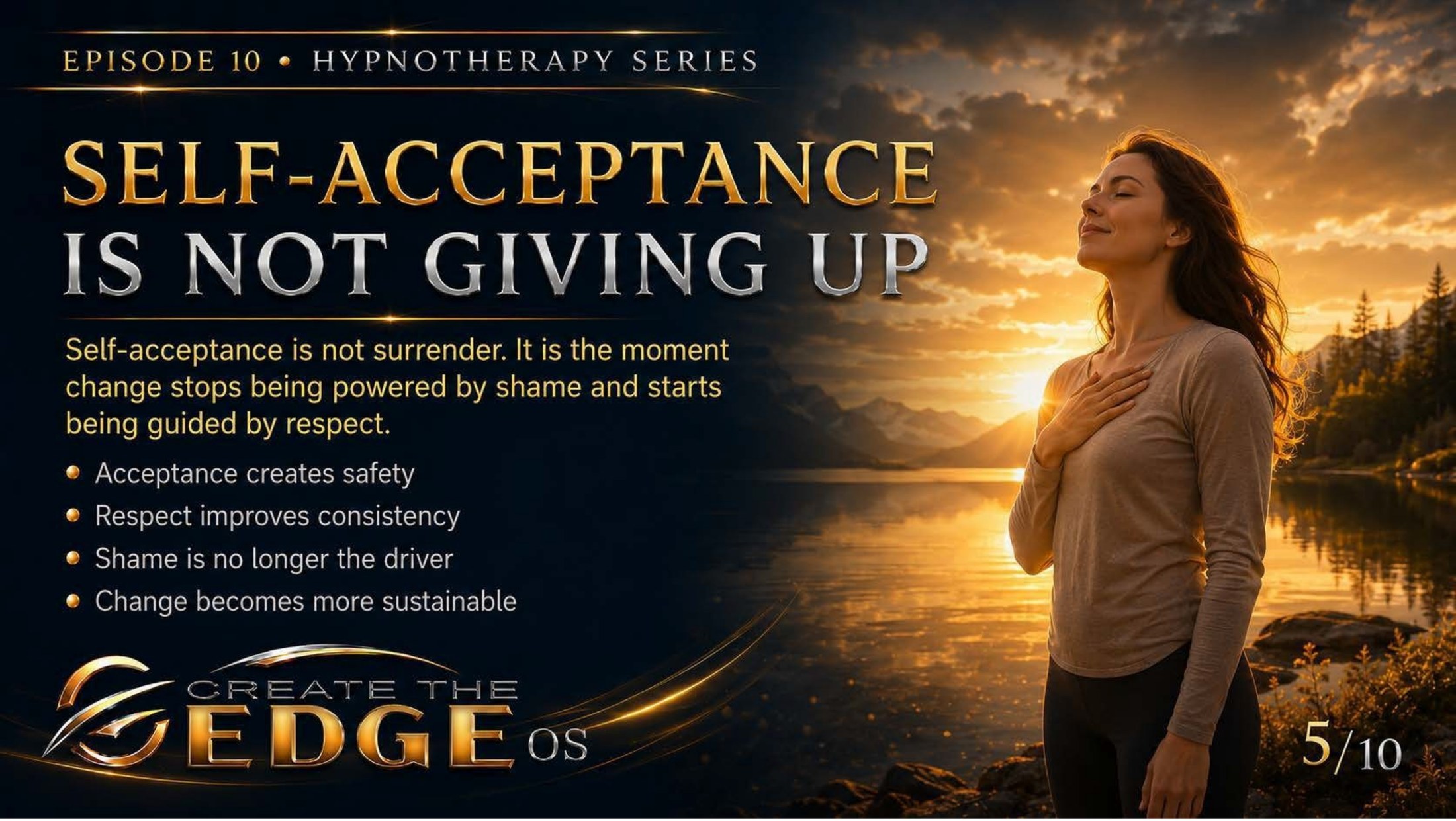
On the slideSelf-acceptance is not surrender. It is the moment change stops being powered by shame and starts being guided by respect: acceptance creates safety · respect improves consistency · shame is no longer the driver · change becomes more sustainable.
Episode 10 · Slide 5
Self-Acceptance Is Not Giving Up
Episode 10 · Slide 5
Now I have to clear up the single biggest fear people have about self-acceptance — the fear that keeps them clinging to self-criticism like it’s a virtue. Look at the woman in this image, hand on her heart, eyes closed, face lifted to the golden light over a still lake, utterly at peace. The slide names the misunderstanding and corrects it: self-acceptance is not giving up. It is not surrender. It is “the moment change stops being powered by shame and starts being guided by respect.”
Here’s the fear, spoken plainly, because I’ve heard it a hundred times and felt it myself: “If I accept myself as I am, won’t I just… let myself go? Won’t I lose all motivation? Isn’t my self-criticism the only thing keeping me from giving up entirely?” So many people hold onto their self-hatred because they’re terrified that without it, they’ll have no reason to change.
I understand that fear completely. And it is exactly backwards. Let me show you why, through the four truths on this slide.
Acceptance creates safety. When you accept yourself, your nervous system finally feels safe — and remember everything we’ve learned: the deep mind only allows real change when it feels safe. Self-rejection keeps the whole system in a state of threat, braced and defended, which is the worst possible ground for change. Acceptance creates the safety that change actually requires.
Respect improves consistency. You’ve seen this thread all along — we care consistently for what we respect, and neglect or punish what we despise. So self-respect doesn’t make you lazy; it makes you consistent, because you keep showing up for someone you value. Self-contempt is what makes change collapse, because no one keeps caring for something they hate.
Shame is no longer the driver. Here’s the engine swap. Shame is a terrible long-term fuel — it burns hot and fast, then leaves you depleted, ashamed, and reaching for comfort. Self-acceptance replaces shame with respect as the driver of change. And respect-fueled change doesn’t burn you out, because it isn’t burning you.
Change becomes more sustainable. And so, paradoxically, the thing you feared would end your progress is exactly what makes it last. Change guided by respect, built on safety, freed from shame — that’s sustainable change. The kind that holds. The kind self-criticism could never give you no matter how hard it lashed.
So please hear this, maybe the most important reframe in the whole book: self-acceptance is not the opposite of change. It is the foundation of lasting change. You don’t have to choose between accepting yourself and growing. The truth is you can only truly grow from a place of acceptance. Self-acceptance isn’t the white flag of surrender — it’s the solid ground you finally get to build on. You were never going to hate yourself into lasting change. But you can absolutely respect yourself into it. That’s not giving up. That’s growing up — into kindness.
On the slideHypnotherapy works with subconscious beliefs so the body can feel safer, the inner critic can soften, and self-respect can grow: relax and focus · reframe old beliefs · install kinder self-talk · reinforce self-respect.
Episode 10 · Slide 6
How Hypnotherapy Helps Body Image
Episode 10 · Slide 6
So how do we actually do this deep work of reclaiming self-acceptance — especially when the harsh beliefs are so old and automatic they feel like part of us? Look at the image: the calm session room, the attentive guide, the relaxed client, and the golden light of the mind opening like a flower beside her. The slide explains the method: hypnotherapy works with subconscious beliefs so the body can feel safer, the inner critic can soften, and self-respect can grow.
Here’s why this work needs to happen at the subconscious level rather than just the conscious one. You can decide, with your conscious mind, to accept yourself — and that’s a beautiful start. But if the deep mind is still running decades of inherited “not enough” conditioning underneath, the conscious decision keeps getting overridden. It’s like trying to redecorate a house while someone in the basement keeps tearing down your work. To truly change body image, we have to go to the basement — the subconscious — where the old beliefs actually live. Look at the four steps.
Relax and focus. First, that relaxed, focused state where the deep mind becomes accessible and receptive. The chattering, defended surface mind quiets, and we can finally reach the level where the body-image beliefs are stored. This is the doorway to the basement.
Reframe old beliefs. Then we gently reframe the inherited beliefs at their root. The “my body is wrong” that was installed by years of conditioning gets met, understood as conditioning rather than truth, and gently rewritten. We’re not arguing with the belief at the surface — we’re changing it where it actually lives.
Install kinder self-talk. In place of the old cruel narration, we install a kinder inner voice — planted deep enough to actually take hold and become your new automatic self-talk, rather than a surface affirmation the deep mind shrugs off. This is the new language, written in the basement where it counts.
Reinforce self-respect. And we reinforce self-respect again and again, until it becomes the deep mind’s new default — the steady ground that everything else grows from. Repetition makes it permanent, the way it makes any new pattern permanent.
Relax. Reframe. Install. Reinforce. Notice this is the same gentle architecture you’ve seen throughout this book, now aimed at the deepest target of all — how you fundamentally see and relate to yourself. And notice what it does, in the slide’s own beautiful words: the body feels safer, the inner critic softens, and self-respect grows. Not forced. Not faked. Genuinely shifted, at the level where it was wounded in the first place. This is how a lifetime of inherited self-judgment finally, gently, gives way to the self-acceptance that was always meant to be yours.

On the slideWhen self-talk becomes more compassionate, food choices, motivation, and body confidence often become easier to maintain: I can support myself · I do not need perfection · I can nourish my body · I can change with kindness.
Episode 10 · Slide 7
A Kinder Inner Dialogue
Episode 10 · Slide 7
Let’s talk about what the new inner dialogue actually sounds like — because this is where all the deep work shows up in your everyday, moment-to-moment experience of being alive. Look at the woman in the image, journaling peacefully by a window at golden hour, surrounded by gentle affirmations in the light: I am enough. I choose kindness. I trust my journey. I am growing. The slide tells you why this matters so practically: when self-talk becomes more compassionate, food choices, motivation, and body confidence often become easier to maintain.
Your inner dialogue is the most constant relationship in your life. You talk to yourself all day, every day, more than you talk to anyone else — and the tone of that endless conversation shapes everything. A cruel inner dialogue makes every day a quiet battle. A kind one makes every day a little more livable. Look at the four new statements on the slide, and feel the difference in each one.
“I can support myself.” Instead of being your own harshest critic, you become your own ally — the supportive voice in your corner. Imagine having a constant companion who believed in you, encouraged you, had your back. That companion can be your own inner voice.
“I do not need perfection.” This one releases the crushing weight so many of us carry. Perfection was always the impossible standard from the rigged script. Letting it go isn’t lowering your standards — it’s freeing yourself from a standard that was never real or kind to begin with. You get to be human. Gloriously, imperfectly human.
“I can nourish my body.” The shift from punishing the body to nourishing it, spoken in the first person, as a capability you own. Not “I must restrict” but “I can nourish” — care framed as ability and choice, not obligation and fear.
“I can change with kindness.” And the heart of this whole chapter, distilled into one sentence — the proof that change and kindness are not enemies. You can change, and you can do it with kindness rather than cruelty. In fact, as we’ve learned, kindness is the only way change truly lasts.
Support. Permission. Nourishment. Kindness. These are the new notes of your inner dialogue, and as they replace the old cruel ones, watch what happens — exactly what the slide promises. The food choices get easier, because they’re flowing from self-care instead of self-attack. The motivation gets steadier, because it’s fueled by respect instead of shame. The body confidence grows, because the voice in your head finally stopped tearing you down. A kinder inner dialogue isn’t a luxury or an indulgence. It’s the soil everything good grows in. And you get to choose, starting today, one kinder sentence at a time, what voice gets to narrate your life.

On the slideFood freedom deepens when nutrition is guided by care instead of fear, and when the body is treated as an ally rather than a problem: choose nourishment · release all-or-nothing thinking · build gentle structure · support the body kindly.
Episode 10 · Slide 8
Nourishment Without Punishment
Episode 10 · Slide 8
When self-acceptance grows, even the way you nourish yourself transforms — because how you feed your body flows directly from how you regard it. Look at the woman in the image, peacefully preparing fresh food in a sunlit kitchen, surrounded by color and abundance, completely at ease. The slide names the shift: food freedom deepens when nutrition is guided by care instead of fear, and when the body is treated as an ally rather than a problem.
Notice the two contrasts the slide draws, because they’re the whole transformation: care instead of fear, and ally rather than problem.
Think about how most dieting works — it’s driven by fear. Fear of gaining, fear of “bad” foods, fear of the scale, fear of losing control. And the body is treated as a problem to be solved, managed, fixed, subdued. But you cannot build a peaceful relationship with food on a foundation of fear, and you cannot lovingly nourish a body you’ve labeled a problem. Fear and problem-solving will always eventually collapse back into the old struggle.
Self-acceptance changes the entire foundation. When you accept and respect your body — when it becomes an ally you’re caring for rather than a problem you’re fighting — nourishment flows from care instead of fear. Look at the four gentle practices, the same ones that grow naturally from a place of acceptance.
Choose nourishment. You feed your ally well, because you want it to thrive — not because a rule forces you, but because care naturally wants to nourish. The choices come from love, not fear.
Release all-or-nothing thinking. The perfectionist trap dissolves in self-acceptance. When you’re not chasing an impossible standard, one imperfect choice is just a choice, not a failure. There’s no wagon to fall off of when you’re simply, kindly, caring for a body you accept.
Build gentle structure. A little supportive rhythm, offered as kindness rather than control — the gentle structure you’d build for someone you love and care for. Support, never a cage.
Support the body kindly. And the thread through it all — kindness, in place of the old fear and punishment. Treating the body as the ally it always was.
Nourish. Release. Gentle structure. Kindness. You’ll notice this echoes the nutrition wisdom from earlier chapters — and that’s the point. It keeps returning because it keeps being true, and because each time we reach it from a deeper place. Here we reach it from self-acceptance, which is the deepest ground of all. When you finally accept the body you live in, feeding it well stops being a fearful battle and becomes a natural, peaceful act of caring for someone you’ve made peace with: yourself.

On the slideProgress often sounds like less comparison, more calm, gentler choices, and growing trust in your relationship with your body: more awareness · less comparison · greater calm · growing self-trust.
Episode 10 · Slide 9
What Progress Feels Like
Episode 10 · Slide 9
Let’s talk again about how to recognize your progress — because in the work of self-acceptance, the progress is almost entirely internal, and if you don’t know how to feel it, you might miss the very transformation you’re living. Look at the woman in the image, walking a coastal path toward the sunrise, relaxed and free. The slide tells you what progress actually sounds and feels like: less comparison, more calm, gentler choices, and growing trust in your relationship with your body.
Notice the slide says progress “sounds like” — because so much of this progress happens in the quiet of your own inner experience, in the changing texture of your daily life. Look at the four signs, and learn to recognize them as the victories they truly are.
More awareness. You start catching things in real time — the comparison as it begins, the harsh voice as it speaks, the inherited script as it tries to run. This awareness is itself the progress, because everything changes the moment you can see clearly. You’re no longer unconsciously living the old script; you’re consciously noticing it, which means you can choose differently.
Less comparison. The comparison trap loosens its grip. You catch yourself measuring against the funhouse mirrors less often, and when you do notice it, you can step out of it more easily. The constant ranking and measuring that drained your peace begins, gradually, to quiet. Imagine how much lighter a day feels with less of that.
Greater calm. A growing peace around your body and yourself — the absence of the old constant tension, the cruel mirror-voice, the relentless self-judgment. This calm is profound progress, because so much of the old struggle was pure inner war, and the war is winding down.
Growing self-trust. And the deepest marker — trust in your relationship with your own body. Trust in your worth, your wisdom, your right to take up space exactly as you are. The self-trust that the outside script spent years destroying, slowly, beautifully rebuilding from the inside.
More awareness. Less comparison. Greater calm. Growing trust. Not one of these will show up as a number on any scale — and yet every one of them is the real reclamation of your self-acceptance, happening in the only place it ever truly mattered: inside you. So measure your progress here. Celebrate the comparison you caught and stepped out of. The kinder thought that surprised you. The moment of calm in front of the mirror. The flicker of trust in yourself. These quiet internal shifts are the homecoming. They are you, reclaiming what was always yours. Honor every one of them — they are the sound of a self finally coming home.

On the slideYou do not have to choose between weight loss, nutrition, and body-image healing. This work can help all three move forward together: continue the work · reinforce compassion · practice between sessions · let healing become natural.
Episode 10 · Slide 10
Your Next Chapter of Self-Acceptance
Episode 10 · Slide 10
Look at this final image — a great wooden door standing open in a stone wall, golden light pouring through, a flagstone path winding out through a flowering garden toward the sunrise. This is your next chapter of self-acceptance, and it opens onto something beautiful. But before we walk the four steps in the workbook below, let the slide’s opening promise settle into you, because it heals that false choice one final time: “You do not have to choose between weight loss, nutrition, and body-image healing. This work can help all three move forward together.”
You were never meant to pick between caring for your body and accepting it, between changing and loving yourself. That was always a false and cruel choice. They move forward together — the self-acceptance makes the care sustainable, the released comparison makes the change possible, the self-respect makes everything last. One healing, not three competing ones. Now, the four steps forward.
One: Continue the work. Reclaiming self-acceptance after a lifetime of conditioning isn’t a single moment — it’s a practice you continue, gently, over time. Each day you choose the kinder truth, you reclaim a little more of what was yours. Continuation is the practice.
Two: Reinforce compassion. The kinder inner dialogue, the self-respect, the gentleness toward your body — these grow stronger every time you reinforce them. Like any new pattern, compassion becomes the well-worn, natural path the more you walk it, while the old cruelty grows over.
Three: Practice between sessions. The real reclaiming happens in your daily life — catching the comparison and stepping out, answering the harsh voice with a kinder truth, treating your body with respect in ordinary moments. The simple practices, used between sessions, are where the new self-acceptance takes root and holds.
Four: Let healing become natural. And gradually — this is the loveliest part — self-acceptance stops being something you have to work at and becomes simply how you are. The kindness becomes natural. The peace becomes your baseline. You return, at last, to that child who simply lived in her body without the cruel commentary — only now you’ve chosen it, consciously, and reclaimed it as your own.
Continue. Reinforce. Practice. Soften. And on the days the old script tries to run again — because it still will, conditioning runs deep — remember the words that have walked us through every chapter: we don’t fail, we fall forward. A day lost to comparison or the harsh voice isn’t a failure; it’s just the old script showing up, and tomorrow you get to choose the kinder truth again. You don’t start over. You continue reclaiming.
And friend — I have walked this exact path, from a self I measured against impossible standards and a mirror I dreaded, all the way home to a self-acceptance I genuinely didn’t believe was possible for me. I stopped performing a script that was never mine, and took the pen back. If I reclaimed what was mine, so can you — because it was always yours to begin with. So let’s take the next step right now, in your own handwriting below. The door is open. The garden is in bloom. The light is golden and warm. And I’m right here beside you, walking home together — to the self-acceptance that was always, always yours.