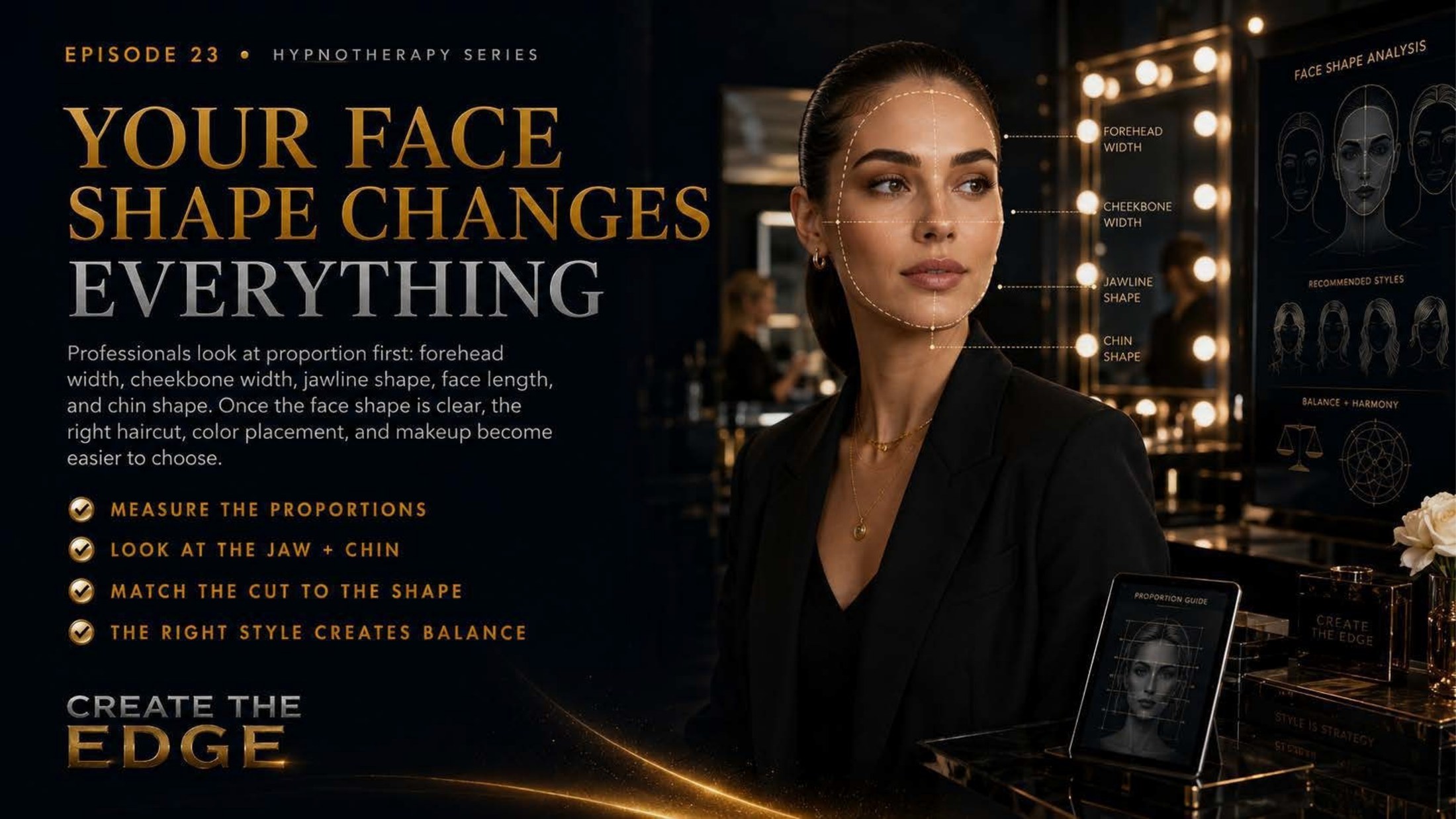
On the slideMeasure the proportions · Look at the jaw and chin · Match the cut to the shape · The right style creates balance
Episode 23 · Slide 1
Your Face Shape Changes Everything
Look at her — standing at a professional station, face mapped with precise dotted lines: forehead width, cheekbone width, jawline shape, chin shape. On the wall: Face Shape Analysis. Recommended Styles. Balance and Harmony. This is not guesswork. This is a discipline.
I want to talk to you about something I have spent more than thirty years doing every single day — reading a face. Not the way a stranger reads a face, making quick judgments about mood or trustworthiness. The way a professional reads a face: as a structure, a set of proportions, a geometry that has its own logic and its own requirements.
Before a professional chooses a cut or a color or a makeup technique, they study five things: forehead width, cheekbone width, jawline shape, face length, and chin shape. The widest area of the face and the overall silhouette — is the face longer than it is wide, or wider than it is long, does the jaw taper or hold square — these measurements reveal which of six categories the face belongs to: oval, round, square, heart, oblong, or diamond.
Once the face shape is clear, everything that follows becomes intentional rather than random. The right haircut, the right color placement, the right makeup technique — all of it is selected to work *with* the face's natural architecture. To create visual balance. To allow the features that are most beautiful to lead.
Measure the proportions. Look at the jaw and chin. Match the cut to the shape. This is not about changing the face. It is about understanding it well enough to let it be its most harmonious, most expressive, most itself.
In this episode I am going to walk you through each face shape and what it asks for — drawing on everything I have learned in three decades behind the chair. This is the knowledge I have given clients who changed careers, started over, stepped into new chapters of their lives. It is the knowledge that can give you that same edge.
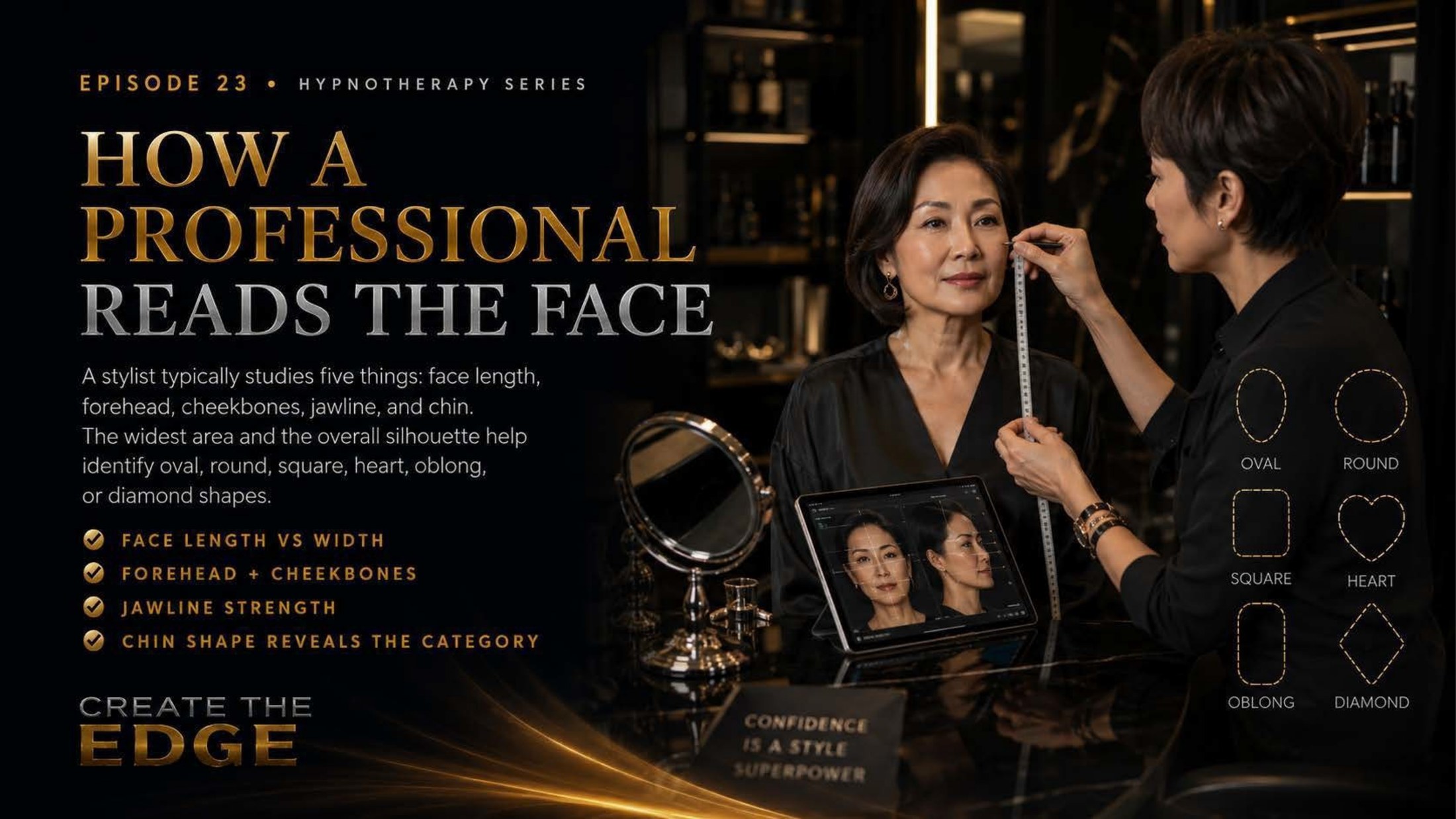
On the slideFace length vs width · Forehead and cheekbones · Jawline strength · Chin shape reveals the category
Episode 23 · Slide 2
How a Professional Reads the Face
Look at her — a stylist with a measuring tape, reading the face of a seated client with the focused attention of someone who has done this thousands of times. On the tablet: analysis of three faces from different angles. On the desk: a sign that reads *Confidence is a style superpower.* To the right: six face shape diagrams — Oval, Round, Square, Heart, Oblong, Diamond.
A stylist typically studies five things. Face length versus width — is the face notably longer, notably wider, or roughly balanced? Forehead — is it broad, narrow, or proportionate to the cheekbones and jaw? Cheekbones — are they the widest point of the face, or is that distinction held by the forehead or jaw? Jawline — is it strong and angular, soft and rounded, or tapered toward a point? Chin — round, squared, pointed?
Face length versus width is usually the first read. An oval face is slightly longer than wide. A round face is roughly equal in all directions with soft curves. A square face has similar width through forehead, cheekbones, and jaw — with a strong, angular jawline. A heart face is widest at the forehead and narrows dramatically toward the chin. An oblong face is noticeably longer than wide with a straighter silhouette. A diamond face is widest at the cheekbones and narrows at both forehead and jaw.
Jawline strength reveals the category in the most useful ways. The strong jaw — square or slightly angular — tells the stylist to soften. The soft, rounded jaw tells the stylist to elongate. The tapered jaw of the heart shape tells the stylist to balance. The narrow jaw of the diamond shape tells the stylist to frame and add width strategically.
Chin shape is often the final confirmation. A rounded chin softens. A pointed chin concentrates. A squared chin holds structure. Knowing which one you are looking at tells the professional exactly where the eye will land naturally — and where it needs to be guided instead.
This is not criticism of any face. This is reading the terrain so the styling can work with it rather than against it. Every face shape has its gifts. The professional's job is to understand them well enough to bring them forward.

On the slideBalanced forehead and jaw · Most cuts can work · Soft volume looks natural · Too much height can over-lengthen
Episode 23 · Slide 3
Oval Face: The Most Flexible Canvas
Look at her — dark waves falling in long, soft layers past her collarbone, the face framed beautifully. To the right: three example styles — long soft waves that add movement, a collarbone-length lob that keeps the oval in harmony, a polished pixie that showcases the face's natural symmetry. At the bottom: the caution, excessive top height that over-elongates.
Oval faces are slightly longer than they are wide, with balanced proportions and a softly rounded jaw. This is often described as the most versatile face shape — and in the salon, that description is accurate. Most cuts work beautifully on an oval face because the proportions are already balanced. The stylist's primary job is not to correct anything, but to enhance what is already harmonious.
Long soft waves are magnificent on the oval face because they add movement and maintain the face's natural balance. The wave creates visual rhythm without disrupting proportion. A collarbone-length lob — that iconic length that lands right at or just above the shoulder — frames the face beautifully and keeps the oval silhouette in harmony. The polished pixie is perhaps the most revealing choice for the oval face, because it removes all the hair from around the features and relies entirely on facial symmetry. It is a bold choice. It works because the oval face can support it.
The one caution: too much height at the crown can over-lengthen an already long face. Volume and movement at the sides serve the oval better than height that adds more length to the face's longer dimension.
If you have an oval face, the world is largely your canvas. The question becomes less *what can I wear* and more *what do I want to express?* Which takes us right back to style personality — your face shape supports the full range. Your identity gets the deciding vote.
Soft volume looks natural. The oval face does not need to work against its own proportions. It simply needs to play.
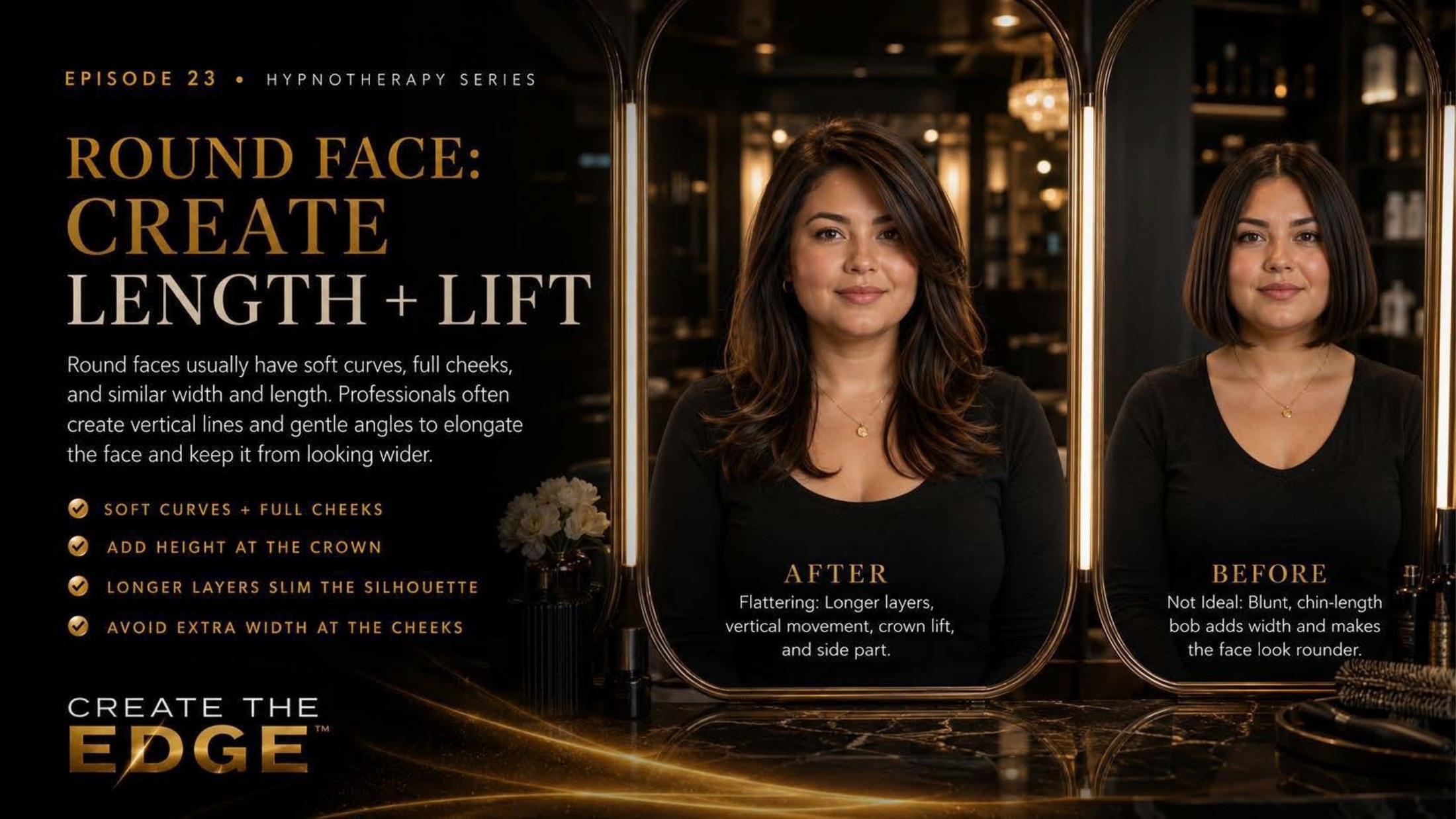
On the slideSoft curves and full cheeks · Add height at the crown · Longer layers slim the silhouette · Avoid extra width at the cheeks
Episode 23 · Slide 4
Round Face: Create Length and Lift
Look at the two mirrors — on the left, the after: longer layers with vertical movement, a crown lift, a side part. On the right, the before: a blunt chin-length bob that adds width and emphasizes the roundness. Same person. Profoundly different story told.
Round faces usually have soft curves, full cheeks, and similar width and length. There is a gentleness to the round face that is inherently beautiful — a youthful softness that many people seek to recreate. The styling goal is not to eliminate that softness but to introduce *direction*: vertical lines and gentle angles that elongate the face and keep it from reading as flat or wide.
Adding height at the crown creates an upward pull that visually lengthens the face. A slight lift at the roots — whether through blow-drying technique, a light mousse, or strategic layering at the crown — changes the proportions immediately. Longer layers that fall past the chin slim the silhouette because length draws the eye downward, creating that sense of elongation.
The side part is a quiet but powerful tool for the round face. A center part divides the face symmetrically, which can emphasize width. A side part creates visual diagonal — an angled line that the eye follows, which breaks up the circular quality of the face shape and introduces asymmetry that reads as more dynamic.
What to avoid: extra width at the cheeks. Cuts that add volume at the widest point of the face — blunt bobs that end at the jaw, full curls that expand outward at cheek level — emphasize the roundness rather than balancing it. The goal is vertical movement that lifts rather than horizontal expansion that widens.
Longer layers. Crown height. Side part. These three tools, working together, can completely transform how the round face reads in a mirror.
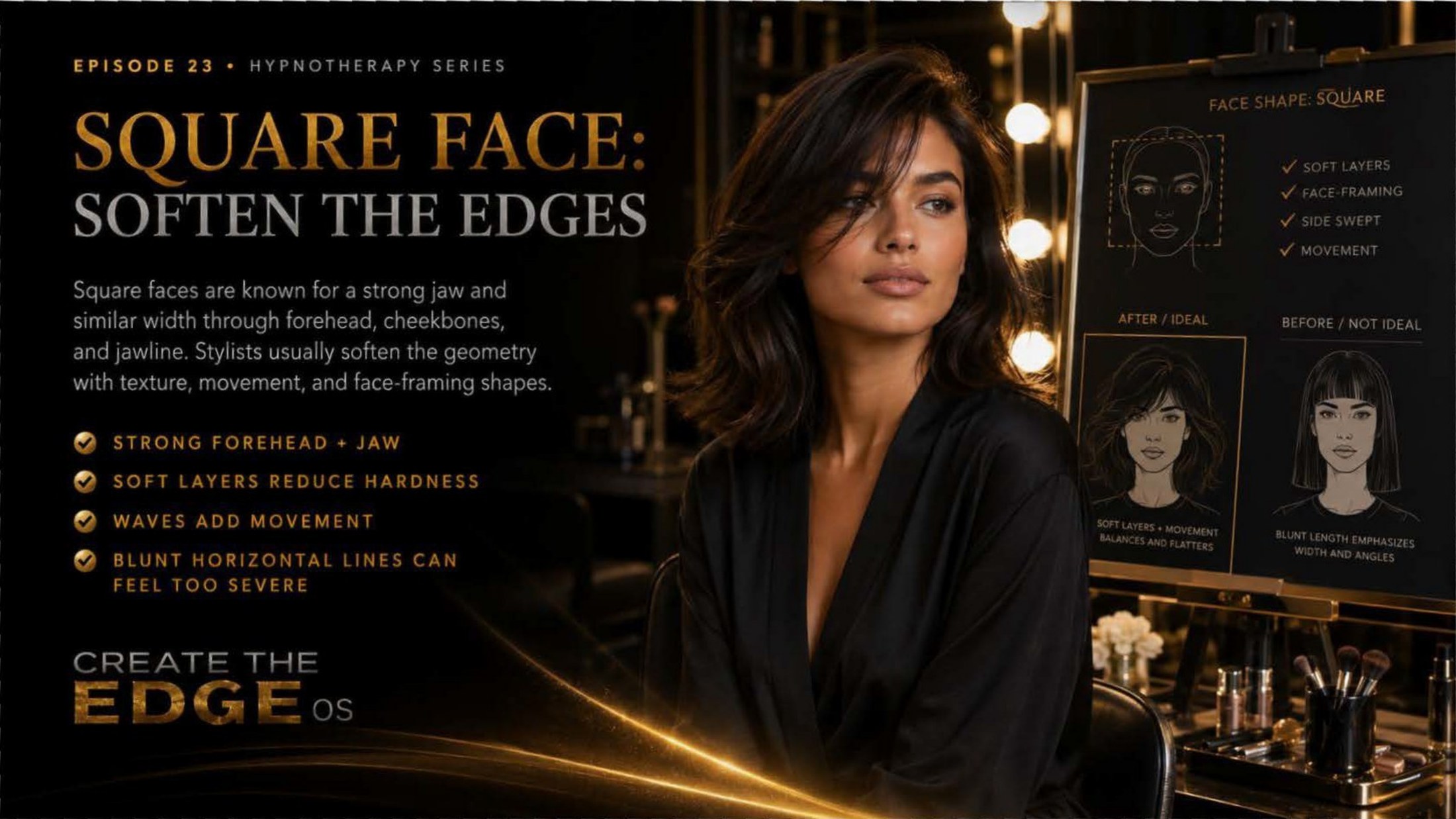
On the slideStrong forehead and jaw · Soft layers reduce hardness · Waves add movement · Blunt horizontal lines can feel too severe
Episode 23 · Slide 5
Square Face: Soften the Edges
Look at her — dark hair with side-swept texture and soft waves, the jawline framed rather than emphasized. To the right: a diagram showing the square face shape with recommendations: soft layers, face-framing movement, side-swept elements. Below: the contrast — blunt length that emphasizes width versus soft layers and movement that balance and flatter.
Square faces are known for a strong jaw and similar width through forehead, cheekbones, and jawline. This is a face shape with genuine power — it reads as decisive, structured, authoritative. I have always told clients with square faces that they have a face that photographs with presence and holds attention in a room. The styling job is not to diminish that strength, but to soften its geometry so that the face reads as both strong *and* approachable.
Soft layers are the primary tool. They break up the angular silhouette and introduce movement that softens the overall impression. Layers that fall across the jaw — especially face-framing pieces that curve inward — draw the eye away from the angular corners and toward the center of the face instead. Side-swept elements work in the same direction: diagonal movement that counters the horizontal strength of the jawline.
Waves add movement and movement is the antidote to hardness. A square face with texture and wave reads very differently from the same face with a blunt, flat shape. The wave introduces organic softness — the eye follows the curve rather than the angle, and the overall impression shifts from severe to sophisticated.
What to avoid: blunt horizontal lines. A one-length cut that ends exactly at the jawline creates a visual parallel to the jaw's strongest angles and doubles the emphasis. Similarly, heavy, straight-across bangs can add a second horizontal line that reinforces the square geometry rather than softening it.
Soften the edges without eliminating the strength. The square face does not need to become round. It needs the kind of styling that reveals its natural authority without making the room feel it has to brace itself.
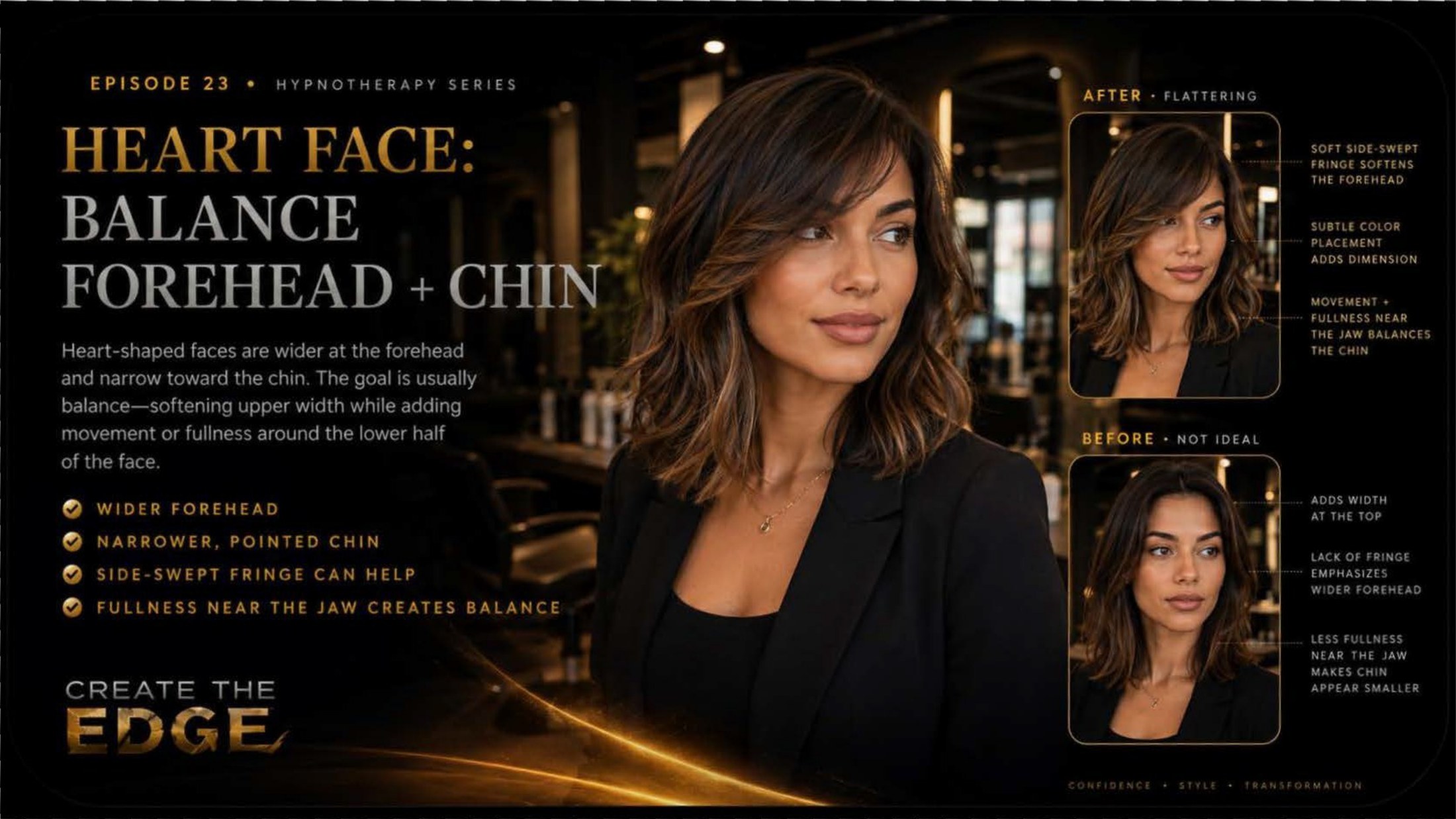
On the slideWider forehead · Narrower pointed chin · Side-swept fringe can help · Fullness near the jaw creates balance
Episode 23 · Slide 6
Heart Face: Balance Forehead and Chin
Look at her — a soft lob with movement and subtle color dimension, the jaw area carrying gentle fullness that creates balance with the broader forehead. To the right: the after shows how soft side-swept fringe softens the forehead, movement near the jaw balances the chin. The before shows the problem: no fringe leaves the forehead to dominate, and absence of jaw fullness makes the chin appear even more pointed.
Heart-shaped faces are wider at the forehead and narrow dramatically toward the chin. This face shape often carries extraordinary cheekbones — that widening through the upper face usually means beautiful, prominent bone structure. The goal of styling is balance: softening the upper width while adding movement or fullness around the lower half of the face.
Side-swept fringe is one of the most effective tools for the heart face. A soft, diagonal fringe that sweeps across the forehead — rather than a straight, full bang that simply covers it — softens the forehead's visual width and introduces movement that draws the eye downward. The diagonal is doing the work: it creates a visual path away from width and toward the center of the face.
Fullness near the jaw creates the balance the heart face needs. A lob or medium-length cut with movement that flows outward slightly at the jaw area adds visual weight at the narrowest point of the face, balancing the forehead. Subtle color placement — dimension near the jaw that catches light and draws the eye — adds the same effect through color rather than cut alone.
What tends to not work: cuts or styles that add volume at the top while leaving the jaw area flat and close to the face. This reinforces the triangular proportion rather than correcting it. The classic updo that pulls all the hair back and up can also emphasize the forehead's width without balancing the lower face.
Balance forehead and chin. Add where you need it, soften where it already has it. The heart face, styled with that principle, becomes one of the most photogenic and striking of all the shapes.
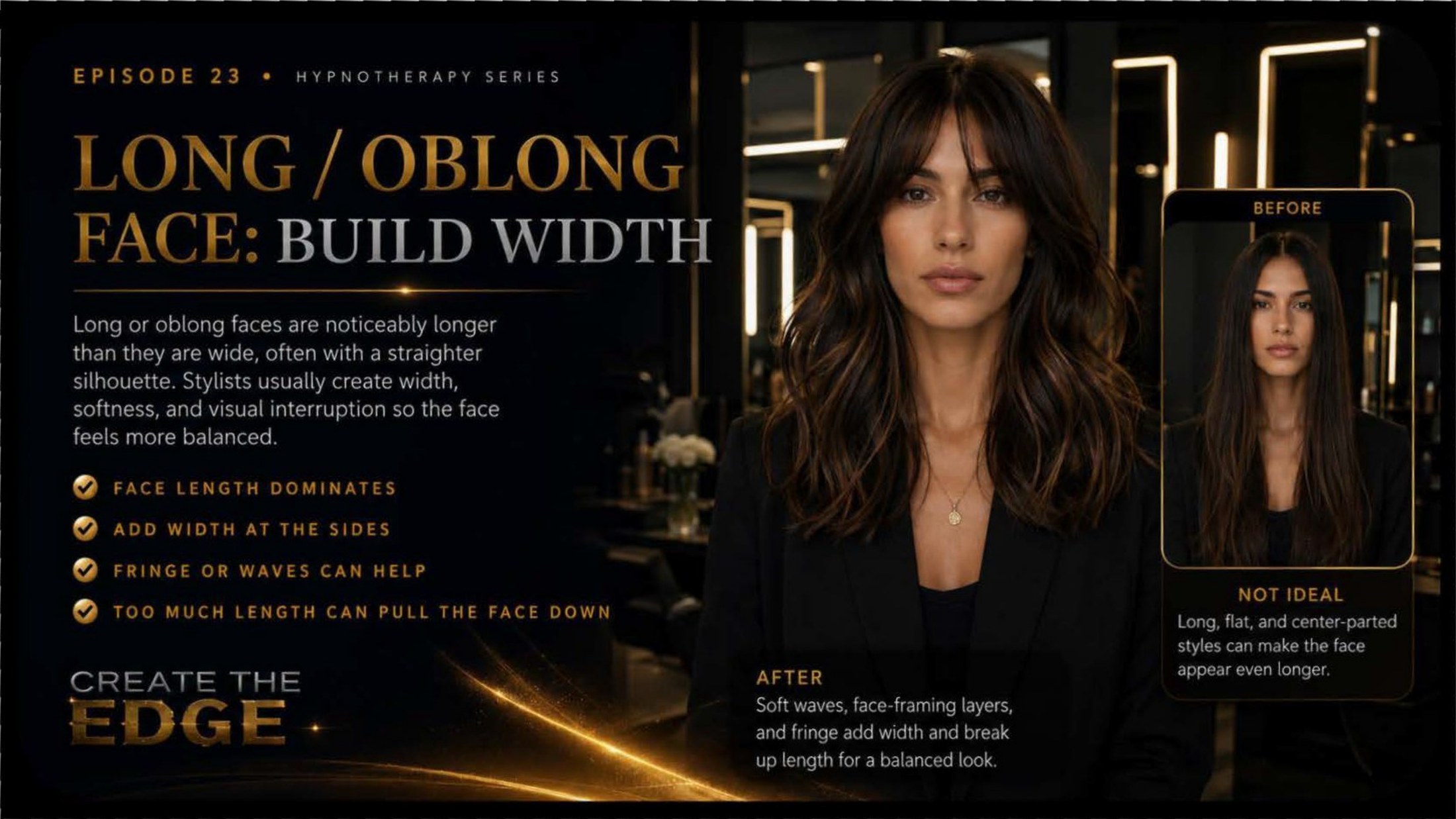
On the slideFace length dominates · Add width at the sides · Fringe or waves can help · Too much length can pull the face down
Episode 23 · Slide 7
Long / Oblong Face: Build Width
Look at her — dark hair with soft waves, face-framing layers, and fringe that adds width and breaks the length. To the right: the before shows the problem — long, flat, center-parted hair that follows the face's vertical line and makes it appear even longer. The after shows the correction: soft waves, face-framing layers, and fringe that add width and create visual interruption.
Long or oblong faces are noticeably longer than they are wide, often with a straighter silhouette through the sides of the face. There is an elegance to the oblong face — it tends to hold length beautifully and photographs with a certain refinement. The styling job is to create visual width, softness, and interruption so the face feels more balanced rather than stretched.
Fringe is the oblong face's most powerful tool. A fringe — whether full, side-swept, or curtain-style — creates a horizontal line across the face that visually shortens the length and adds width at the same time. It divides the face into sections, which makes each section feel more proportionate. Even a soft, wispy fringe that barely grazes the eyebrows accomplishes this.
Waves and texture at the sides build width. When hair has volume and movement that falls outward rather than straight down, it adds visual mass at the sides of the face — exactly where the oblong face needs it. A style with side volume and movement reads as considerably wider than the same style falling flat and close to the head.
Too much length can pull the face down further. Long hair that falls past the shoulders and lies flat against the sides of the face tends to extend the vertical line rather than interrupt it. This does not mean long hair is not possible — it means long hair on the oblong face works best with layers and movement that create width rather than emphasizing length.
Create visual interruption. Add width. Let the fringe break up the journey the eye makes from forehead to chin. The oblong face is already elegant — styling gives it the balance to feel complete.
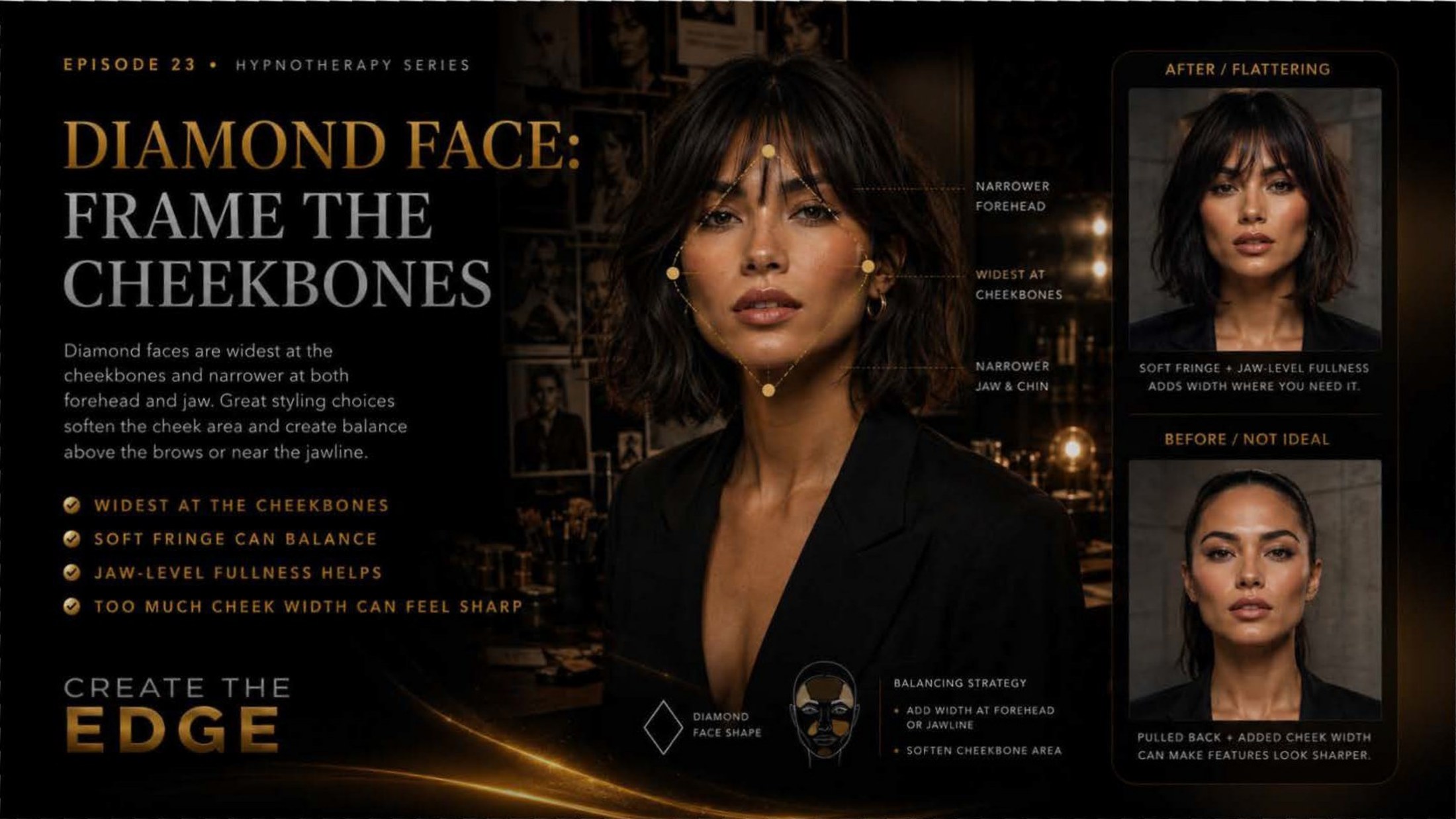
On the slideWidest at the cheekbones · Soft fringe can balance · Jaw-level fullness helps · Too much cheek width can feel sharp
Episode 23 · Slide 8
Diamond Face: Frame the Cheekbones
Look at her — striking cheekbones mapped with precision, fringe and jaw-level fullness balancing the diamond's dramatic width. To the right: the after shows how a soft fringe and jaw-level fullness adds width where it is needed above the brows and near the jawline. The before shows the problem: hair pulled back and volume added at the cheek area makes the prominent cheekbones appear even sharper.
Diamond faces are widest at the cheekbones and narrower at both the forehead and the jaw. This is a face shape with genuine drama — those prominent, wide cheekbones are among the most sought-after features in photography and film. The styling goal is to balance the width of the cheekbones by adding volume and frame above and below, so the cheekbones lead rather than dominate.
Adding width at the forehead is the first strategy. A soft fringe — particularly a curtain fringe that parts in the center and falls gently to either side — adds visual mass at the forehead, creating more balance between the narrow top and the wide middle of the face. Side-swept fringe can accomplish the same thing with a slightly different aesthetic.
Jaw-level fullness is the second strategy. A cut or style that allows hair to fall with slight volume and movement at the jaw area adds visual weight at the narrower lower face, creating balance with the prominent cheekbones from below. A lob with soft movement at the ends accomplishes this beautifully — the slight outward curve at jaw level creates the visual width that the face shape needs.
What tends to pull back and add volume at the cheekbones — sleek hairstyles that are tight to the face above the ears and then suddenly expand at the cheek — amplifies the already-wide cheekbone area rather than framing it. The goal is balance above and below, so the cheekbones sit within a harmonious proportion rather than jutting out from a narrower frame.
Frame the cheekbones. Add where the face is narrower. The diamond face, balanced, is one of the most remarkable of all the shapes — all that drama, held in proportion.
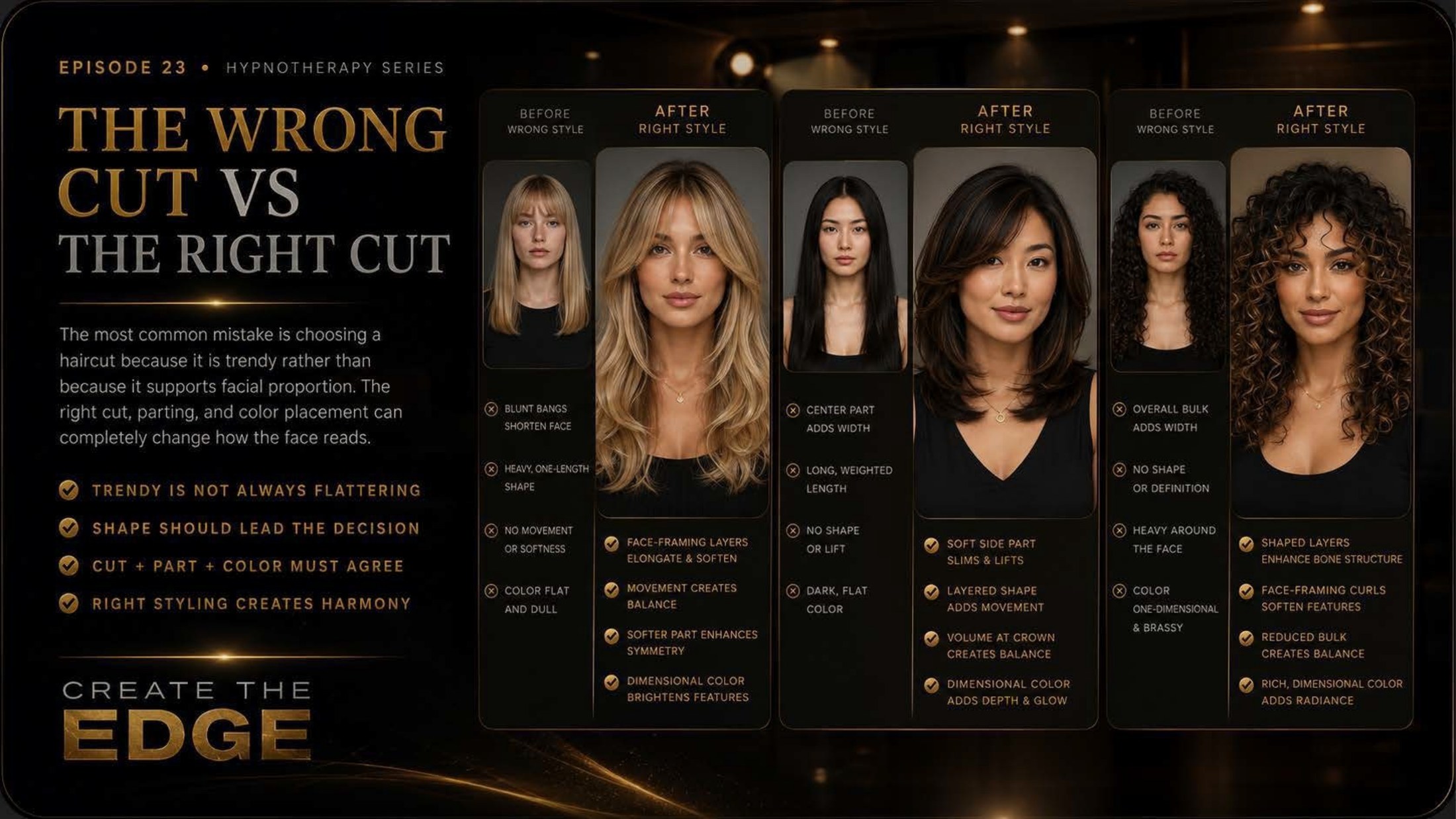
On the slideTrendy is not always flattering · Shape should lead the decision · Cut, part, and color must agree · Right styling creates harmony
Episode 23 · Slide 9
The Wrong Cut vs The Right Cut
Look at this comparison chart — three people, each shown before and after: a blonde with face-framing layers replacing blunt heavy bangs; an Asian woman with a layered side-part replacing a flat center-parted long style; a woman with curly hair where shaped layers and dimensional color replace an undefined, bulk-heavy shape. Each before has a clear problem. Each after has a clear solution. The principle is the same in every case.
The most common mistake I see is choosing a haircut because it is trending rather than because it supports the face's natural proportion. Trends have their place — they introduce new ideas, new techniques, new possibilities. But a trend worn on a face it does not serve is just a beautiful shape in the wrong location.
Look at the blonde. Blunt, heavy bangs across a forehead that is already the widest point of the face add a thick horizontal line that shortens the face and emphasizes width. The one-length shape adds no movement and the flat color adds no dimension. The after: face-framing layers that elongate and soften, a softer part that enhances symmetry, dimensional color that brightens the features. The same face. Completely different presence.
The center part on the oblong face draws the eye straight down. It follows the face's longest line and amplifies it. A soft side part and layered shape that adds movement and volume at the sides interrupt that vertical pull and create width. The color shift from flat and dark to dimensional adds glow and depth that makes the face look illuminated from within.
Cut, part, and color must agree. This is the principle that professionals work with and that most people never hear articulated. The cut creates the shape. The part determines the direction. The color places the light and shadow. When all three work in the same direction — when they are all telling the same story about the face — the result feels effortless, inevitable, right. When even one is working against the others, the whole system is fighting itself.
Right styling creates harmony. And harmony is what makes someone look, in the best way, unmistakably like themselves.
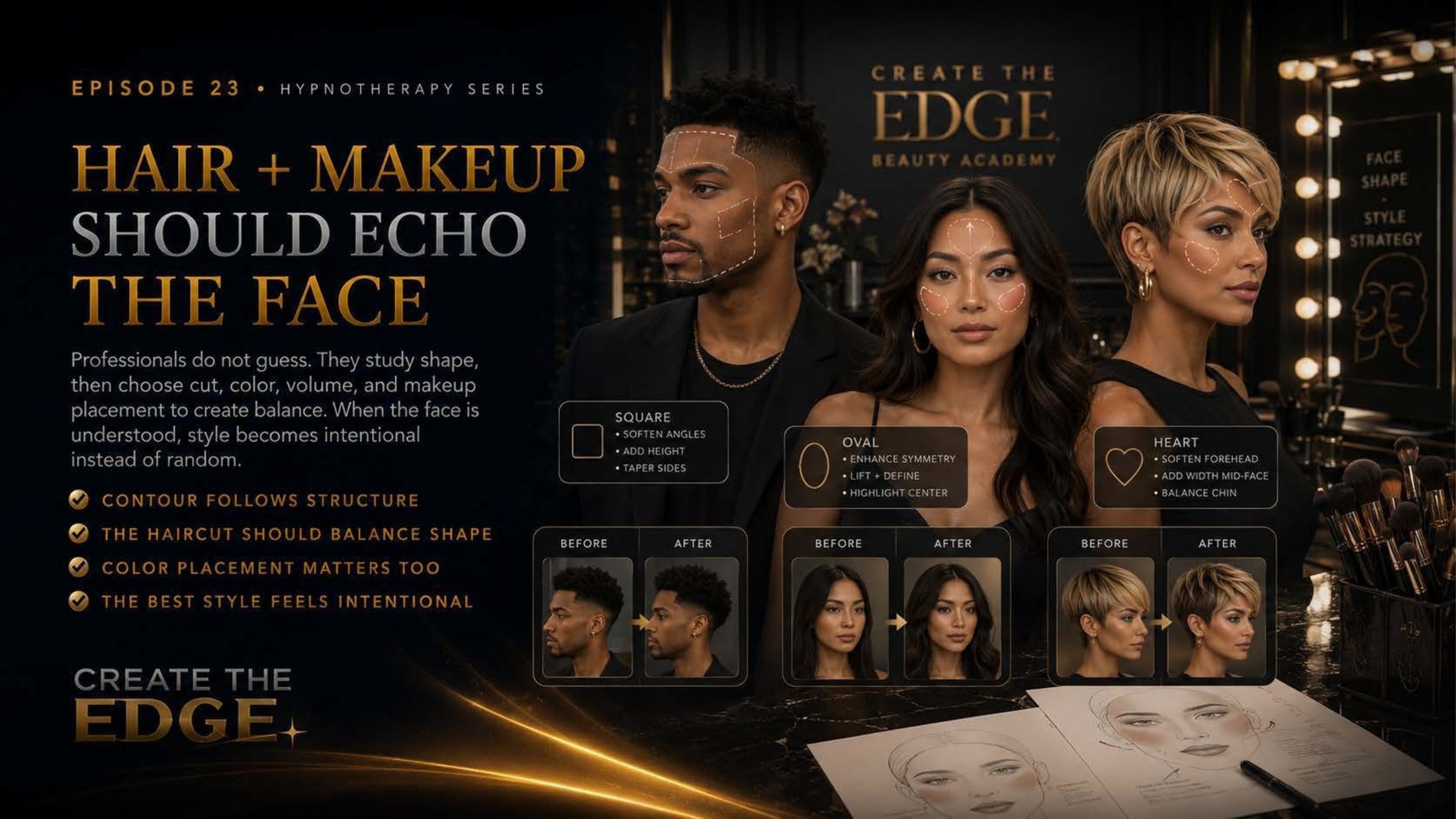
On the slideContour follows structure · The haircut should balance shape · Color placement matters too · The best style feels intentional
Episode 23 · Slide 10
Hair and Makeup Should Echo the Face
Look at this — three people, three face shapes, each with the structural lines of the face mapped and a side-by-side before and after. On the wall: the Create The Edge Beauty Academy. Face Shape. Style Strategy. Professionals do not guess. They study shape, then choose cut, color, volume, and makeup placement to create balance.
This is the principle I want to leave with you from this episode: professionals do not guess. Not the great ones. They study the structure of the face the way an architect studies a building — not to judge it, but to understand it well enough to work with it rather than against it. When you understand the face's natural geometry, every decision that follows — cut, color, contour, highlight — becomes intentional rather than random.
Contour follows structure. In makeup, this means using light and shadow to emphasize what the face already has while visually balancing what it needs. For a square face: light placement at the center of the forehead and chin to draw the eye inward, shadow at the corners of the jaw to soften the angles. For an oblong face: horizontal highlight across the cheekbones to add width, fringe or lighter products across the forehead to shorten length. For a heart face: light at the jaw to add visual weight, softer treatment at the forehead to reduce emphasis.
The haircut should balance the face shape. The color should serve the cut. Both should serve the face. When all three elements work in concert — when the stylist has read the face with the same care that a skilled musician reads a piece before playing it — the result is something that feels both considered and effortless. The client looks like herself, only clearer. Only more.
The best style feels intentional. Not styled to death. Not overdone. Intentional — every choice made with awareness of the face's unique architecture, every element selected to serve the whole. That is the difference between a good haircut and a transformative one. And it begins before the scissors move, in the careful, respectful reading of the face in front of you.
I have spent thirty years learning to read faces. Every face has taught me something. Yours will too. — Misty