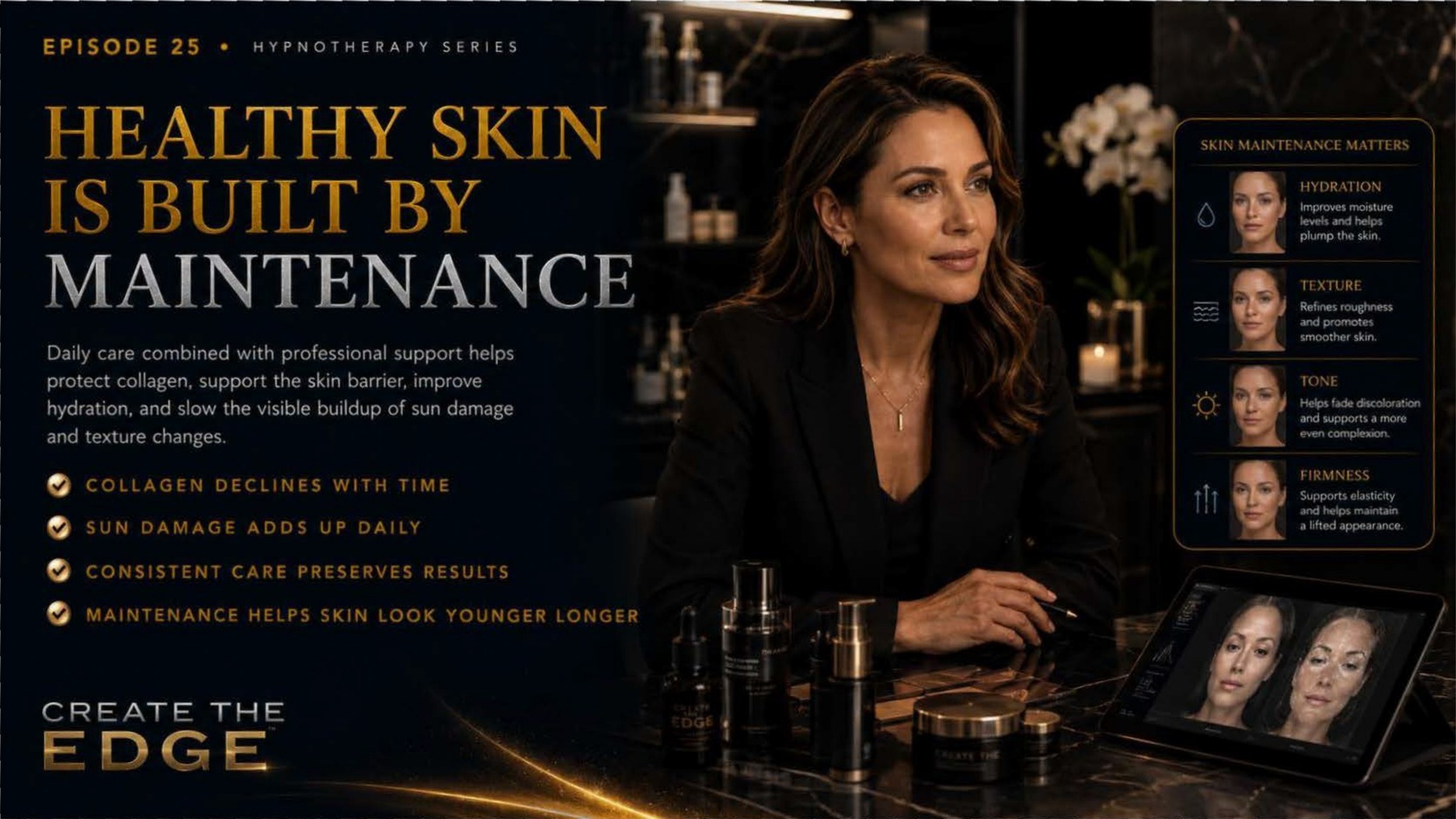
On the slideCollagen declines with time · Sun damage adds up daily · Consistent care preserves results · Maintenance helps skin look younger longer
Episode 25 · Slide 1
Healthy Skin Is Built by Maintenance
Look at her — seated at a professional station surrounded by precision skincare, a tablet showing before-and-after results, her expression focused and certain. To the right: Skin Maintenance Matters — broken down into four results that consistent care produces: Hydration, Texture, Tone, Firmness. Not magic. Not luck. A plan.
I want to open this episode with the truth that underlies everything we are about to cover: healthy skin is built. Not inherited, not stumbled into, not achieved in a single treatment. It is built through daily decisions made consistently over time, guided by the kind of professional knowledge that most people never receive until they happen to find the right esthetician.
Collagen is the protein that gives skin its firmness, its elasticity, its capacity to spring back. From our mid-twenties onward, the body's collagen production begins to slow — not dramatically at first, but measurably. Sun damage accumulates daily, even on cloudy days, even in cars — ultraviolet radiation degrades collagen, creates pigmentation irregularities, and thickens the skin's surface in ways that take years to fully show but can be dramatically slowed with the right protection.
Daily care combined with professional support helps protect collagen, support the skin barrier, improve hydration, and slow the visible buildup of sun damage and texture changes. This is not a luxury protocol. It is maintenance in the same sense that maintaining a home or a vehicle is maintenance: regular, consistent attention that prevents small issues from becoming large ones.
The people whose skin seems to defy time are rarely genetically blessed. They are consistent. They have a plan. They started earlier than you might think and they have not stopped. In this episode I am going to give you that plan — from the daily foundation to the professional treatments that take results further — drawing on everything I have learned as a licensed medical aesthetician.
Maintenance helps skin look younger longer. Not forever — longer. That is a worthy and achievable goal.
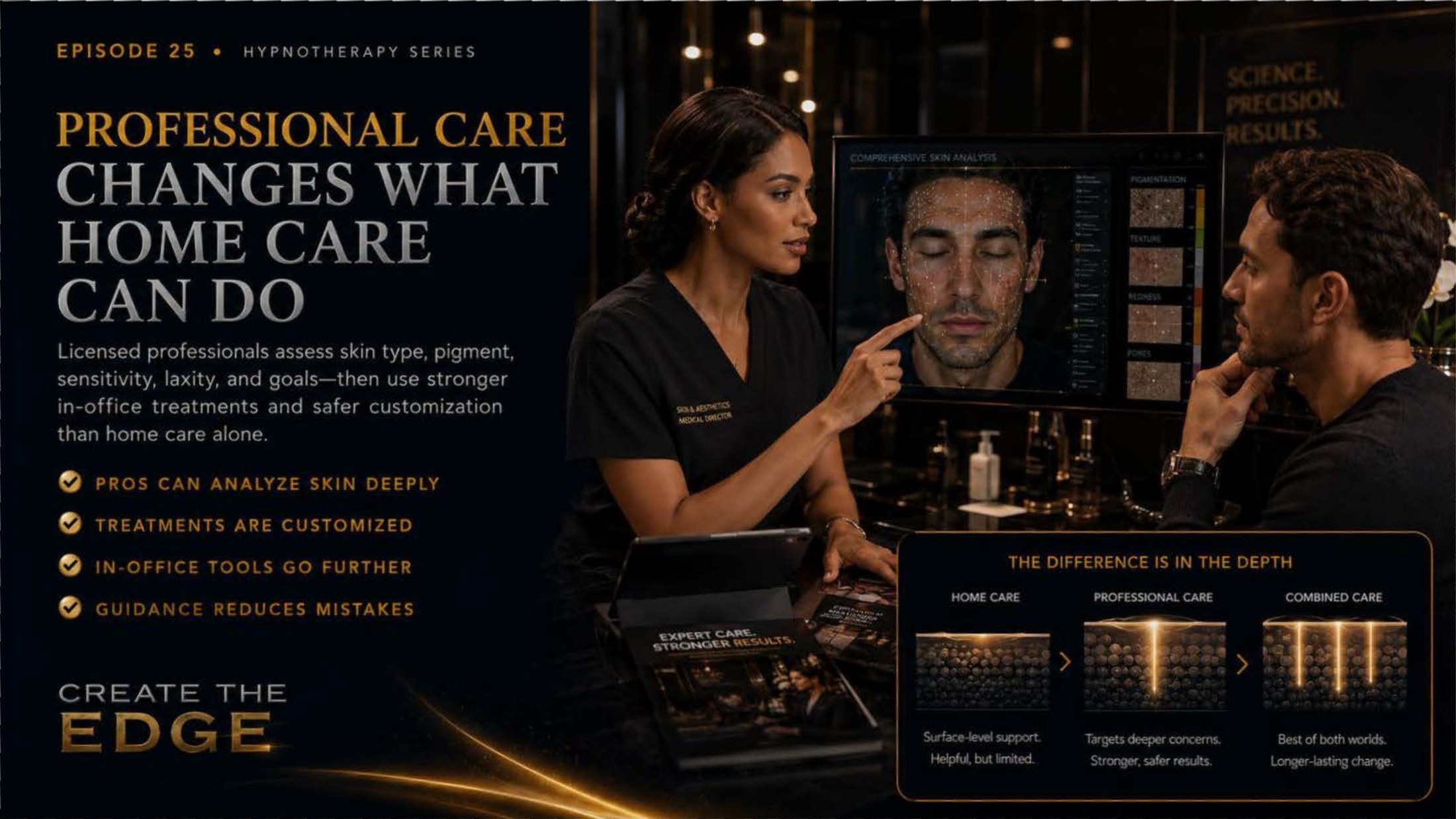
On the slidePros can analyze skin deeply · Treatments are customized · In-office tools go further · Guidance reduces mistakes
Episode 25 · Slide 2
Professional Care Changes What Home Care Can Do
Look at this image — a licensed aesthetician performing a comprehensive digital skin analysis, the technology mapping pigmentation, texture, redness, and pores across the face in real time. On the wall: *Science. Precision. Results.* Below: a diagram showing three levels of penetration — Home Care reaching only the surface, Professional Care targeting deeper concerns, Combined Care delivering the best of both.
The difference between home care and professional care is not effort — it is depth. Your at-home products work at the surface of the skin: they can hydrate, protect, gently exfoliate, and deliver some active ingredients into the upper layers of the epidermis. That is meaningful and important. But it is surface-level support. Professional treatments work at a fundamentally different level.
Licensed professionals assess skin type, pigment, sensitivity, laxity, and goals through tools and training that no over-the-counter product can replicate. A thorough skin analysis can reveal sun damage that is not yet visible to the naked eye, congestion beneath the surface, early collagen loss, and barrier disruption — and from that analysis, a customized treatment plan can be built that addresses your actual skin, not a generalized version of it.
In-office tools go further because they are regulated to do so. Chemical peels at clinical concentrations that would not be safe to sell over the counter. Microneedling devices that create precise, controlled micro-channels. Laser systems that deliver energy to specific targets at specific depths. These tools produce changes that home care simply cannot replicate — not because home care is inadequate, but because the two levels of care are designed to do different things.
Guidance reduces mistakes. Some of the most significant skin damage I have seen in my career was self-inflicted — over-exfoliation, use of actives that were incompatible or inappropriate for the skin type, sun exposure after treatments that required protection. A professional relationship means you have someone who knows your skin's history and can prevent the errors that cost months of healing.
The wisest skin approach combines both: daily home care that protects and maintains, and professional care that targets, corrects, and accelerates. Together, they are the best of both worlds.
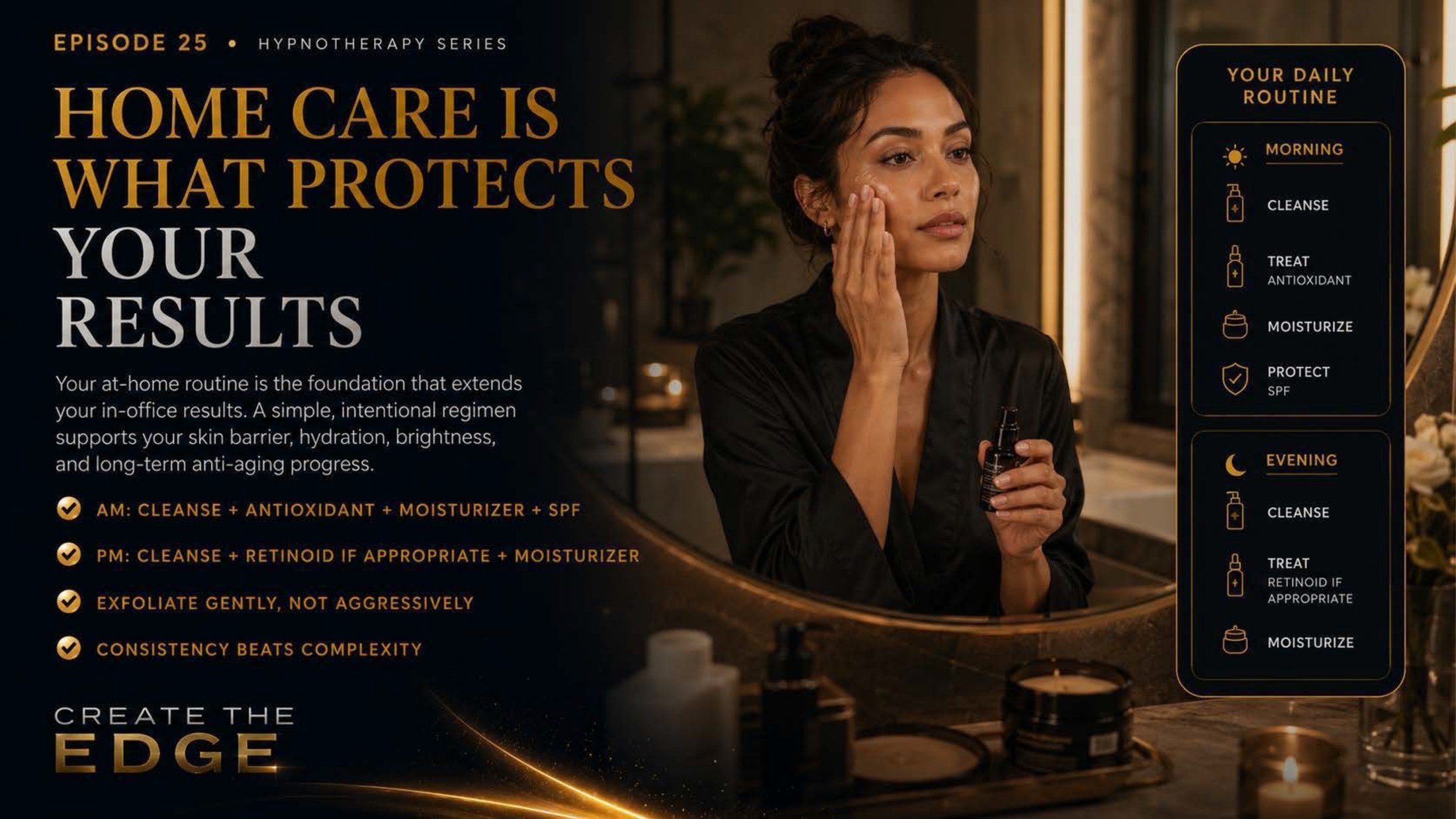
On the slideAM: Cleanse, antioxidant, moisturizer, SPF · PM: Cleanse, retinoid if appropriate, moisturizer · Exfoliate gently, not aggressively · Consistency beats complexity
Episode 25 · Slide 3
Home Care Is What Protects Your Results
Look at her — applying serum in the mirror, her morning routine precise and intentional. To the right: Your Daily Routine mapped out — Morning: Cleanse, Treat with antioxidant, Moisturize, Protect with SPF. Evening: Cleanse, Treat with retinoid if appropriate, Moisturize. Simple. Sequential. Complete.
Your at-home routine is the foundation that extends your in-office results. Think of it this way: professional treatments create change. Home care protects that change, extends it, and builds on it between appointments. Without consistent home care, professional results fade faster. With it, they compound.
Morning is about protection. A gentle cleanser that removes overnight skin products and environmental residue without stripping the barrier. An antioxidant — vitamin C is the gold standard, but niacinamide, vitamin E, and ferulic acid also serve this purpose — that neutralizes free radicals generated by UV exposure throughout the day. A moisturizer appropriate to your skin type that seals hydration and supports barrier function. And SPF — every single morning, every single day, year-round. SPF is not a summer product. It is the most evidence-backed anti-aging tool available without a prescription.
Evening is about repair. A gentle cleanse to remove the day. A retinoid — if your skin is ready and tolerant, introduced slowly and built up gradually — that supports cellular turnover, stimulates collagen production, and addresses both fine lines and surface congestion. A moisturizer to counteract the potential dryness that retinoids can introduce and support overnight recovery.
Exfoliate gently and not aggressively. Over-exfoliation is one of the most common causes of barrier damage and sensitization I see — the belief that more is better leading to a cycle of irritation that undoes everything the rest of the routine is building. Once or twice a week, a gentle chemical exfoliant is sufficient for most skin types. More is not more.
Consistency beats complexity. A simple routine done every day produces dramatically better results than an elaborate one done sporadically. Start here.
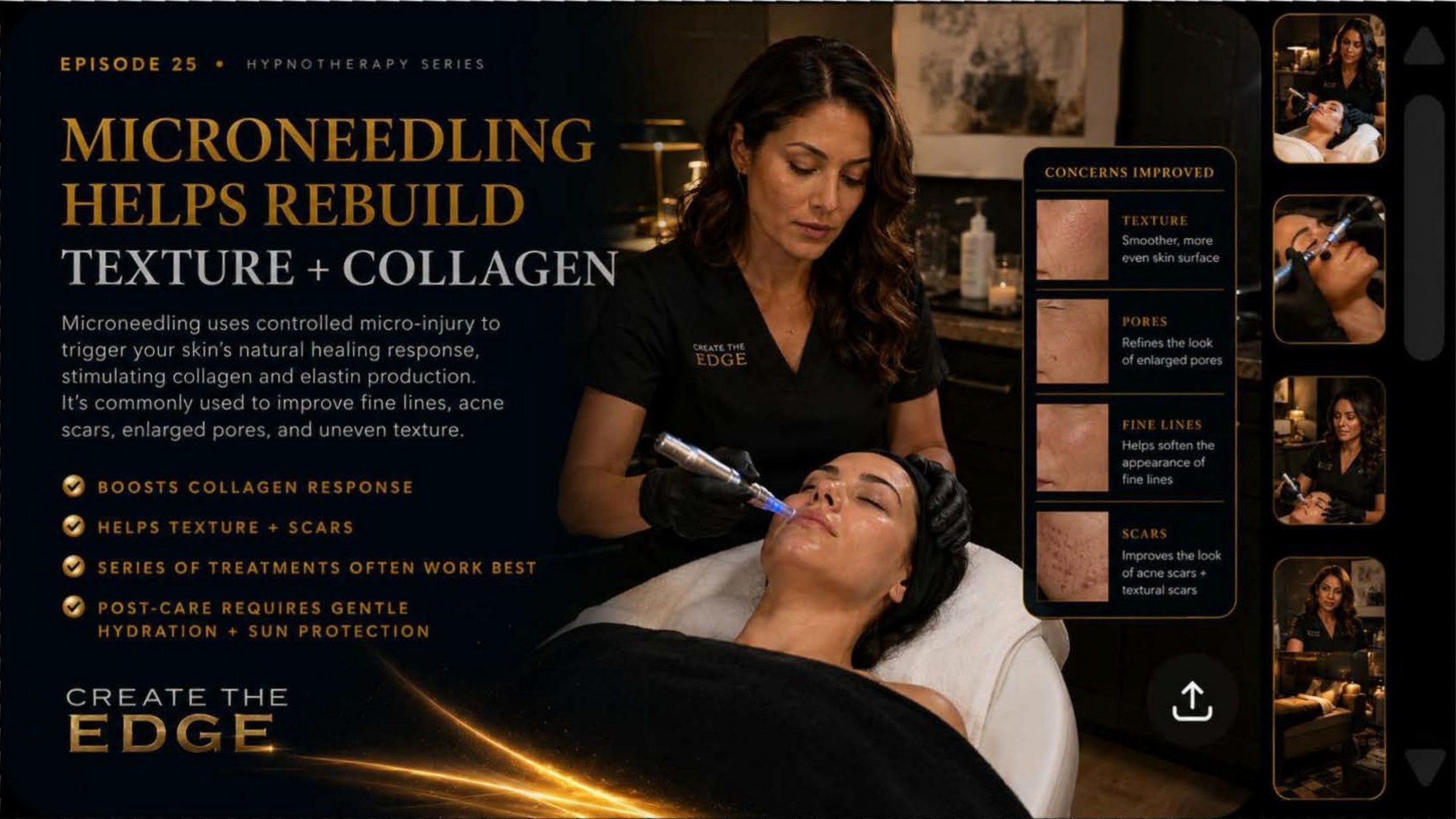
On the slideBoosts collagen response · Helps texture and scars · Series of treatments often work best · Post-care requires gentle hydration and sun protection
Episode 25 · Slide 4
Microneedling Helps Rebuild Texture and Collagen
Look at this — a professional microneedling treatment in progress at a Create The Edge studio, the device moving across the skin with precision, the esthetician focused and skilled. To the right: before-and-after imagery showing four key improvements: Texture — smoother, more even skin surface. Pores — refined appearance of enlarged pores. Fine Lines — softened appearance. Scars — improved look of acne and textural scars.
Microneedling uses controlled micro-injury to trigger the skin's natural healing response, stimulating collagen and elastin production in a way that external topicals simply cannot access. The device creates thousands of precise, tiny channels in the skin — shallow enough to be safe, deep enough to reach the dermis where collagen lives — and the skin responds by initiating a repair cascade that produces new collagen over the weeks that follow.
The results are cumulative. A single treatment produces a measurable improvement in skin texture and a stimulation of collagen response. A series — typically three to six treatments spaced four to six weeks apart — produces compounding results as each session builds on what the previous one initiated. This is why microneedling protocols are built as series rather than single events.
The concerns it addresses most effectively are texture irregularities — rough or uneven surface — enlarged pores, fine lines and early wrinkles, and acne scars or textural scars. For active, inflamed acne, microneedling is not appropriate; for the scarring left behind after acne has resolved, it is one of the most effective tools available.
Post-care requires gentle hydration and sun protection. In the forty-eight to seventy-two hours following treatment, the skin is in an active repair state and the channels created by the needles make it temporarily more permeable — which means actives penetrate more deeply, but also means irritants can cause more significant reactions. Gentle hydration, no active ingredients, no sun exposure, and SPF every day during the healing period.
Microneedling is one of the treatments I recommend most consistently to clients at all stages of skin aging — because it harnesses the skin's own healing intelligence rather than introducing foreign substances. The skin produces the change. The treatment simply creates the conditions for it.
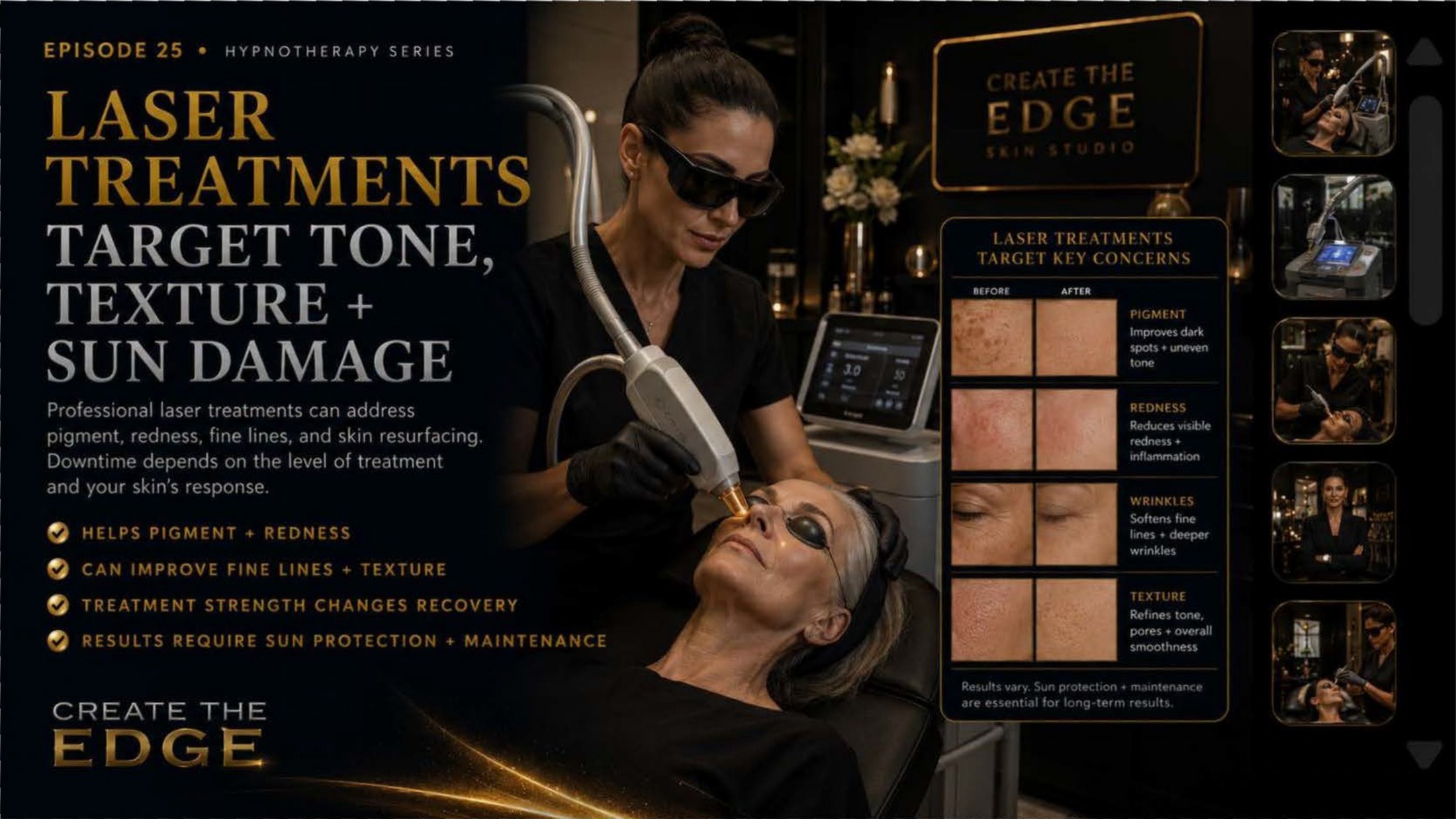
On the slideHelps pigment and redness · Can improve fine lines and texture · Treatment strength changes recovery · Results require sun protection and maintenance
Episode 25 · Slide 5
Laser Treatments Target Tone, Texture, and Sun Damage
Look at her — a mature client receiving a laser treatment at the Create The Edge Skin Studio, protective eyewear in place, the provider focused. To the right: before-and-after comparisons for four concerns — Pigment (dark spots and uneven tone), Redness (visible inflammation), Wrinkles (fine and deeper lines), Texture (pores and overall smoothness). At the bottom: Results vary. Sun protection and maintenance are essential for long-term results.
Professional laser treatments work by delivering targeted energy to specific concerns within the skin — energy that disrupts pigmentation, stimulates collagen production, reduces redness, or resurfaces the skin's surface depending on the wavelength and intensity chosen. Different lasers target different chromophores: melanin for pigmentation, hemoglobin for redness and vascular concerns, water for resurfacing and collagen stimulation.
For pigmentation — sun spots, post-inflammatory hyperpigmentation, melasma in some cases — certain laser wavelengths can break up the pigment clusters that have accumulated in the skin over years of UV exposure, allowing the body to clear them naturally. For redness and visible capillaries, other wavelengths target the hemoglobin in dilated vessels, collapsing them without damaging the surrounding tissue. For fine lines and skin resurfacing, fractional lasers create thousands of tiny treatment zones that stimulate intense collagen remodeling.
Treatment strength changes recovery. At the gentle end, some laser treatments have no real downtime — a bit of redness that resolves in hours. At the intensive end, ablative resurfacing treatments can require a week or more of recovery as the skin heals from the deliberate controlled injury that produces dramatic remodeling. The right treatment for each person depends on their skin concerns, their skin type, their lifestyle, and their recovery tolerance.
Results require sun protection and maintenance. Laser-treated skin is newly sensitized to UV radiation, and without rigorous sun protection, the very concerns the treatment addressed — pigmentation particularly — can return more quickly than they would have otherwise. This is not a limitation of the technology. It is the reality of living in a sun-exposed world.
Laser treatments, properly chosen and professionally administered, are among the most powerful tools available for visible skin rejuvenation. In the right hands, for the right concerns, the results can be remarkable.
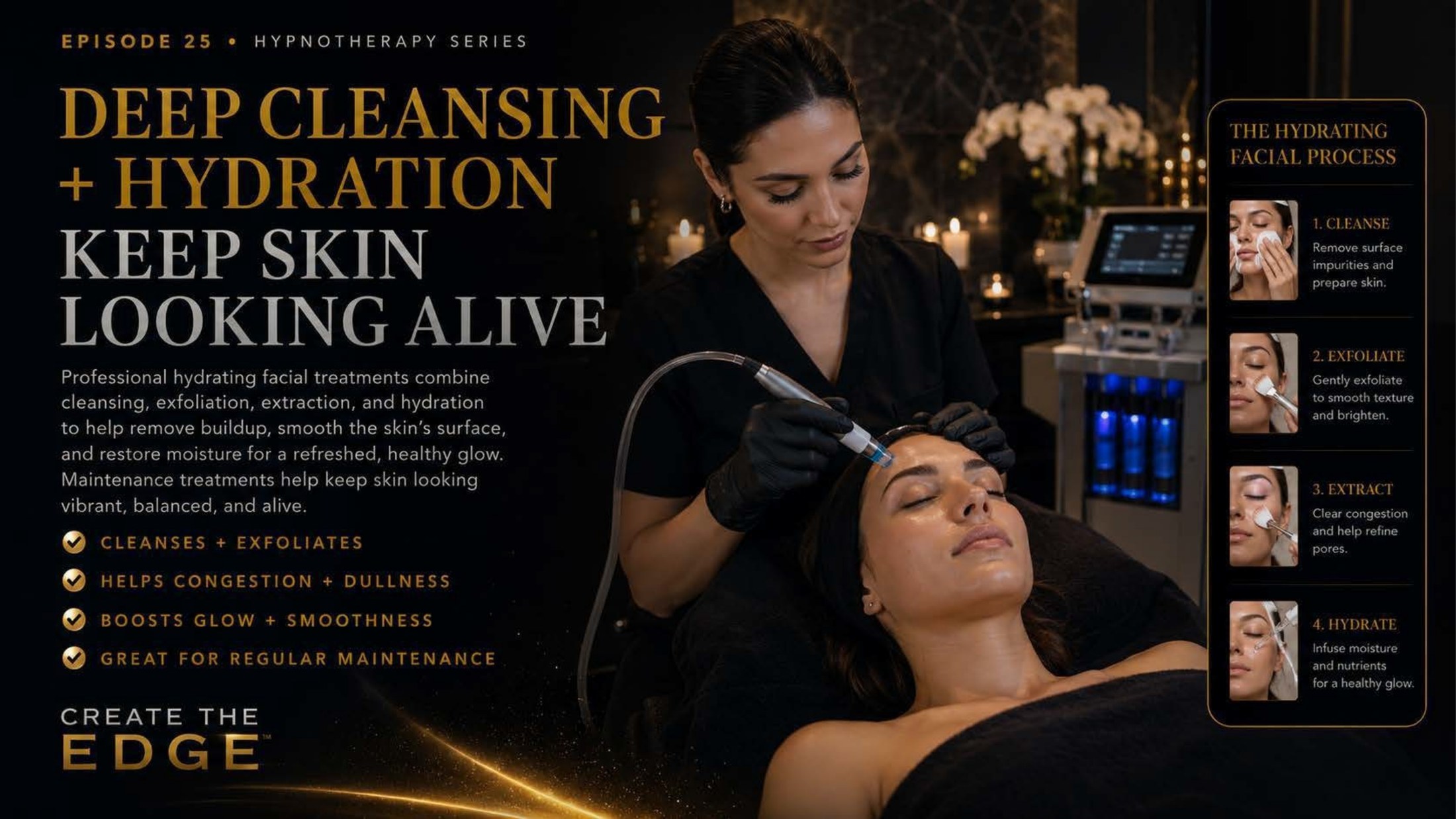
On the slideCleanses and exfoliates · Helps congestion and dullness · Boosts glow and smoothness · Great for regular maintenance
Episode 25 · Slide 6
Deep Cleansing and Hydration Keep Skin Looking Alive
Look at her — receiving a professional hydrating facial treatment, the provider working with precision and care, the studio serene and professional. To the right: The Hydrating Facial Process spelled out in four steps — Cleanse: remove surface impurities and prepare skin. Exfoliate: gently smooth texture and brighten. Extract: clear congestion and refine pores. Hydrate: infuse moisture and nutrients for a healthy glow.
Of all the professional treatments available, the hydrating facial is the one I most consistently recommend as the foundation of a maintenance protocol — because it does something that no product at home can fully replicate: it removes, resurfaces, and replenishes in a single session, performed by someone who can assess what your skin actually needs in real time and adjust accordingly.
Professional hydrating facial treatments combine cleansing, exfoliation, extraction, and hydration to help remove buildup, smooth the skin's surface, and restore moisture for a refreshed, healthy glow. The cleansing step removes not just surface makeup and environmental debris but the oxidized sebum and product residue that accumulate at the pore opening. The exfoliation step — typically a combination of enzymatic and mechanical exfoliation at professional concentrations — smooths the surface and brightens the complexion. Extraction, performed by a skilled professional, clears congestion from pores in a way that is safe for the skin tissue and effective in ways that at-home attempts often are not. And the hydration step infuses the newly cleared and exfoliated skin with moisture, hyaluronic acid, peptides, or other actives appropriate to your skin's needs.
The result, consistently, is skin that looks alive in a way that is difficult to achieve any other way. Not dramatically changed — alive. Bright, smooth, clear, rested. The kind of skin that makes people ask what you have been doing.
Maintenance treatments every six to eight weeks keep this level of clarity as the ongoing baseline rather than the occasional peak. For clients who have skin concerns being addressed with other treatments — microneedling, laser, peels — the hydrating facial provides the regular maintenance layer that extends and protects those results.
Cleanse. Exfoliate. Extract. Hydrate. Four steps. A ritual. And over time, a relationship with your skin that changes what is possible.
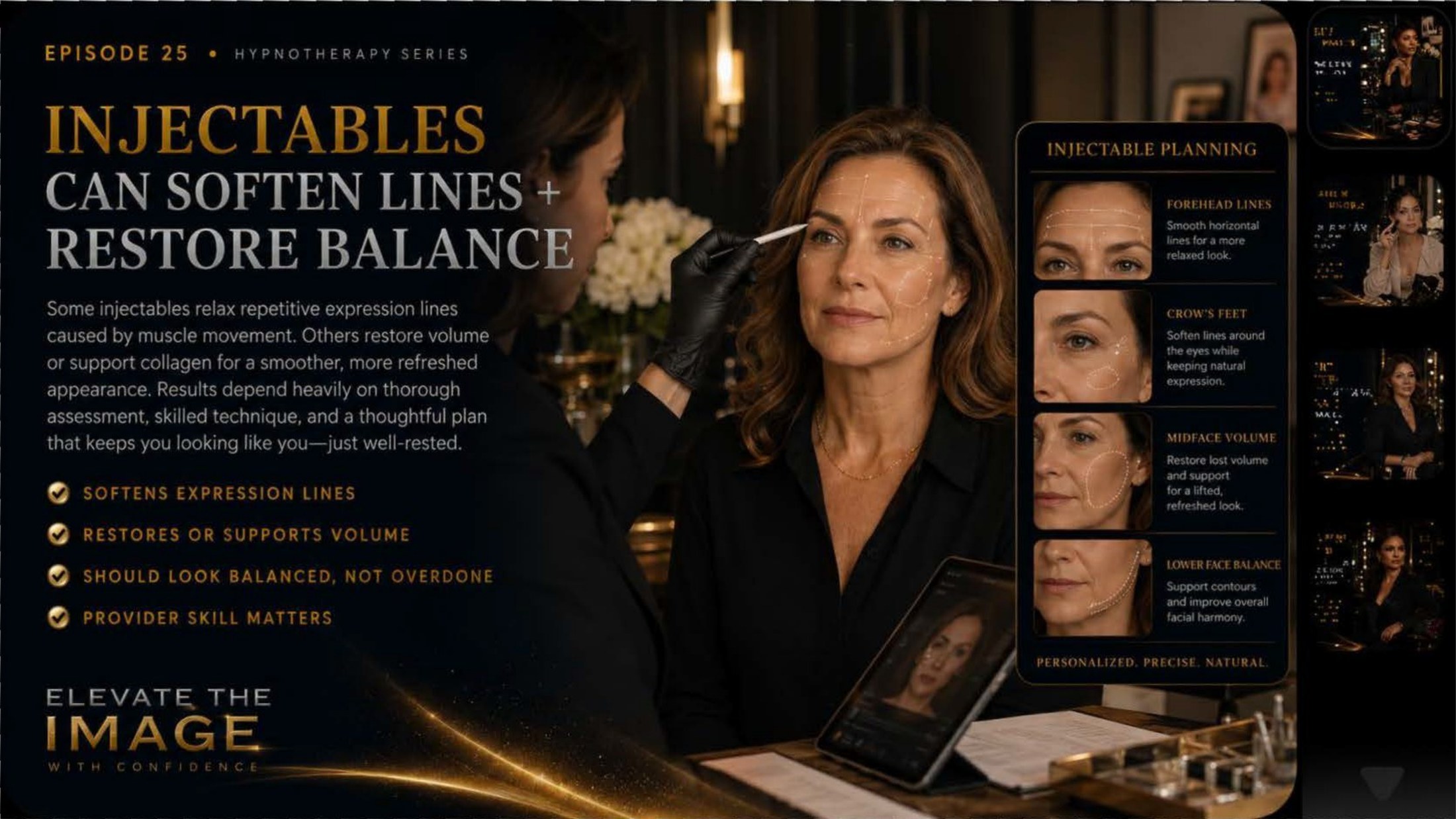
On the slideSoftens expression lines · Restores or supports volume · Should look balanced, not overdone · Provider skill matters
Episode 25 · Slide 7
Injectables Can Soften Lines and Restore Balance
Look at her — a mature client receiving an injectable treatment, the provider's mapping visible on the face, the image beside it showing the injectable planning guide: Forehead Lines (smooth horizontal lines for a more relaxed look), Crow's Feet (soften lines around the eyes while keeping natural expression), Midface Volume (restore lost volume and support for a lifted, refreshed look), Lower Face Balance (support contours and improve overall facial harmony). Personalized. Precise. Natural.
Injectable treatments fall into two broad categories that serve different purposes and are often used together. The first category — neuromodulators — works by relaxing the repetitive muscle movement that creates expression lines over time. Forehead lines, crow's feet, the vertical lines between the brows — these are the product of years of movement, and relaxing the underlying muscle temporarily softens them and prevents them from deepening further. When done with a light hand by a skilled provider, the result looks like a well-rested version of yourself: animated, expressive, but without the lines that were beginning to read as stress or fatigue rather than character.
The second category — fillers — restores or supports volume. As we age, the fat pads that give the face its three-dimensional structure gradually migrate and diminish. The cheeks that were once full flatten. The temples hollow slightly. The area under the eyes deepens. Volume-restoring treatments can address these changes by replacing what has been lost, creating a lifted, refreshed appearance that reflects how you actually feel rather than the fatigue that volume loss can project.
Should look balanced, not overdone. This is the principle that every reputable injector works from and the standard by which every injectable result should be judged. The goal is not to look like you have had something done. The goal is to look like you — only slightly better rested, slightly more refreshed, slightly more like the version of yourself you feel on the inside. When that goal is achieved, injectables are invisible. When it is not, they announce themselves.
Provider skill matters enormously. Injectable treatments in skilled hands with thorough consultation and a conservative aesthetic produce results that can genuinely rejuvenate without distorting. In less skilled or less thoughtful hands, the same products produce the results that have unfortunately become cultural shorthand for what injectables look like. Seek a provider with a reputation for natural results. Ask to see their work. Do not make this decision on price alone.
Personalized. Precise. Natural. That is the standard. Hold every provider to it.
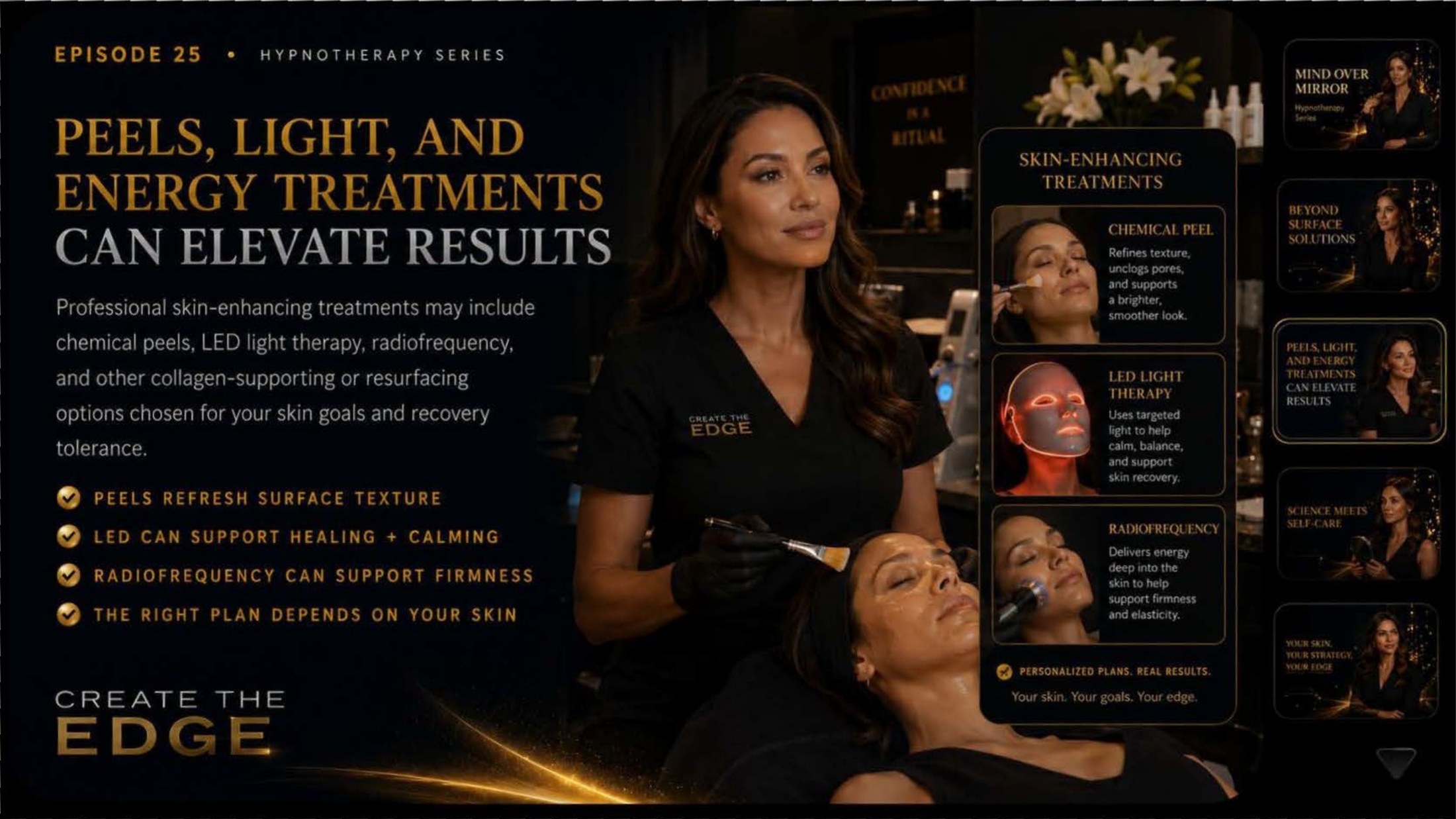
On the slidePeels refresh surface texture · LED can support healing and calming · Radiofrequency can support firmness · The right plan depends on your skin
Episode 25 · Slide 8
Peels, Light, and Energy Treatments Can Elevate Results
Look at this — a provider applying a chemical peel, a client receiving LED light therapy with its warm therapeutic glow, another receiving radiofrequency treatment. On the wall: *Confidence is a Ritual.* Below: the three treatments broken down — Chemical Peel: refines texture, unclogs pores, and supports a brighter, smoother look. LED Light Therapy: uses targeted light to help calm, balance, and support skin recovery. Radiofrequency: delivers energy deep into the skin to help support firmness and elasticity.
Beyond the foundational treatments — microneedling, laser, hydrating facials — there is a category of skin-enhancing treatments that work at the surface and the structural level to address specific concerns and elevate overall skin quality. These are the modalities I often incorporate into customized treatment plans to add precision where the broader treatments leave room for refinement.
Chemical peels work by applying a controlled acid solution to the skin's surface, dissolving the bonds that hold dead skin cells in place and accelerating cellular turnover. The result is a smoother, brighter, more refined surface — with improvements in texture, pore appearance, and the early signs of sun damage. Peel depth varies from superficial treatments with no downtime to medium-depth treatments that require several days of healing. The right depth for each person depends on their skin concerns, skin type, and lifestyle.
LED light therapy uses specific wavelengths of light to support different skin functions. Red light, which penetrates to the dermis, supports collagen production and cellular repair — making it an excellent post-treatment addition after microneedling or laser to support the healing process. Near-infrared light penetrates deeper and reduces inflammation. Blue light targets the bacteria associated with acne. LED is one of the few treatments with essentially no downtime and no discomfort, making it an accessible option for regular maintenance.
Radiofrequency delivers energy deep into the skin that heats the dermis and deeper tissues, stimulating immediate collagen contraction and longer-term collagen production. It is one of the primary tools for addressing skin laxity — the loosening of skin that accompanies volume loss and collagen decline — and for supporting the firmness and elasticity that keep the face looking structurally supported.
Your skin. Your goals. Your edge. The right combination of these treatments, personalized to your actual concerns, produces results that no single treatment can achieve alone.
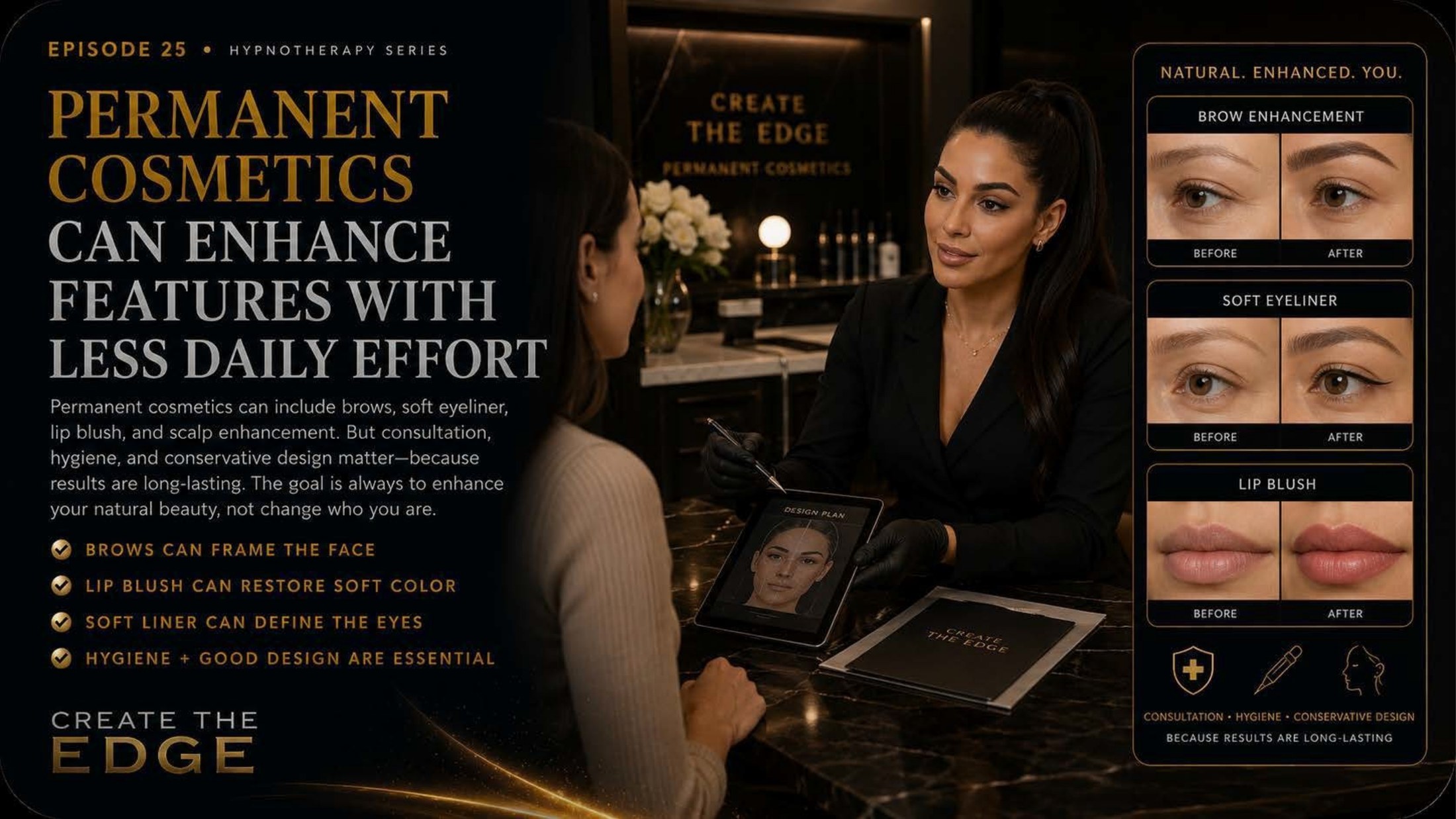
On the slideBrows can frame the face · Lip blush can restore soft color · Soft liner can define the eyes · Hygiene and good design are essential
Episode 25 · Slide 9
Permanent Cosmetics Can Enhance Features With Less Daily Effort
Look at this — a permanent cosmetics consultation in progress at Create The Edge, the provider showing a digital design plan to a client. To the right: three before-and-after examples. Brow Enhancement: from sparse and uneven to full, defined, natural-looking brows that frame the face beautifully. Soft Eyeliner: from no lash line definition to a subtle, precise liner that makes the lashes appear fuller and the eyes more awake. Lip Blush: from pale, undefined lips to a soft, dimensional blush tone that restores the natural color and definition that aging often diminishes. Natural. Enhanced. You.
Permanent cosmetics — also called micropigmentation or cosmetic tattooing — uses a specialized device to implant pigment into the superficial layers of the skin, creating semi-permanent enhancements to features that can be time-consuming to recreate with traditional makeup daily, or that have changed with age in ways the client wishes to address.
Eyebrows are the most commonly requested permanent cosmetic service, and for good reason: eyebrows frame the face more completely than any other single feature. They establish the proportion between the upper and lower face, they communicate emotion before any other feature, and they are among the first features affected by hormonal changes, aging, over-tweezing history, and medical conditions. A well-designed permanent brow — whether through hair-stroke techniques like microblading, powder brow, or combination methods — can restore a brow that has thinned significantly or create the shape, arch, and definition that brings the face into better proportion.
Lip blush restores the soft color and definition that lips often lose with age. As the natural vermillion border — the precise edge where lip meets skin — softens and the natural pigmentation fades, lips can appear thinner and less defined than they feel. Lip blush adds a tone that mimics the lip's natural color in its younger, more pigmented state, and traces the border to restore the crispness that aging diminishes.
Soft liner defines the eyes by creating the appearance of fuller lashes at the lash line — not a dramatic liner look, but the subtle definition that makes eyes look more awake and defined without daily effort. For clients who have difficulty applying eye makeup due to vision changes or motor limitations, this can be genuinely transformative.
Hygiene and good design are essential. Results are long-lasting — which means a poorly designed brow or an overly dark liner lives on your face for years. Consult with a technician whose portfolio shows consistently natural, appropriate results. Conservative design is always the right starting point.

On the slideHome care protects the foundation · Professional care targets bigger concerns · Maintenance keeps results going · Consistency helps turn back the clock visually
Episode 25 · Slide 10
The Best Results Come From a Smart Plan, Not One Treatment
Look at her — silver-haired, luminous skin, the city glowing at golden hour behind her. To the right: a before-and-after, and below it the Yearly Roadmap — Daily Home Care (cleanse, treat, hydrate, nourish), Every 3 Months Maintenance (support collagen, clarity, and long-term health), Targeted Professional Treatments (address deeper concerns with precision), Daily Sun Protection (SPF is your best anti-aging treatment). At the bottom: *Consistency. Strategy. Time. That's where transformation happens.*
Visible rejuvenation is not a one-time fix. It is the result of a thoughtful plan. This is the principle that everything in this episode has been building toward — because the most common mistake I see is the belief that a single treatment will produce lasting transformation. It can produce a visible change. But without the structure of consistent care around it, that change fades, and the underlying concerns continue to progress.
Home care protects the foundation. Every day, twice a day, with sunscreen every morning regardless of season or weather — this is the non-negotiable baseline. Professional care targets the bigger concerns that home care cannot reach: the pigmentation that has accumulated over decades, the collagen loss that has softened the face's structural definition, the texture irregularities that reflect years of sun exposure. Maintenance keeps the results going — regular appointments every six to eight weeks that prevent the gradual return of concerns that were addressed in more intensive treatment phases.
Consistency helps turn back the clock visually. Not metaphorically — measurably. Skin that receives consistent care — daily protection, regular professional attention, appropriate active treatments — demonstrates measurably different levels of collagen density, pigmentation regularity, and barrier function than skin that does not. The science is clear. The results are visible.
This isn't about chasing perfection. It is about graceful, strategic age management that supports you for years to come. Skin that looks healthy, rested, and cared for — at every age. Skin that reflects the fact that you take yourself seriously.
Consistency. Strategy. Time. That is where transformation happens. Begin today, and let tomorrow's face thank you. — Misty